Best Table Saws with Quiet Induction Motors for Indoor Shops
What's inside
As an Amazon Associate I earn from qualifying purchases. This post may contain affiliate links at no extra cost to you.
Contents
What “quiet” means in a table saw
An induction motor can make a table saw less irritating than a comparable saw with a high-speed universal motor, but it does not make the whole machine quiet. The blade cutting wood, dust collection, and vibration through the floor can all be louder than the motor itself. A quiet-running saw is useful in an indoor shop because it cuts down on motor whine and tends to run with less vibration; hearing protection is still necessary.
Most cabinet saws and many contractor-style saws use induction motors. Typical ratings are 1.5 to 3 horsepower, often on 120- or 240-volt circuits. Check the manufacturer’s stated voltage and circuit requirements before buying: a 3 HP saw generally needs 240 volts, while a 1.5 HP model may run on either voltage depending on its wiring and specification. Do not assume a standard household outlet will support a saw just because its plug fits.
As an Amazon Associate we earn from qualifying purchases at no extra cost to you.
For indoor use, also consider where the saw’s sound goes. A solid wall behind the machine, rubber feet, and a stable floor can help limit transmitted vibration. An enclosed cabinet may reduce some mechanical noise, but it also needs suitable dust collection and ventilation; never block motor vents or modify guards to make a saw quieter.
Which type suits your shop?
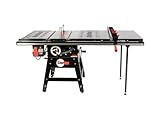
A cabinet saw is the usual choice for a permanent indoor shop. Its heavy base and enclosed cabinet help resist movement, and its induction motor is generally suited to repeated work. The trade-offs are price, weight, and installation: many weigh several hundred pounds, and moving one into a basement or through a narrow doorway can require planning.
Contractor-style saws can be a sensible middle ground. They are usually lighter and less expensive than cabinet saws, while still offering an induction motor on many models. Their open bases can transmit more vibration, and the motor may hang off the rear, so check the footprint and available clearance before ordering. A benchtop saw is cheaper and easy to store, but most use universal motors. It is not the best match if a quiet induction motor is the main reason for upgrading.
For a small shop that routinely cuts hardwood or thick stock, look at a 3 HP cabinet saw with an induction motor. For lighter work, a 1.5 HP contractor-style table saw may be enough and costs less to buy and run.
Quick comparison
| Type | Typical motor and power | Best fit | Main trade-off |
|---|---|---|---|
| Cabinet saw | 1.75–3 HP induction; commonly 240 V at 3 HP | Frequent cuts, hardwood, fixed shop | Cost, weight, and electrical setup |
| Contractor-style saw | Often 1–1.5 HP induction; check each model | Occasional to regular work, moderate budgets | More vibration and less mass than a cabinet saw |
| Benchtop saw | Usually a universal motor | Portable work and limited budgets | Higher-pitched sound; less suitable for quiet indoor use |
What to check before buying
Start with power, not the horsepower headline. Confirm the saw’s voltage, required breaker size, and whether it can be wired for your shop. A motor that struggles on an undersized circuit may trip breakers or bog down in a cut. That is not fixed by buying a saw with a larger nameplate rating if the circuit cannot supply it. If you need new wiring, include that cost in the comparison.
Next, inspect the fence and the table. A fence should lock securely and stay parallel to the blade; poor alignment can cause burning, inaccurate cuts, or binding. A flat, sturdy table and a reliable miter slot matter more than extra accessories. Ask whether the saw includes a riving knife, blade guard, and anti-kickback pawls, and keep the safety equipment installed for through-cuts. A riving knife that is misaligned or removed unnecessarily can increase the chance of kickback.
Dust collection matters indoors. A cabinet saw with a 4-inch dust port still needs a collector that can move enough air through the hose and fittings; a weak shop vacuum may not capture fine dust well. Check for openings around the cabinet and blade area, and budget for suitable extraction. Fine wood dust is a health hazard, not just a cleanup nuisance.
Look closely at the return, delivery, and setup arrangements. A heavy saw can be difficult to return after assembly, and a machine delivered to the curb may need several people or lifting equipment to place safely. Measure doorways, stair turns, and the working area, including space for long boards to enter and leave the saw.
When a cheaper saw is fine
If you mainly rip construction lumber, cut sheet goods occasionally, or need a saw that can be carried to different jobs, a benchtop model may be the practical choice. It will usually be louder, but spending more on a cabinet saw does not make sense if you will use it only a few times a month. A contractor-style saw can also be enough for a small indoor shop that handles modest stock and has a suitable circuit.
Choose the more substantial induction-motor saw when the machine will run frequently, you work with hardwood, or reduced motor whine and vibration are priorities. Do not use sound alone as a quality test: a quiet motor cannot compensate for a loose fence, poor blade, or unsafe setup. Use a sharp blade suited to the cut, support long stock, and wear hearing and eye protection regardless of motor type.
For buyers comparing heavier options, search for 240 V induction-motor cabinet table saws and verify each listing’s motor, voltage, included safety parts, and delivery terms against the manufacturer’s specifications. Product titles and marketplace listings can omit details that determine whether a saw will actually work in your shop.