Best Miter Saw For Woodworking
Key takeaways
- A criteria-led guide to choosing the best miter saw for woodworking, judged on fence design, detent accuracy, blade deflection and dust control rather than horsepower claims.
What's inside
As an Amazon Associate I earn from qualifying purchases. This post may contain affiliate links at no extra cost to you.
Most miter saw shopping advice is written for framers. It talks about cut capacity, amp draw and whether the saw will survive being thrown into a truck bed. None of that tells you whether the saw will cut a 45 that closes cleanly on a walnut picture frame. The best miter saw for woodworking is judged on a different set of criteria: how flat the table is, how much the fence supports a tall workpiece, whether the miter detents land in the same place twice, and how much the blade wanders under load.
We have looked at a lot of saws on this desk, and the pattern is consistent. The mechanical fundamentals separate a saw you can trust for casework and trim from one you fight every time you need a repeatable angle. Below is how we weigh those fundamentals, what the main saw categories actually give you, and where the money is worth spending.
As an Amazon Associate we earn from qualifying purchases at no extra cost to you. Product prices and availability are accurate as of the date shown and are subject to change.




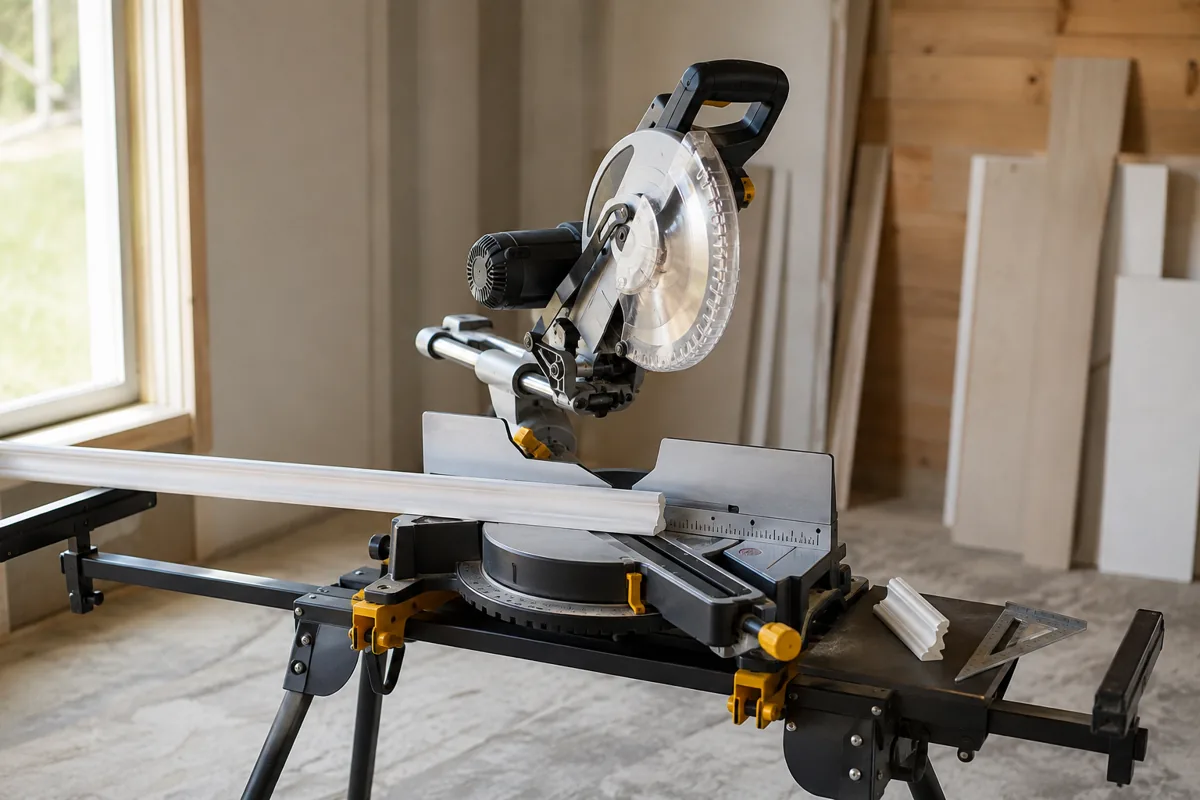
Saw Categories at a Glance
Before anything else, decide which category fits your work. Capacity you never use costs you money, bench space and portability.
| Saw type | Typical crosscut capacity | Best suited to | Main compromise | ||
|---|---|---|---|---|---|
| 10″ | single-bevel miter | About 5-6″ | at 90 degrees | Frames, small boxes, narrow trim | No sliding action, bevels one way only |
| 10″ | sliding compound | Roughly 11-12″ | Shelving, cabinet parts, most shop work | More moving parts to keep in alignment | |
| 12″ | sliding compound | Roughly 13-16″ | Wide boards, stair parts, crown | Heavier, larger blades deflect more | |
| 12″ | non-slide compound | About 7-8″ | Tall stock cut vertically, trim carpentry | Limited flat crosscut width | |
| 8-1/2″ | cordless slider | Roughly 10-12″ | Site work, small shops, dust-sensitive rooms | Blade selection is narrower |
For most woodworkers building furniture and cabinets, a 10-inch or 8-1/2-inch slider hits the sweet spot. A 10-inch blade has less unsupported steel hanging past the arbor than a 12, so it deflects less and leaves a cleaner face on hardwood. If you regularly cut wide panels or stair treads, the 12-inch slider earns its keep, but you pay for it in blade cost and vibration.
The Mechanical Criteria That Decide the Best Miter Saw for Woodworking
Fence height and squareness
The fence is the single most overlooked component. Look for a tall cast fence, ideally with an upper sliding or removable section, machined flat and square to the table. Short stamped fences give a tall workpiece almost nothing to register against, and any cupping in the board translates straight into an out-of-square cut. Check that the two fence halves are coplanar, that they can be shimmed or adjusted, and that they clamp solidly rather than relying on friction alone.
Table flatness and turntable fit
A miter saw table is a reference surface. If it is dished, your workpiece rocks, and no amount of blade calibration will fix that. The turntable should sit flush with the wings, spin without lifting, and lock without shifting the angle as the lever engages. That last point is where cheap saws fail: the detent finds 45, then the lock nudges it a fraction of a degree as you tighten. Eight of those errors around an octagon and the joint will not close.
Detents and micro-adjustment
Positive stops at the common angles save real time, but only if they are crisp and repeatable. The better saws pair firm detents with an override so you can park just off a stop, plus a fine adjuster for dialing in a fussy angle. Bevel stops matter just as much and are more often neglected. A bevel that only stops at 0 and 45, with no adjustment for the 33.9 degrees crown molding wants, limits what you can do.
Blade deflection and arm rigidity
Push a slider through 4/4 hard maple and you learn a lot. Deflection shows up as a slight convex or hollow cut face, and as burn on the trailing edge. Rails with generous bearing surfaces, minimal play when you rock the head side to side, and a stiff pivot yoke all reduce it. Rear-rail sliders need clearance behind the saw; some designs use fixed rails and a moving head so the saw can live against a wall, which is worth real money in a small shop.
Dust collection
No miter saw collects dust well. The honest question is how badly it fails. A shrouded blade guard with a port sized for standard hose fittings, positioned to catch the exit stream, will pull perhaps half to two-thirds of the fine dust with a real extractor behind it. The rest goes on the floor and into the air. Plan on a shop vac plus a simple plywood hood behind the saw. Treat any manufacturer claim about dust capture as a best-case number from a straight 90-degree cut.
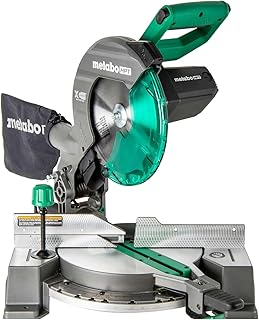
10-Inch Sliding Compound Miter Saw
This is the category we point most furniture and cabinet builders toward. A 10-inch slider gives you roughly a foot of crosscut, stiffer blades than a 12, cheaper quality blade replacements, and a manageable weight if the saw ever needs to move. Prioritize a tall fence and adjustable bevel stops over headline capacity numbers when comparing models in this class.
Cordless or Corded
Cordless miter saws have matured. Brushless platforms like DeWalt XR, Milwaukee FUEL and Makita LXT will run a full day of trim work on large-format packs, and the good ones use electronic braking and soft start, which is easier on the arbor and on your work. For a stationary shop saw wired to a dedicated circuit, corded still makes sense: unlimited runtime, no battery cost, and generally lower price for the same cut quality.
The genuine argument for cordless in a shop is dust and cord management, plus the ability to carry the saw to a job or to the driveway. If you already own a battery platform, staying inside it is usually the cheaper path. If you do not, buying into one for a single tool is not.
- ✔ Tall cast fences and adjustable bevel stops make repeatable joinery possible
- ✔ 10-inch blades deflect less than 12-inch and cost less to replace with quality carbide
- ✔ Electronic brake and soft start reduce vibration marks and blade shock
- ✔ Fixed-rail slider designs let the saw sit against a shop wall
- ✘ No miter saw collects dust adequately without an extractor and a shop-built hood
- ✘ Factory blades are usually framing-grade and should be swapped for an 80-tooth crosscut blade
- ✘ Detent lock creep is common on budget saws and hard to fix permanently
- ✘ 12-inch sliders are heavy, take real bench depth, and vibrate more
Blades, Setup and the Stand
Budget for a blade. Whatever ships in the box is almost certainly a general-purpose or framing blade with a low tooth count. For woodworking, a thin-kerf 80-tooth ATB crosscut blade in 10-inch, or 80 to 100 teeth in 12-inch, is the upgrade that changes cut quality most. A negative or low positive hook angle keeps the saw from climbing into the work on a slider.
Set the saw up properly once. Square the blade to the table, then square the fence to the blade, then set the bevel stops, in that order, using a good machinist square rather than the built-in scale. Add a sacrificial zero-clearance fence and a fresh kerf slot to kill tearout on the underside. Then build or buy a stand with extension wings and a flip stop; without support out to the left and right, everything you learned about fences is wasted because the board is sagging.
Miter Saw Stand With Extension Wings
A folding stand with two adjustable outfeed wings and a repeatable flip stop improves your cuts more than moving up a saw tier. Look for wings that adjust to the table height rather than assuming a fixed offset, and a stop block that clamps hard enough not to creep after a dozen cuts.
Verdict
For furniture, cabinets and general shop work, a 10-inch sliding compound saw with a tall cast fence, adjustable bevel stops and a real dust port is the most sensible choice, paired with an 80-tooth crosscut blade and a stand with extension wings. Step up to a 12-inch slider only if wide stock is routine work rather than an occasional problem. Choose a non-slider 10-inch if your work is frames and small boxes, where the stiffness and lower price are advantages rather than limitations.
Buy on the fence, the table and the detents. Motor specifications look impressive on a box and matter least in practice, because almost every saw in this class has enough power for hardwood at a sane feed rate. The saw that holds an angle and supports the workpiece is the one that makes good joints.
Frequently Asked Questions
Is a 10-inch or 12-inch miter saw better for woodworking? For most shop work, 10-inch. Less blade overhang means less deflection, cleaner cut faces in hardwood, and cheaper quality carbide blades. Choose 12-inch when you regularly crosscut wide boards, stair parts or large crown, and accept the extra weight and vibration that comes with it.
Do I still need a table saw if I buy a good miter saw? Yes. A miter saw crosscuts and cuts angles; it does not rip stock to width, cut sheet goods safely or handle most joinery. The two tools cover different jobs, and most shops end up with both.
Can a miter saw cut accurate enough angles for picture frames? It can, with a saw that has repeatable detents, a fine bevel and miter adjuster, and a zero-clearance fence. Errors compound around a closed frame, so plan on a shooting board or a disc sander with a miter table for final fitting on visible joints. That combination is faster and more reliable than chasing a perfect saw cut.
Check prices on Amazon →