Benchtop Planer For Beginners
Key takeaways
- A criteria-led guide to choosing your first benchtop planer, judged on snipe control, cutterhead lock, knife type and dust extraction rather than marketing claims.
What's inside
- What a Benchtop Planer Actually Does (and What It Doesn’t)
- The Comparison That Matters: Feature Tiers, Not Brands
- Choosing a Benchtop Planer for Beginners: Six Mechanical Criteria
- Setup and Technique That Eliminates Most Snipe
- When to Spend Up to a Helical Head
- Frequently Asked Questions
- Verdict
- Related Guides
- What a Benchtop Planer Actually Does (and What It Doesn’t)
- The Comparison That Matters: Feature Tiers, Not Brands
- Choosing a Benchtop Planer for Beginners: Six Mechanical Criteria
- Setup and Technique That Eliminates Most Snipe
- When to Spend Up to a Helical Head
- Frequently Asked Questions
- Verdict
- Related Guides
As an Amazon Associate I earn from qualifying purchases. This post may contain affiliate links at no extra cost to you.
Buying a benchtop planer for beginners is one of the few tool purchases where the cheap option and the good option often look nearly identical in photographs. Both have a cast or steel table, two feed rollers, a three-knife cutterhead and a crank on top. The difference shows up in the first hour of use: one leaves a dished divot in the last four inches of every board, and the other doesn’t. That divot is snipe, and it is the single reason most beginners end up frustrated with an otherwise capable machine.
We look at planers the way we look at any surfacing machine: how flat is the bed, how firmly is the cutterhead restrained, how consistently do the rollers pull stock, and where does the chip volume go. A 13-inch portable planer will move roughly a trash bag of shavings in ten minutes of real work. Everything else is secondary to those mechanics.
As an Amazon Associate we earn from qualifying purchases at no extra cost to you. Product prices and availability are accurate as of the date shown and are subject to change.



What a Benchtop Planer Actually Does (and What It Doesn’t)
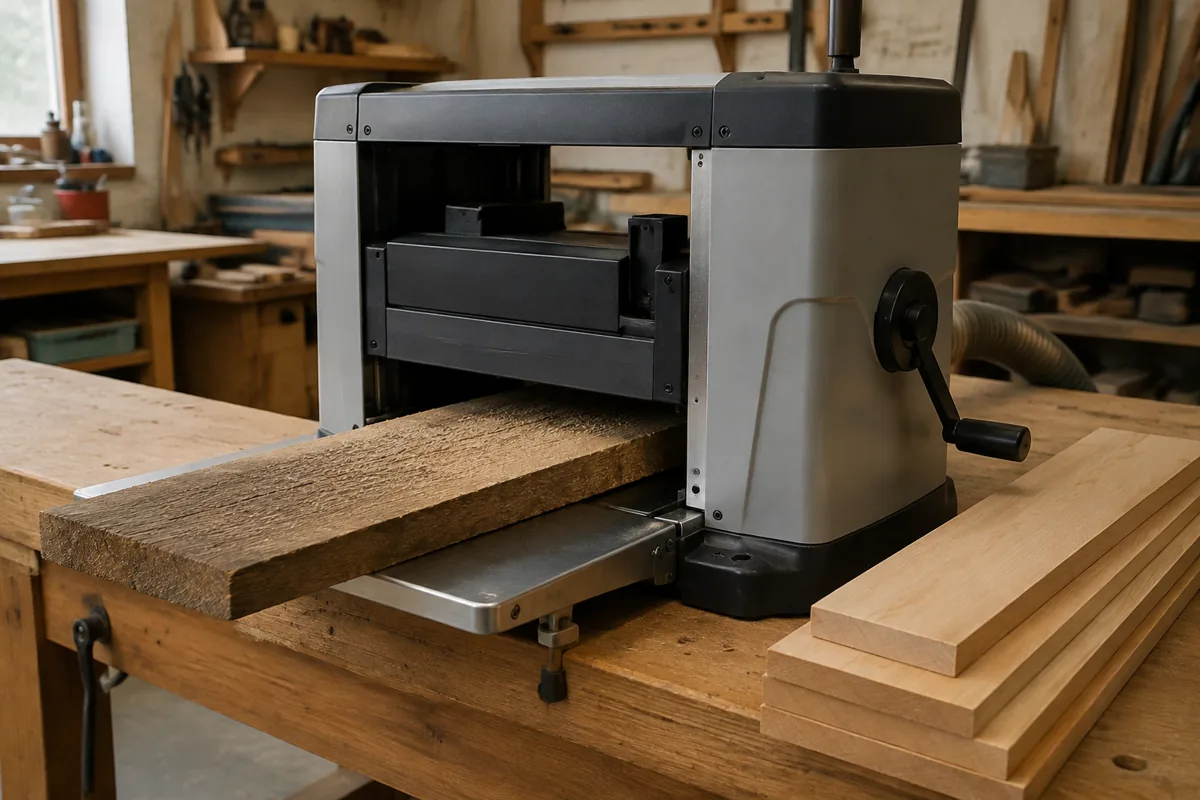
A thickness planer makes a board parallel. It does not make it flat. The feed rollers press whatever cup or twist exists in the stock down against the bed, the cutterhead skims the top surface, and when pressure releases the board springs back into the same shape it went in with, only thinner. This trips up nearly every new owner who expects rough lumber to come out ready for glue-up.
The practical consequence: a planer wants a flat reference face first. That comes from a jointer, a hand plane, a router sled, or from buying surfaced lumber (S2S or S4S) at the yard. If your budget covers exactly one machine and you have no jointing solution, plan on either a planer sled or a scrub plane and winding sticks. Nothing about a more expensive planer solves this for you.
What a planer does exceptionally well is bring stock to a consistent, repeatable thickness across a whole project, resaw cleanup, and dimensioning shop-sawn material. For beginners that means drawer sides that actually match, tenon cheeks that reference off a known thickness, and the ability to buy cheaper rough lumber instead of paying the premium for surfaced boards.
The Comparison That Matters: Feature Tiers, Not Brands
Portable planers cluster into three tiers. Price ranges below are typical street pricing categories rather than quotes, since planers swing heavily during holiday sales.
| Tier | Typical width | Cutterhead | Snipe behavior | Best suited to |
|---|---|---|---|---|
| Entry portable | 12 to 12.5 in | Two knives, no head lock | Visible on most boards, needs technique | Occasional hobby use, small parts |
| Mid portable | 13 in | Three knives, cutterhead lock | Minimal with lock engaged | The default first planer for most beginners |
| Helical upgrade | 13 in | Segmented carbide inserts | Minimal, quieter cut | Figured wood, high volume, noise-sensitive shops |
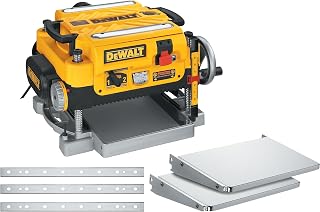
The jump from the entry tier to the mid tier is where the mechanical features arrive: a cutterhead lock, three knives instead of two, dual feed speeds on some models, and an infeed/outfeed table that can be shimmed into alignment. That jump is usually a modest amount of money and it is the one we tell first-time buyers not to skip.
Choosing a Benchtop Planer for Beginners: Six Mechanical Criteria
1. Cutterhead lock
This is the highest-value feature on the entire machine. Without a lock, the cutterhead assembly can lift slightly on its threaded posts as a board enters or exits, and that lift becomes snipe. Marketing names differ across brands, but any description involving a head lock, cutterhead lock or anti-snipe latch is describing the same mechanism. Verify it exists before anything else.
2. Bed and extension table flatness
The main bed is usually fine. The hinged infeed and outfeed extensions are the variable. They should be adjustable, and out of the box they should sit dead level with the bed or a hair proud of it. Check them with a straightedge on day one. Extensions that droop are a mechanical guarantee of snipe no matter how good the head lock is.
3. Knife type and change procedure
Most beginner planers use double-edged disposable straight knives. They index on pins, they take about fifteen minutes to flip or replace, and they cost meaningfully less than a segmented head. Helical or spiral heads with carbide inserts cut quieter, handle figure and reversing grain with less tearout, and let you rotate a single damaged insert instead of replacing a whole knife. They also add real money to the purchase, either factory-installed or as an aftermarket swap. For a first machine, straight knives are entirely adequate; buy a spare set at the same time so a nick doesn’t stop a project.
4. Depth-of-cut control and stops
Look for a positive depth stop or thickness stop and a legible depth scale. A gauge that indicates the actual cut a given board will receive is more useful than a bare thickness readout, because it prevents the beginner’s habit of taking too much per pass. Two feed speeds are a genuine nicety: the slower rate produces more cuts per inch and a better finish on the final pass.
5. Dust port and chip handling
Planers are the heaviest chip producers in a small shop, ahead of the jointer and well ahead of the table saw. A 4-inch port on a real dust collector is ideal. A 2.5-inch port on a shop vacuum will work for light use but clogs faster and the vacuum’s filter loads quickly. Whatever the port size, running with no extraction at all packs shavings between the board and the bed, and those trapped chips press into the surface and leave dents.
6. Weight, footprint and the reality of storage
A 13-inch portable planer runs roughly 60 to 90 pounds. That is liftable but awkward, and it wants either a dedicated stand or a shelf you can slide it off of. Factor in about three feet of clear space on each side for infeed and outfeed. Nothing derails a beginner faster than a machine that requires ten minutes of shuffling before every use.
13-Inch Three-Knife Benchtop Planers
This is the category we point most first-time buyers toward. Filter listings for a cutterhead lock and three knives, then compare dust port size and whether the extension tables are adjustable. Read the questions section for owner reports on snipe.
Setup and Technique That Eliminates Most Snipe
Snipe is part machine and part operator. Before blaming the planer, work through the mechanical checks: engage the cutterhead lock on every pass, straightedge the extension tables and shim or adjust them level, wax the bed so boards glide instead of stuttering, and confirm the feed rollers are clean and free of pitch buildup.
Then adjust technique. Support the board with light upward pressure as it enters and again as it exits, keeping it registered against the bed rather than lifting it. Feed boards back to back so each one holds the next in the rollers. Take shallow passes; a sixty-fourth to a thirty-second on hardwood is plenty, and the last pass should be the lightest of all. When absolute precision matters, plane stock an inch or two long and cut the sniped ends off after dimensioning. That last trick is what production shops do, and it makes the whole problem academic.
One safety note that gets skipped in beginner guides: never plane stock shorter than the machine’s minimum length, usually around 12 inches. A short board can be caught between the rollers and the cutterhead with nothing supporting it, and it will be launched. Glue short pieces to a carrier board or plane them long and cut after.
- ✔ Consistent, repeatable thickness across an entire project
- ✔ Unlocks cheaper rough lumber instead of surfaced stock
- ✔ Disposable knives are inexpensive and fast to change
- ✔ Portable enough to store off the bench between uses
- ✘ Cannot flatten a cupped or twisted board on its own
- ✘ Produces more chips than any other small-shop machine
- ✘ Snipe requires setup discipline on lower tiers
- ✘ Loud enough to require hearing protection every session
When to Spend Up to a Helical Head
Segmented carbide heads earn their premium in three situations: you work figured maple, cherry or walnut where tearout ruins parts; you run enough board footage that knife changes become an interruption; or you share a wall with someone and the noise reduction is worth money on its own. The cut is not automatically better on straight-grained pine, and a well-tuned straight-knife head with fresh edges leaves a very clean surface.
If your first six months of projects are shop furniture, boxes and construction lumber, straight knives are the right call. Aftermarket helical heads exist for most popular 13-inch machines, so this is an upgrade you can defer rather than a decision you have to make at purchase.
Helical / Spiral Cutterhead Planers
Worth the premium if you plan on figured hardwoods or high volume. Confirm whether the head is factory-installed or an aftermarket kit, and check that replacement inserts are stocked before you commit to a platform.
Frequently Asked Questions
Do I need a jointer before I buy a planer? Not necessarily, but you need some way to create a flat reference face. A planer sled, a hand plane, or buying S2S lumber all work. Skipping this step entirely is what leads to parallel-but-still-twisted boards.
Is 12.5 inches wide enough, or should I get 13? The half inch rarely decides a project on its own. What usually separates those two widths in the catalog is the feature set: 13-inch machines more often include the cutterhead lock, three knives and dual feed speeds. Buy for the features, and the width follows.
Can I run a benchtop planer on a shop vacuum instead of a dust collector? Yes for light use, with the understanding that a 2.5-inch hose moves far less chip volume than a 4-inch port on a collector. Empty the canister often, expect faster filter loading, and never run the machine with no extraction at all.
Verdict
For a first machine, the mid-tier 13-inch portable planer with a three-knife head and a working cutterhead lock is the buy. It costs modestly more than the two-knife entry machines and it solves the one problem that actually drives beginners away from the category. Set the extension tables level with a straightedge before the first board, wax the bed, engage the lock every pass, and plan on cutting sniped ends off precision parts. Defer the helical head until figured wood or volume makes the case for it, and spend the difference on a real dust collection solution instead. That order of priorities gets a new shop to accurate, repeatable stock faster than any single feature on the box.
Check prices on Amazon →