How to Keep a Band Saw Blade from Twisting in Thick Stock
What's inside
As an Amazon Associate I earn from qualifying purchases. This post may contain affiliate links at no extra cost to you.
A band saw blade that twists in thick stock usually signals a setup, blade, or feed problem—not a need to push harder. The blade may be too narrow for the cut, poorly tensioned, dull, or wandering because the guides are set incorrectly. Thick hardwood makes these weaknesses easier to see: the blade has more material to remove, and side pressure can bend it before the cut is complete.
Start with the blade and setup before buying anything. A wider blade, correct tension, sharp teeth, and steady feed solve most problems. If the saw still drifts after those checks, its frame, tires, or guide system may need attention.
Contents
Tell twisting from ordinary drift
Twisting means the blade rotates in the cut, so its teeth no longer point squarely along the intended path. A resawn board may show a wavy face, or the blade may bind partway through a cut. Drift is different: the blade runs at an angle to the fence or table, but stays in roughly the same orientation. Drift can often be handled by adjusting the fence or tracking; twisting usually calls for correcting blade support, blade choice, or feed technique.
Stop if the blade binds, makes a sharp change in pitch, or the stock starts to close behind it. Switch off the saw and wait for the blade to stop before adjusting anything. Forcing the work can kink or break the blade, damage the cut, and put your hands too close to a moving blade.
Choose a blade suited to the cut
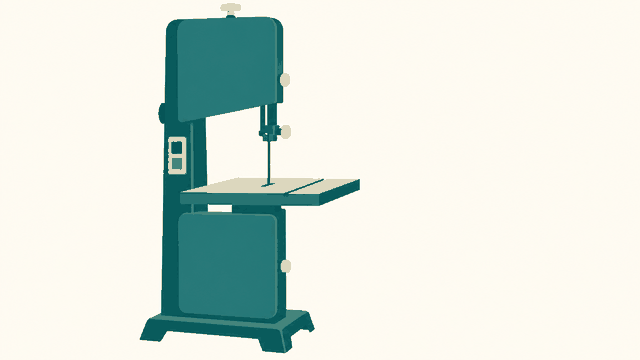
For straight resawing, a wider blade is generally more stable than a narrow one. Many 14-inch saws accept blades around 1/2 inch wide, and some accept 3/4-inch blades, but check the saw manufacturer’s limits first. A blade that is too wide for the wheel size may not track or flex properly. Narrow blades are useful for curves, but they are more prone to deflecting in a deep straight cut.
Tooth pattern matters too. A coarse blade clears sawdust faster in thick stock than a fine blade. For resawing, a blade with roughly 2–3 teeth per inch is a common choice; very fine teeth can clog and heat up. Skip-tooth or hook-tooth patterns may help with chip clearance, but the right option depends on the wood and saw. A purpose-made resaw band saw blade is worth considering if you regularly cut thick boards. For occasional work, a suitable, sharp general-purpose blade may be enough.
| Cut or blade choice | Typical use | Main trade-off |
|---|---|---|
| Wide, coarse blade | Straight cuts and resawing thick stock | Needs a saw that can tension and track it; limited curve cutting |
| Narrow blade | Tight curves and smaller work | More likely to deflect in thick, straight cuts |
| Fine-tooth blade | Thinner stock and smoother cuts | Can clear chips poorly in deep cuts |
Set tension, tracking, and guides
Use the tension scale only as a starting point. Scales on many saws are approximate, and a wide blade that is under-tensioned can bow behind the cut. Follow the saw manual’s instructions and the blade maker’s guidance; do not keep tightening past the saw’s capacity. Excessive tension can strain the frame, bearings, or blade. If the saw cannot tension the blade width you want, a narrower blade is the safer choice.
With the saw unplugged, check that the blade tracks correctly on the wheels according to the manual. Set the side guides just behind the tooth gullets, not against the teeth, and close enough to support the blade without rubbing during normal running. Set the thrust bearing just behind the blade, with a small clearance when the blade is idle; it should support the blade only when cutting pressure pushes it back. Guides set too far away allow the blade to twist before they catch it. Guides pressed against the blade cause heat and wear.
Guide designs differ, so follow your saw’s manual for exact clearances. Ceramic blocks and bearing guides can both work when correctly adjusted. Replacing guides is not a cure for bad tension, a dull blade, or a feed rate that pushes the blade sideways.
Feed steadily and support the work
Keep the stock flat on the table and feed it at a steady pace. Let the teeth cut; if you must shove hard, the blade may be dull, the cut may be too ambitious, or the saw may be short on power. On a resaw cut, a fence helps maintain direction, but it should be aligned to the blade’s actual drift rather than assumed parallel to the miter slot. Test on scrap before committing a good board.
Support long or heavy stock so it cannot sag, roll, or pull sideways. Keep the table clear of offcuts and use a push stick when the cut puts your hands near the blade. Do not twist the work to steer a wandering blade; that loads the blade sideways and can worsen the cut.
Check for wear and machine limits
A dull blade often needs more feed pressure and produces heat, burning, or fine dust instead of clean chips. Replace it if teeth are missing, the blade is kinked, or the weld area is damaged. Also inspect the tires for wear or debris and check that the wheels and guides are secure. A blade that keeps wandering despite correct setup may be exposing a saw that cannot maintain tension or has worn components.
For an occasional resaw, a sharp blade, careful setup, and a scrap test are usually cheaper than upgrades. If you resaw often, a band saw resaw fence can make repeat cuts easier to control, but it will not correct blade twist by itself. Fix the cause first, then decide whether a dedicated blade or fence is worth the added cost.