Benchtop-Style Stationary Planer vs Floor-Standing Planer for Furniture Shops
What's inside
As an Amazon Associate I earn from qualifying purchases. This post may contain affiliate links at no extra cost to you.
Contents
What You Are Comparing
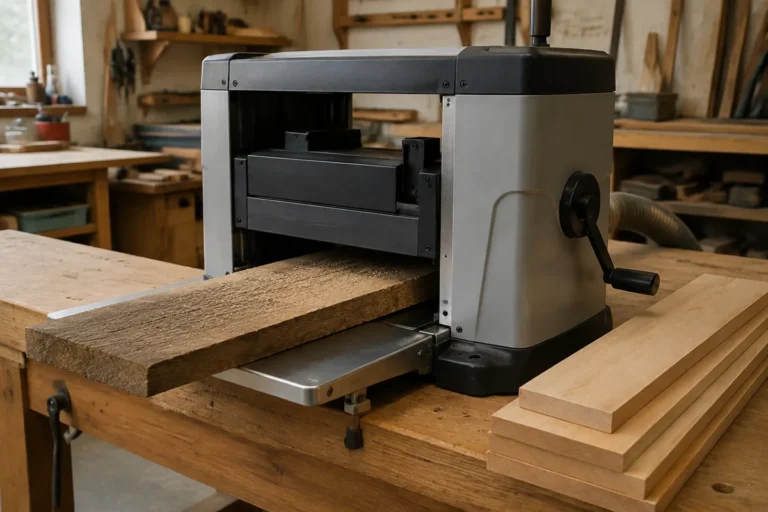
A benchtop planer and a floor-standing planer do the same basic job: they flatten one face of a board and bring it to a consistent thickness. Both are thickness planers, not jointers. A planer will make the opposite face parallel to the reference face, but it will not reliably remove a bow or cup unless one face is already reasonably flat.
The difference is capacity, feed stability, noise, dust handling, and how well the machine survives repeated work. A benchtop planer is usually the sensible choice for a small shop, occasional furniture projects, or a woodworker who needs to store the machine between uses. A floor-standing machine earns its space when the planer runs often, handles wide or heavy stock, and needs to produce predictable results for hours at a time.
As an Amazon Associate we earn from qualifying purchases at no extra cost to you.


Where a Benchtop Planer Makes Sense
Most benchtop planers accept boards roughly 12 to 13 inches wide and around 6 inches thick. That covers many table legs, cabinet parts, shelves, drawer components, and small slabs. They commonly use a cutterhead with two or three straight knives, though several current machines use helical or segmented carbide cutters.
The main advantage is cost and portability. A good 13-inch benchtop thickness planer costs much less than a serious floor-standing machine and can be carried by two people or mounted on a mobile stand. It is also easier to justify if you buy rough lumber only a few times per month.
Benchtop machines can produce excellent furniture parts. Use a sharp cutterhead, take light passes, and support long boards before and after the table. For final sizing, a cut of 1/32 inch or less is usually easier on the machine and leaves a cleaner surface than trying to remove 1/8 inch in one pass.
The compromises show up quickly with wide, heavy, or difficult stock. Small tables and lightweight stands allow the machine to move or vibrate. Feed rollers may struggle with a twisted board, and the cutterhead can leave snipe—the deeper cut often found at the first or last few inches of a board. Snipe is not always a defect in the cutterhead; it often results from inadequate infeed or outfeed support.
What the Floor-Standing Machine Adds
Floor-standing planers generally have a heavier frame, longer tables, stronger feed systems, and motors intended for sustained use. Common capacities range from 15 to 24 inches, with some industrial machines going much wider. A 15-inch planer is a major step up for a furniture shop because it handles wide panels, larger tabletops, and thicker stock without the same overhang and stability problems.
The extra mass matters. A machine weighing several hundred pounds is less likely to shift as a board enters the rollers. More substantial feed rollers maintain pressure across rough lumber, and longer beds reduce the effect of short support surfaces. These improvements do not eliminate snipe, but they make it easier to minimize and repeatably control.
Floor-standing models also tend to offer better chip collection. A planer can produce a surprising volume of chips: a board reduced by 1/16 inch across 12 inches can fill a dust bin quickly over several feet of stock. A small shop vacuum may work with a benchtop machine for light cuts, but a floor-standing planer usually needs a dedicated dust collector with a 4-inch hose and adequate airflow. Without it, chips can clog the hood, recirculate into the shop, or interfere with the rollers.
Look at the cutterhead before looking at cosmetic features. Straight knives are less expensive to replace and can cut cleanly when sharp, but they need regular sharpening or replacement. A helical head uses many small carbide inserts. It costs more initially, but a damaged insert can be rotated or replaced individually, and the cut is often quieter with less noticeable tear-out in figured wood.
Benchtop vs Floor-Standing
| Factor | Benchtop planer | Floor-standing planer |
|---|---|---|
| Typical width | 12–13 inches | 15–24 inches or more |
| Typical weight | 60–100 pounds | 250–1,000+ pounds |
| Best use | Occasional furniture parts and small shops | Frequent production and wide, heavy stock |
| Power needs | Usually 120 volts | 120 or 240 volts, depending on motor |
| Dust collection | Shop vacuum or small collector for light work | Usually a 4-inch dust-collector system |
| Main weakness | Noise, snipe, vibration, and limited capacity | Cost, floor space, moving difficulty, and power requirements |
What Furniture Makers Should Check
Measure your actual lumber before choosing capacity. A nominal 12-inch board may be too wide after jointing, and a 13-inch planer may have less usable width than expected once clearance and support are considered. If your furniture routinely uses 14- to 16-inch panels, a 15-inch planer is the minimum practical class. For occasional wide panels, you can glue up narrower boards, use a router sled, or pay for milling rather than buying a much larger machine.
Check the minimum thickness as well as the maximum. Many planers bottom out around 1/8 to 1/4 inch, but thin drawer parts and veneering stock need careful handling. Very thin pieces can flex, vibrate, or get pulled unevenly. A sacrificial carrier board can help, although it adds setup time and reduces available thickness capacity.
Pay attention to feed-rate options. A faster setting saves time on rough stock; a slower setting generally improves surface quality. If a machine has only one feed speed, plan on taking lighter cuts for visible furniture surfaces. Also check whether replacement knives or inserts are easy to find. An inexpensive planer becomes a poor bargain if its proprietary knives are unavailable or expensive.
Which Planer Fits Your Shop?
Choose a helical benchtop planer if you make a few projects a month, mainly process boards under 12 inches wide, and need to move or store the machine. A straight-knife benchtop model is fine when price matters most and you are willing to manage noise, snipe, and cutter replacement. The cheaper option is not automatically a compromise for a hobbyist; it is often the correct size for the work.
Choose a 15-inch floor-standing thickness planer when the machine will run weekly, you process wide hardwood regularly, or consistent feed and reduced vibration are worth the floor space. Budget separately for a mobile base, dust collector, spare knives or inserts, and a dedicated circuit if required.
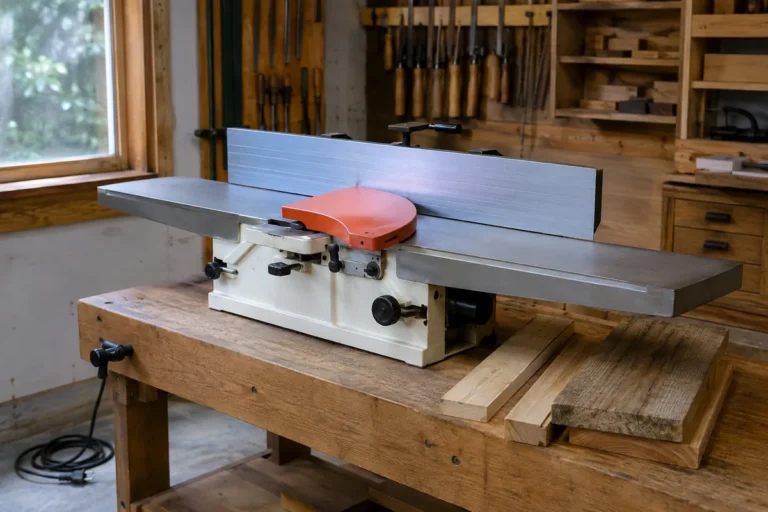
Before either purchase, make sure you have a jointer or another reliable way to create a flat reference face. If boards enter the planer twisted and unsupported, the machine will faithfully reproduce that problem on the opposite face. The planer is a thicknessing tool; the rest of the milling setup determines whether it can do its job well.