How to Choose Table Saw Blade Kerf for a Low-Power Motor
What's inside
As an Amazon Associate I earn from qualifying purchases. This post may contain affiliate links at no extra cost to you.
On a low-power table saw, blade kerf is not a minor specification. It directly affects how much wood the motor must remove with every pass. A full-kerf blade can make a small saw bog down, trip its overload protection, or leave burn marks in hardwood. A thin-kerf blade reduces the load, but it also brings compromises in stiffness, cut quality, and compatibility with the saw’s riving knife.
For most portable or benchtop table saws with motors in the 1-1/2 to 2-1/4 horsepower range, a thin-kerf combination blade is the sensible starting point. The correct choice depends on the saw’s actual power, the material you cut, the blade diameter, and whether the blade will work safely with the factory splitter or riving knife.
Contents
What blade kerf means
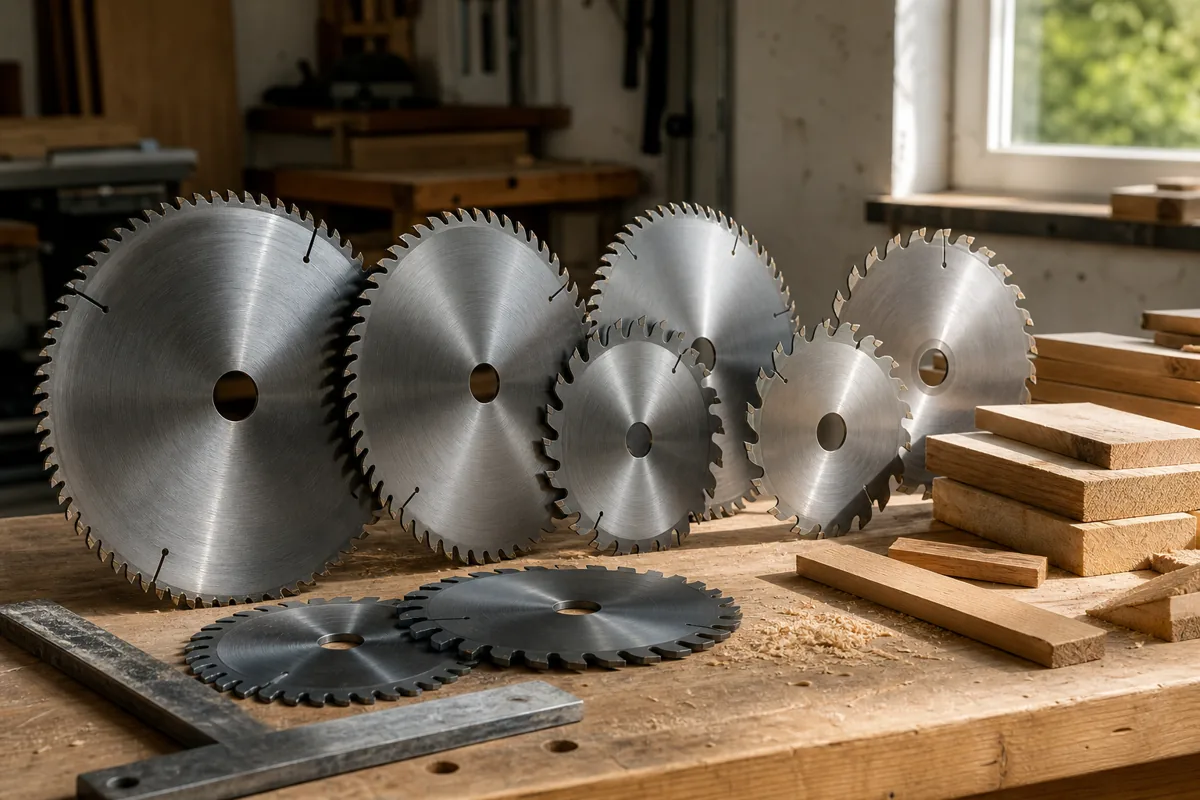
Kerf is the width of the slot cut by the blade. A typical 10-inch full-kerf blade removes about 1/8 inch of material. Thin-kerf blades usually remove about 3/32 inch, while some specialty blades are close to 1/16 inch. That difference looks small, but it represents roughly 25 percent less material for a 3/32-inch blade to remove compared with a 1/8-inch blade.
The motor still has to spin the blade and push the workpiece, but the reduced kerf lowers cutting resistance. This is most noticeable when ripping thick stock, making long cuts in plywood, or cutting dense woods such as maple, oak, and beech. A thin-kerf blade will not turn a weak saw into a cabinet saw, but it can keep the motor from slowing as severely.
Choose kerf by saw power and stock thickness
Manufacturer horsepower ratings are not perfectly comparable. A universal-motor saw may advertise a high peak horsepower figure while delivering much less useful continuous power. The practical test is how the saw behaves during a cut: if the blade speed drops audibly with moderate feeding pressure, reducing kerf is worthwhile.
| Typical saw situation | Useful kerf range | Best use | Main caution |
|---|---|---|---|
| Small benchtop saw, roughly 1-1/2 to 2 HP | 3/32 inch | Construction lumber, plywood, occasional hardwood | May flex more during aggressive feeding |
| Portable jobsite saw, roughly 2 to 2-1/4 HP | 3/32 to 1/8 inch | General ripping and crosscutting | Full kerf can overload the motor in thick hardwood |
| Underpowered or aging saw | 3/32 inch, sometimes narrower | Reducing load and preventing stalls | Check splitter or riving-knife clearance carefully |
| 3 HP cabinet saw or stronger | 1/8 inch | Frequent hardwood ripping and production work | Thin kerf is not necessary for motor relief |
For a saw below about 2 HP, start with a good 3/32-inch blade rather than jumping immediately to an ultra-thin blade. It provides useful load reduction without being excessively flexible. A 1/16-inch blade can help on a very small saw, but it is more sensitive to feed pressure and may produce a less confident cut in thick material.
Understand the trade-offs
The main advantage of thin kerf is lower power consumption. It also wastes less wood, which matters when breaking down expensive hardwood or making many repeated cuts. Less removed material means less sawdust and slightly faster cutting when the saw is power-limited.
The disadvantages are just as real. Thin blades have narrower steel plates, so they can deflect if you force the stock, twist the workpiece, or cut through knots. Deflection can leave a cut that is not square or can cause the blade to rub on the side of the kerf. That rubbing creates heat, burns the wood, and increases motor load—the exact problem the thin blade was supposed to reduce.
A thin-kerf blade is therefore not permission to push faster. Use a steady feed rate and let the blade maintain speed. If the motor begins to labor, slow down. If the cut starts burning despite a sharp blade and correct alignment, stop and check for fence pressure, a pinched kerf, or blade deflection.
Match tooth count to the job
Kerf alone does not determine performance. For general work, a 10-inch blade with about 40 to 50 teeth is a practical compromise. It can rip and crosscut plywood, dimensional lumber, and many hardwoods without requiring separate blades for every task.
A 24-tooth thin-kerf ripping blade removes stock quickly and places less total cutting edge in the wood at one time. It is useful for long rips, but its surface may be rougher and it is a poor choice for clean crosscuts. An 80-tooth blade can make a clean crosscut in plywood or hardwood, but the many teeth increase cutting resistance. On a weak saw, it may cut slowly and heat up.
For an underpowered saw, a thin-kerf combination blade with a moderate tooth count is often better than an ultra-fine finish blade. If you regularly rip thick solid wood, consider a dedicated thin-kerf ripping blade. For one blade that handles ordinary shop work, look for a 10-inch thin-kerf combination blade.
Check riving-knife and splitter compatibility
This is the most important safety issue. The riving knife or splitter must be thinner than the blade’s kerf but thicker than the blade plate. If the splitter is wider than the cut, the workpiece can bind against it. If it is too close to the blade or poorly aligned, the blade can rub it.
Measure the blade plate and the riving knife, or check the saw manual. Do not assume every thin-kerf blade is compatible. Some saws use a fixed splitter designed around a narrow range of kerfs. A blade that technically fits the arbor may still be unsafe if the splitter is too thick. In that case, buy a compatible replacement riving knife or use a blade within the manufacturer’s specified range. Search for thin-kerf table saw riving knives only after confirming the mounting pattern and thickness.
Set up the saw before blaming the blade
A thin blade cannot compensate for a poorly adjusted saw. Confirm that the blade is sharp, parallel to the miter slot, and properly tensioned on the arbor. Align the fence so it does not pinch the workpiece against the blade. Support long stock so its weight does not pull the cut closed.
Use the correct blade diameter and arbor hole, and never remove the blade guard or riving knife simply to make a noncompatible blade fit. If the saw still stalls with a sharp 3/32-inch blade, reduce the stock thickness, make a partial cut followed by a second pass, or use a band saw for heavy resawing. The cheaper full-kerf blade is fine when the saw maintains speed and you mostly cut thin plywood or softwood. On a genuinely power-limited saw, however, spending a little more on a quality thin-kerf blade is usually cheaper than replacing burned stock or an overheated motor.