Best Stationary Jointers for Preparing Lumber for Tabletop Glue-Ups
What's inside
As an Amazon Associate I earn from qualifying purchases. This post may contain affiliate links at no extra cost to you.
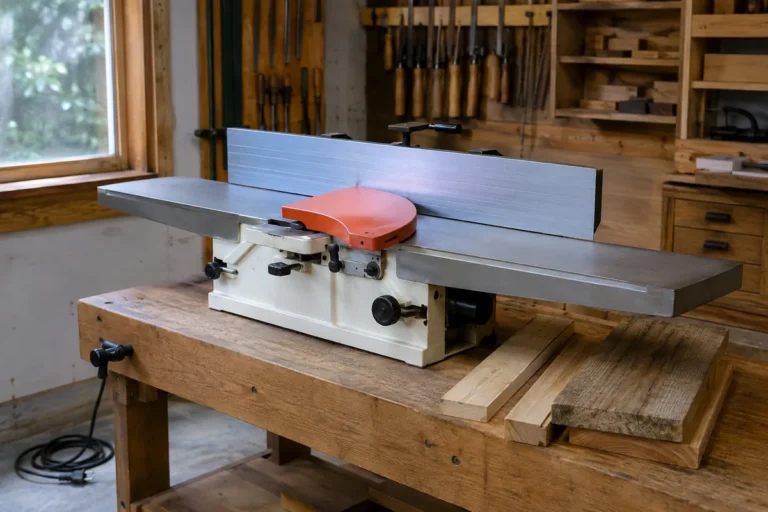
A clean tabletop glue-up starts with edges that meet without gaps. A table saw can produce straight cuts, but it does not automatically correct a board’s slightly bowed edge or establish a reliable reference face. A stationary jointer does both: the infeed table supports the rough board, the cutterhead removes material, and the outfeed table receives the newly flattened surface.
For most furniture builders, the best choice is an 8-inch floor-standing jointer with a helical or segmented cutterhead. It offers enough capacity for common hardwood boards without taking up the space or money required by a 12-inch machine. Smaller jointers can work, but their limitations show up quickly when preparing wide panels.
As an Amazon Associate we earn from qualifying purchases at no extra cost to you.


Contents
What a Jointer Does for Glue-Ups
A jointer performs two related jobs. First, it flattens one face of a rough board. Second, it cuts one edge straight and square to that face. That edge becomes the reference edge for ripping on a table saw.
For a tabletop, the usual process is to flatten the best face, joint one edge, then rip the opposite edge parallel on the table saw. If a board is already flat and only needs a straight edge, you can skip face jointing. A jointer should not be used to make two opposite edges parallel; that is the table saw or planer’s job.
For glue-ups, jointing is not about producing a polished surface. The cut should be straight and square, with just enough material removed to eliminate the hollow or high spots. Taking 1/32 inch per pass is often adequate. Heavy cuts can flex a board, overload the motor, and create a surface that looks flat but is not consistent from end to end.
Choosing the Right Jointer Size
Jointer width determines the widest face you can flatten in one pass. A 6-inch machine is useful for narrow furniture parts, drawer components, and typical construction lumber. It is also usually the least expensive floor-standing option. However, a 6-inch cutter cannot fully flatten a 7-inch or 8-inch tabletop board, so you may need a planer sled or hand tools for wider stock.
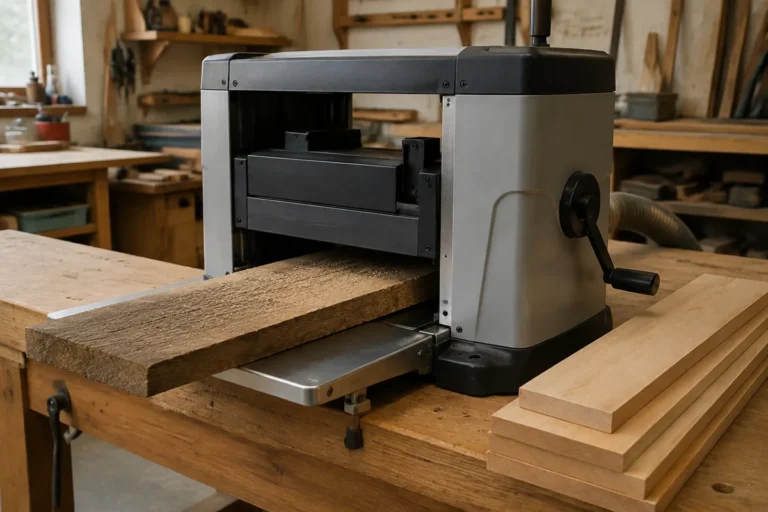
An 8-inch jointer is the practical middle ground. Its tables are generally longer and more stable than those on compact machines, and it handles most boards used for dining tables, benches, desks, and countertops. An 8-inch machine is also a sensible match for a 13- or 15-inch thickness planer: the jointer establishes one flat face and straight edge, while the planer brings the opposite face parallel.
A 12-inch jointer is valuable for wide slabs and large casework, but it is expensive, heavy, and demanding of shop space. It may also require a larger dust collector and a 240-volt circuit. Unless you routinely buy wide rough lumber, the extra capacity is difficult to justify.
| Jointer width | Best use | Main limitation |
|---|---|---|
| 6 inch | Small shops, narrow parts, occasional tabletop work | Cannot flatten wider boards in one pass |
| 8 inch | General furniture and most tabletop glue-ups | Higher cost and footprint than a 6-inch machine |
| 12 inch | Wide slabs, large tabletops, production work | Very expensive, heavy, and space-intensive |
Cutterhead and Fence Details That Matter
Most modern choices use either straight knives or a helical-style cutterhead with many small carbide inserts. Straight knives are cheaper to replace and can leave an excellent surface when sharp and correctly aligned. They also tend to produce more noticeable tear-out in figured maple, oak, and reversing grain.
A helical cutterhead usually costs more, but its staggered carbide inserts make difficult grain easier to manage. Individual inserts can be rotated when one corner dulls or is damaged. The trade-off is replacement cost: a full set of inserts is more expensive than a pair of conventional knives. For ordinary straight-grained pine, ash, or soft maple, sharp straight knives are perfectly adequate. For a general-purpose upgrade, compare 8-inch helical cutterhead jointers.
The fence should be rigid, easy to adjust, and capable of holding a true 90-degree setting. A fence that shifts during a pass can ruin an entire set of glue-up edges. Look for a long cast-iron or thick steel fence with positive stops at 90 degrees. A built-in 45-degree stop is useful, but it matters less than a dependable square setting.
Table length is just as important as width. Long tables support long boards and reduce rocking as the work enters and leaves the cutterhead. For tabletop stock, roughly 60 inches or more of combined table length is preferable. Short tables can joint edges, but they make face flattening harder and increase the chance of creating a hollow in the board.
Floor-Standing Versus Benchtop Machines
A floor-standing jointer is the better choice when you have room for it. Its heavier base resists movement, its tables are generally longer, and its larger motor is less likely to bog down on hardwood. A mobile base can make an 8-inch machine practical in a small shop, provided the base locks firmly before use.
A benchtop jointer is cheaper and easier to store, but it is a compromise. Short tables and narrow capacities make it better for edge jointing short boards than for flattening full-length tabletop parts. It can be a reasonable purchase if you mostly work with boards under 5 feet long, have limited power, or only need to correct an occasional edge. Compare current benchtop jointer options only after checking table length and maximum cut depth, not just motor horsepower.
Power, Dust Collection, and Setup
A 1-1/2 to 2 horsepower motor is sufficient for most 6- and 8-inch jointers used by one person. Three horsepower is useful for continuous hardwood work, but it often means a 240-volt installation. Do not judge performance by horsepower alone; a rigid table, accurate fence, and properly aligned cutterhead matter more.
Dust collection is essential. Jointer shavings fill a shop quickly and can obstruct the cutterhead guard or clog the chute. A collector moving roughly 600 to 800 cubic feet per minute at the machine is a practical target, with a short 4-inch hose and minimal bends. A shop vacuum may handle light benchtop work but commonly struggles with a full-size jointer.
Before the first glue-up, verify that the outfeed table is level with the highest point of the cutterhead, the fence is square, and the tables are coplanar. Joint a test board and inspect the edge against a straightedge. If the jointed edges touch at the ends but show a gap in the middle, the setup or feeding technique is producing a hollow. If they touch in the middle and gap at the ends, the edge is crowned.
What to Buy
Buy a floor-standing 8-inch jointer if tabletop glue-ups are a regular project. Choose straight knives to keep the initial cost down when you work mostly with easy grain and do not mind occasional knife changes. Choose a helical cutterhead when you work with figured hardwood, value quieter operation, or want to rotate individual carbide inserts instead of sharpening or replacing long knives.
A 6-inch jointer is fine when your boards are narrow and your budget is tight. Spend the savings on a good thickness planer, straightedge, and accurate table-saw setup. A 12-inch machine makes sense only when its capacity will be used repeatedly. The most expensive jointer in the shop cannot compensate for bowed lumber, poor support, or an outfeed table that is out of alignment.