Best Jointers for a Dedicated Rough-Lumber Milling Station
What's inside
As an Amazon Associate I earn from qualifying purchases. This post may contain affiliate links at no extra cost to you.
A dedicated rough-lumber station needs a jointer that can flatten a board without becoming the bottleneck for every other milling step. The key choice is not simply cutterhead type or motor size. It is whether the jointer’s bed length, cutter width, fence, and dust handling suit the stock you actually buy—and the space you can give the machine.
As an Amazon Associate we earn from qualifying purchases at no extra cost to you.



Contents
Choose the width and bed for your stock
A 6-inch jointer can flatten many narrow boards, but its capacity becomes a hard limit when you regularly mill wide tabletops, panels, or slab stock. An 8-inch machine is a more flexible choice for a serious shop; 12-inch and wider jointers suit larger work and cost more in purchase price, floor space, and electrical and dust-collection demands. Measure the boards you expect to flatten, including their widest rough sections, before shopping.
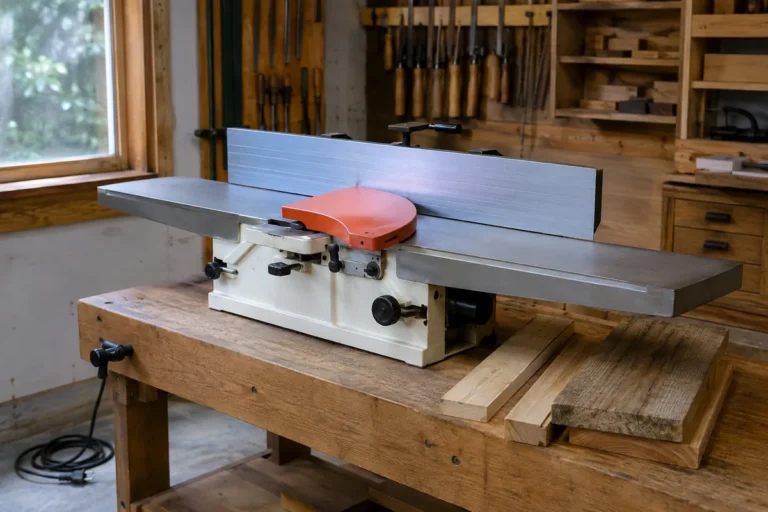
Bed length matters just as much. Longer beds support long boards through the cut and make it easier to establish a straight reference face. Short benchtop machines can be useful for trim and small parts, but they are a poor substitute for a floor-standing machine when routine stock is several feet long. A jointer does not make a board flat simply by being wide: the operator must control the board against the infeed table and fence throughout the pass.
Jointer types at a glance
| Type | Best fit | Main trade-off |
|---|---|---|
| Benchtop, typically 6 inches | Small shops, short parts, occasional narrow stock | Limited width and bed length; less support for long boards |
| Floor-standing, 6 to 8 inches | General furniture and cabinet work | More floor space and setup cost; 6-inch width can still constrain wide stock |
| Floor-standing, 12 inches or wider | Wide boards, larger projects, frequent rough-lumber milling | Higher cost, larger footprint, and greater demands on power and dust collection |
Straight knives or helical-style cutterhead?
Straight-knife jointers are often the less expensive route. They can leave a clean surface when knives are sharp, correctly set, and the grain is cooperative. Their weak point is maintenance: a nick can leave a repeating ridge along the board, and resetting multiple knives evenly takes care. Keep spare knives available if a dull or damaged edge would stop work.
Helical-style heads use multiple small inserts. A damaged insert can often be rotated or replaced individually, and angled cutting edges tend to reduce tear-out in difficult grain. They are not maintenance-free: inserts still wear, and replacement costs add up. They also do not prevent tear-out on every board. For a new station that will process mixed species and irregular stock, consider a floor-standing 8-inch helical-head jointer. If the budget is tight and you are comfortable setting knives, a straight-knife machine is a reasonable purchase.
Check the details before buying
Look for tables that adjust smoothly and lock securely, with clear depth-of-cut controls. A typical pass removes about 1/32 to 1/16 inch; deeper cuts raise the load on the cutterhead, increase the chance of tear-out, and make it easier to lose control of a twisted board. Take light passes, especially on wide or hard stock. A long, rigid fence should tilt accurately and return to 90 degrees without fuss, since a small fence error can turn a flat face into a face that is not square to the edge.
Check the cutter guard, push blocks, and access to the knives or inserts. A guard that sticks or is awkward to reset is more likely to be bypassed. Also verify voltage and circuit requirements against your shop. Larger machines may need a dedicated circuit; do not assume a nearby outlet is adequate. Dust ports vary, commonly around 4 inches on floor machines, and a jointer can produce a large volume of chips. A weak collector or narrow hose can clog, leaving chips on the tables where they interfere with the cut.
Plan the station around long boards
Allow clear infeed and outfeed space at least as long as your typical boards, plus room to stand safely beside the machine. For 8-foot stock, a jointer squeezed between a wall and another machine is frustrating even if its table is long enough. Mobile bases help when space is limited, but the machine must be locked solidly before use. A moving or rocking jointer can spoil a pass and create a safety hazard.
Set up the station so rough lumber can move from inspection to jointing and then to a planer without awkward turns. Remove loose bark, grit, staples, and embedded metal before cutting; these can damage knives or inserts and send fragments flying. Sight down each board and mark the high spots and intended reference face. Joint the face first, then joint one edge square to it. The planer can make the opposite face parallel, but it cannot reliably correct a twisted board that was never flattened on the jointer.
Match the machine to the workload
For a small shop processing mostly narrow boards, a 6-inch floor-standing jointer can be a sensible way to get longer beds without paying for unused width. Choose a benchtop unit only if the work is genuinely short and occasional; saving space and money does not compensate for unsupported long stock.
For regular furniture making with mixed board widths, an 8-inch floor-standing jointer is a practical middle ground. Step up to a wider machine when your lumber repeatedly exceeds that capacity or you need to flatten wide stock in fewer setups. If wide boards are rare, the cheaper machine is fine: break down the stock where appropriate, or arrange another method for those occasional oversized pieces. Buy for the boards you mill week after week, not the exceptional slab that may never arrive.