Bosch Track Saw Review: Cutting Accuracy, Track Options, and Value
What's inside
- Bosch Track Saw Review: Cutting Accuracy, Track Options, and Value
- Which Bosch track-saw setup fits your work?
- Accuracy: the rail and setup matter as much as the saw
- Bevels, materials, and dust collection
- Track compatibility: verify before you build around it
- Ownership costs and the decision to buy
- Related Guides
- Bosch Track Saw Review: Cutting Accuracy, Track Options, and Value
- Which Bosch track-saw setup fits your work?
- Accuracy: the rail and setup matter as much as the saw
- Bevels, materials, and dust collection
- Track compatibility: verify before you build around it
- Ownership costs and the decision to buy
- Related Guides
As an Amazon Associate I earn from qualifying purchases. This post may contain affiliate links at no extra cost to you.
Contents
- Bosch Track Saw Review: Cutting Accuracy, Track Options, and Value
- Which Bosch track-saw setup fits your work?
- Accuracy: the rail and setup matter as much as the saw
- Bevels, materials, and dust collection
- Track compatibility: verify before you build around it
- Ownership costs and the decision to buy
- Related Guides
Bosch Track Saw Review: Cutting Accuracy, Track Options, and Value
The Bosch GKT18V-20GCE is the Bosch track saw to consider if you want accurate plunge cuts, a useful bevel range, and cordless convenience—but its value depends on whether its track system fits your existing setup. It is best suited to breaking down sheet goods, trimming doors and panels, and making repeatable straight cuts; it is less compelling if you need the lowest-cost entry point or already own a different brand’s track.
Which Bosch track-saw setup fits your work?
Bosch’s current cordless track-saw option is the 18V GKT18V-20GCE, part of its Professional 18V system. The saw’s central advantage is controlled cutting: the blade plunges into the work, and the base runs along a guide rail to help keep long cuts straight. That combination is particularly useful for plywood, melamine-faced panels, and solid-wood boards too wide for a table saw.
As an Amazon Associate we earn from qualifying purchases at no extra cost to you.
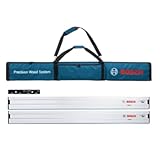


Choose a bare tool if you already have compatible Bosch batteries and can verify that your intended rail is supported. A kit is more practical if you need a battery, charger, and rail from the outset. Before buying, check the exact regional model and package: included rails and accessories can differ, and product specifications may vary by market.
| Decision point | What to expect | Best fit |
|---|---|---|
| Blade diameter | 165 mm (6½ in) | Sheet goods, panels, and general workshop cuts |
| Maximum cutting depth at 90° | 57 mm (about 2¼ in) | Most common sheet stock and many solid-wood boards |
| Maximum cutting depth at 45° | 42 mm (about 1⅝ in) | Bevel cuts in thinner stock; confirm capacity for the material |
| Bevel range | −1° to 47° | Standard bevel work plus slight undercuts for fitting |
| Power source | Bosch Professional 18V battery platform | Shops already invested in compatible Bosch 18V tools |
Figures are for the GKT18V-20GCE and should be checked against Bosch’s specification for the exact local version. Cutting depth is not the same as usable depth through a rail: the rail and splinter guard sit above the workpiece, so leave margin when planning cuts near the saw’s maximum capacity.
Accuracy: the rail and setup matter as much as the saw
A track saw can make a long, clean line, but it does not make an inaccurate setup accurate. For a panel cut, mark the finished edge, position the rail so its splinter guard aligns with that line, and support the sheet so the offcut cannot sag or pinch the blade. On laminated panels, keep the finished face oriented according to the blade’s cutting direction and use a sharp, suitable blade to reduce chipping.
For repeat work, check that the rail is straight, the saw sits securely on it, and any anti-slip strips are clean and in good condition. A rail that shifts mid-cut can spoil an otherwise precise setup. When joining rails for a long rip, align them carefully with the rail connectors; even a small step at the joint can show up as a deviation in the cut.
Expect the best results on sheet goods and boards that are flat, firmly supported, and within the saw’s capacity. A track saw is not a substitute for a jointer or planer: it will follow a bowed board rather than correct the bow. For narrow parts, secure the workpiece and rail so neither can move, and keep hands outside the cutting path.
Bevels, materials, and dust collection
The 47° maximum bevel gives the Bosch extra room beyond a conventional 45° setting, while the −1° setting allows a slight undercut. That can help when fitting panels into a corner or making a joint where the visible edge should close tightly. Bevel capacity falls to 42 mm, so a thick board that is within the 90° depth limit may be too thick at an angle.
For plywood and veneered panels, use a sharp fine-tooth blade and make a test cut on scrap before cutting the finished piece. Melamine and other chip-prone surfaces benefit from careful rail placement and a steady feed. The saw can also cut solid wood, but blade choice and workpiece support matter: long boards should be supported on both sides of the cut, without squeezing the kerf shut.
The dust port can be connected to a suitable dust extractor or vacuum. Extraction is preferable indoors, especially when cutting MDF, which produces fine dust. Even with a vacuum attached, some dust can escape around the blade and plunge opening; keep the saw’s air paths clear and do not assume extraction removes the need for appropriate workshop dust controls.
Track compatibility: verify before you build around it
Rail compatibility is a major value question, not a minor accessory detail. Bosch rails and some rails made for compatible guide-rail systems may work with the saw, but compatibility can depend on the rail profile, saw adjustment, and regional product version. Do not assume that every rail marketed under another brand will fit accurately or safely.
If you already own rails, confirm compatibility with Bosch’s documentation or a qualified dealer, then check that the saw slides without excessive play and that the splinter guard is positioned correctly for the blade. If you are starting from scratch, compare the price of the saw plus the rail length you actually need. A short rail is manageable for cabinet panels; breaking down full-size sheets is easier with a long rail or properly aligned joined sections.
Ownership costs and the decision to buy
The purchase price is only part of the cost. You may also need a rail, clamps, a dust extractor, batteries, and replacement blades. Blade wear is usually the first recurring cost, particularly in abrasive or resin-heavy sheet materials. Clean pitch from the blade as needed, check the teeth for damage, and avoid forcing a dull blade through a cut; a slow, rough cut can increase heat and reduce finish quality.
Keep the rail’s glide surfaces and saw base free of chips, and periodically inspect the rail’s grip strips and splinter guard. Damaged or loose anti-slip material can undermine accuracy. Store rails flat or supported so they do not get bent, and avoid dragging them across grit that can scratch the workpiece.
- Choose Bosch if: you own compatible Bosch 18V batteries, want a cordless plunge saw, and can use or source a confirmed-compatible rail.
- Compare alternatives if: you already have another guide-rail system, since replacing rails can erase the apparent savings of a bare tool.
- Consider a corded saw if: you make long, frequent cuts at a fixed bench and prioritize uninterrupted operation over portability.
- Choose a simpler setup if: you make only occasional short cuts and do not need the control or clean edge of a track-guided plunge saw.
Market pricing varies by country, kit contents, and promotions, so compare complete setups rather than bare-tool prices. Include the rail, battery capacity, charger, and extraction connection in the calculation. For a shop that already uses Bosch 18V tools and needs a capable panel-cutting saw, the GKT18V-20GCE can be a sensible fit. For buyers with a different rail ecosystem, compatibility and total system cost should decide the purchase before brand loyalty does.