Kreg Track Saw Guide: Best Rails, Saws, and Accessories
What's inside
- Quick picks by situation
- What the Kreg track saw system includes
- Rail length and real cutting capacity
- Splinter protection: the dedicated saw has the advantage
- Plunge saw versus Accu-Cut
- Replacement accessories and compatibility
- Setup that prevents most mistakes
- Ownership, maintenance, and common failures
- Bottom line
- Related Guides
- Quick picks by situation
- What the Kreg track saw system includes
- Rail length and real cutting capacity
- Splinter protection: the dedicated saw has the advantage
- Plunge saw versus Accu-Cut
- Replacement accessories and compatibility
- Setup that prevents most mistakes
- Ownership, maintenance, and common failures
- Bottom line
- Related Guides
As an Amazon Associate I earn from qualifying purchases. This post may contain affiliate links at no extra cost to you.
For most buyers, the best kreg tracksaw setup is the Kreg Adaptive Cutting System Plunge Saw with a 62-inch Guide Track; choose the 100-inch track for full-sheet work, the Accu-Cut when you already own a compatible circular saw, and the Rip-Cut when low cost matters more than splinter-free plunge cuts.
As an Amazon Associate we earn from qualifying purchases at no extra cost to you.


Contents
- Quick picks by situation
- What the Kreg track saw system includes
- Rail length and real cutting capacity
- Splinter protection: the dedicated saw has the advantage
- Plunge saw versus Accu-Cut
- Replacement accessories and compatibility
- Setup that prevents most mistakes
- Ownership, maintenance, and common failures
- Bottom line
- Related Guides
Quick picks by situation
| Situation | Best Kreg option | Why it fits | Main compromise |
|---|---|---|---|
| Frequent cabinet or furniture work | Adaptive Cutting System Plunge Saw + 62-inch track | Purpose-built plunge saw, enclosed blade, controlled starts, and replaceable track strips | Higher initial cost than a saw guide |
| Breaking down plywood or panels | Plunge Saw + 100-inch Guide Track, or two joined tracks | Longer cuts with a continuous guide edge | Less convenient to store and transport |
| You already own a circular saw | Kreg Accu-Cut | Converts a compatible circular saw into a guided cutting setup | Not the same as a true plunge saw; compatibility depends on saw shape and base |
| Occasional crosscuts and rip cuts | Kreg Rip-Cut | Compact, inexpensive, and quick for repeated cuts from a panel edge | It is an edge-guided saw guide, not a track saw for arbitrary starting points |
| Small shop or jobsite storage | 62-inch track with Plunge Saw | More portable than a 100-inch rail and adequate for many cabinet components | Cannot make a full 96-inch rip in one pass without repositioning or joining tracks |
What the Kreg track saw system includes
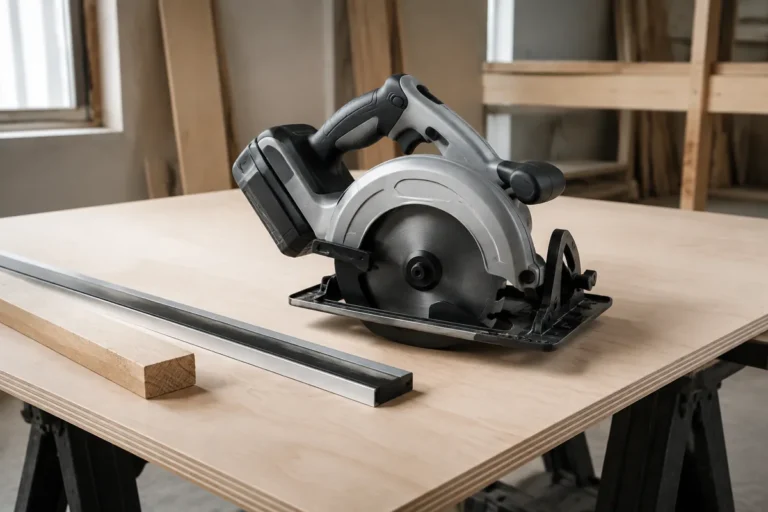
Kreg’s dedicated option is the Adaptive Cutting System Plunge Saw. It uses a 6-1/2-inch blade and a guide-track interface designed to keep the saw aligned while the track’s splinter guard marks the cut line. The saw is intended for controlled plunge cuts rather than only cuts that begin at the edge of a board.
The system is separate from Kreg’s Accu-Cut and Rip-Cut. Accu-Cut is a universal-style guide that mounts a compatible circular saw to a straight rail. Rip-Cut uses a measuring guide that references the edge of a sheet or board. These products can improve circular-saw accuracy, but they do not provide identical plunge behavior, track clamping, or dust containment.
Rail length and real cutting capacity
The most useful Kreg guide-track sizes are 62 inches and 100 inches. The rail length is not the same as the maximum finished cut: the saw body, track overhang, and the need to position the guide beyond the workpiece all reduce practical capacity. A 62-inch rail is suitable for many cabinet sides, shelves, doors, and crosscuts. A 100-inch rail is the more sensible choice for ripping the long edge of a standard 4-by-8-foot sheet.
| Rail choice | Nominal length | Practical use | Portability |
|---|---|---|---|
| Short guide rail | Approximately 50 inches | Compact panels, crosscuts, and the Accu-Cut-style setup | Easy to store in a small vehicle or shop |
| ACS Guide Track | 62 inches | Cabinet parts, doors, shelves, and most crosscuts | Good balance of reach and handling |
| ACS Guide Track | 100 inches | Long rips and full-sheet breakdown | Best performance on a support table; awkward in tight spaces |
For a 96-inch rip, a 100-inch rail leaves only a small amount of positioning margin. Support the sheet on foam insulation or a cutting table, mark the waste side clearly, and keep the track fully supported before the saw enters the material. For repeated full-sheet work, two shorter compatible tracks joined with the manufacturer’s connectors can be easier to transport than one long rail, but the joint must be aligned carefully.
Splinter protection: the dedicated saw has the advantage
A track saw’s rubber splinter guard is valuable because it sits directly on the cut line and supports the fibers on the waste side. The first few cuts trim the guard to the exact blade position, so the track should be aligned to the keeper side of the pencil mark rather than centered on it.
The guard is a consumable. It can fray from dragging the rail, become inaccurate after changing blade geometry, or lose effectiveness when packed with dust. Replace it when the edge is visibly torn or the cut begins showing breakout. A fine-tooth blade helps, but blade choice cannot compensate for a damaged or incorrectly trimmed splinter strip.
The Accu-Cut can improve accuracy over freehand cutting, but its result depends more heavily on the circular saw’s base, blade, and adjustment. If your primary materials are veneered plywood, melamine, or expensive hardwood panels, the dedicated Plunge Saw and intact splinter guard are the safer choice.
Plunge saw versus Accu-Cut
Choose the ACS Plunge Saw when
- You need to start cuts in the middle of a sheet or countertop.
- You make repeated cabinet cuts and want consistent rail alignment.
- You value a blade guard that covers the blade before and after the cut.
- You want a system with purpose-designed replacement tracks and accessories.
Choose Accu-Cut when
- You already own a circular saw that fits the guide base correctly.
- Your work mostly begins at a panel edge.
- You want a lower-cost route to guided straight cuts.
- You can accept more setup and less predictable compatibility.
Check the circular saw before buying Accu-Cut. The shoe must sit securely on the guide platform, the blade must clear the guide hardware, and the saw’s motor housing must not collide with the rail during travel. Cordless saws are particularly variable in shoe shape and battery placement. Do not assume that a saw fitting one manufacturer’s guide base will fit another without checking the dimensions and mounting method.
Replacement accessories and compatibility
The most important replacement parts are the blade, splinter guard, anti-slip strips, track connectors, and clamps. Kreg’s own ACS guide tracks are the safest match for the ACS Plunge Saw. Third-party rails may have similar dimensions, but similar-looking tracks are not automatically compatible: the saw carriage, guide ribs, strip location, and connector geometry can differ.
Replacement blades should match the saw’s specified diameter, arbor, kerf range, and rotation direction. For plywood and veneered panels, a fine-finish blade generally produces cleaner results than a coarse framing blade. A coarse blade can be useful for construction lumber, but it increases tear-out and places more demand on the splinter guard.
Track clamps are useful when cutting narrow or slippery stock, even when the rail’s anti-slip surface seems adequate. Keep clamps below the saw’s travel path. If the rail moves during a cut, the resulting error can be larger than the width of the blade and may ruin a cabinet component.
Setup that prevents most mistakes
- Support the entire panel. Use a sacrificial surface so the blade can pass through without contacting concrete, metal, or a valuable workbench.
- Mark the keeper side. The guide edge indicates the blade path; account for the kerf and place the rail on the correct side of the line.
- Trim the splinter guard. Make the first cut slowly in scrap or at the panel edge, then use the trimmed edge as the visual reference.
- Set cutting depth. Allow the blade to extend only slightly beyond the material. For a 3/4-inch sheet, roughly 1/8 to 1/4 inch of extra blade exposure is usually preferable to a deeply exposed blade.
- Check the rail before starting. Confirm that the track is flat, the anti-slip strips are clean, and no clamp or connector obstructs the saw.
- Feed at a steady rate. Forcing the saw can deflect the blade; moving too slowly can burn the material. Let the blade’s sound and chip removal guide the feed rate.
A simple sizing calculation helps when choosing a rail. If the required cut is 72 inches and you want at least 4 inches of rail beyond each end for stable entry and exit, you need approximately 80 inches of usable guide length. A 62-inch rail is therefore undersized for that cut; use a 100-inch rail or a properly joined-track arrangement.
Ownership, maintenance, and common failures
Dust is the main long-term enemy. Vacuum the saw’s vents and track channel, brush debris from the anti-slip strips, and wipe the rail before storing it. Do not fold or sharply bend the splinter guard. Store tracks flat or fully supported so they do not develop a curve.
The parts most likely to wear first are the splinter strip, anti-slip material, and blade. A dull blade often appears to be a motor problem: the saw cuts slowly, wanders, burns the edge, or requires excessive pressure. Replace or sharpen the blade before adjusting the guide system. Also inspect the track connector after repeated assembly; even a small step at a joined rail can mark the workpiece or interrupt the saw’s travel.
Never lift the saw by the track, start with the blade already buried in the panel, or reverse the saw while the blade is spinning. Those habits increase the chance of a damaged splinter guard, rough cut, or kickback. Follow the current manual for blade changes, electrical safety, and plunge-lock operation.
Bottom line
The Kreg Adaptive Cutting System is the strongest choice when clean panel cuts, repeatability, and a true plunge action matter. Buy the 62-inch rail for general cabinet and furniture work, the 100-inch rail for frequent full-sheet ripping, and compatible connectors if portability is more important than a single long rail. Accu-Cut is the value route for owners of a suitable circular saw, while Rip-Cut is best treated as a compact measuring guide for edge-based cuts—not as a full replacement for a dedicated kreg tracksaw.