Kreg ACS Review: Is the Adaptive Cutting System Worth It?
What's inside
As an Amazon Associate I earn from qualifying purchases. This post may contain affiliate links at no extra cost to you.
The Kreg ACS is worth it for serious DIY woodworkers who regularly break down sheet goods and want table-saw-level accuracy without dedicating a permanent footprint — but only if you budget realistically for the full system, because the table, track, and accessories add up faster than the marketing suggests.
As an Amazon Associate we earn from qualifying purchases at no extra cost to you.


Contents
What the Kreg ACS Actually Is
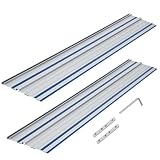
The kreg acs (Adaptive Cutting System) is a modular cutting platform built around three components: a plunge-cut track saw, a 62-inch aluminum guide track, and a folding project table. The idea is simple — instead of wrestling a 4×8 sheet of plywood onto a table saw, you lay the track on the sheet and run the saw along it. The table elevates this from a floor-level operation to a repeatable station with parallel guides and a built-in measuring system.
Each component is sold separately, which is both the system’s flexibility and its biggest cost trap. You can buy just the saw and track to work on sawhorses or foam insulation on the floor, then add the kreg acs table later when budget or space allows.
Key Specs at a Glance
| Component | Spec | Notes |
|---|---|---|
| ACS Plunge Saw | 12A motor, 6-1/2″ blade, ~2-1/8″ max cut depth at 90° | Variable speed 2,000–5,500 RPM; bevels to 47° |
| Guide Track | 62″ aluminum | Crosscuts full 48″ sheet width; anti-chip splinter guard |
| Project Table | ~40″ x 54″ work surface, folds for storage | Includes 48″ and 24″ parallel guides, MDF sacrificial top |
| Rip capacity (on table) | Rips up to ~24″ wide with repetitive stops | Narrower than a cabinet saw, fine for cabinet parts |
| Saw weight | ~16 lbs | Comparable to other corded plunge saws |
| Blade | 48-tooth carbide, 20mm arbor | Non-standard arbor — Kreg or compatible blades only |
Cut Accuracy: The Real Reason to Buy
The ACS earns its keep on accuracy, not speed. The track’s zero-clearance splinter guard presses right against the blade, so cuts on veneered plywood come out crisp on the show face with minimal tear-out — something a circular saw and a straight edge clamp simply can’t match consistently.
On the table, the parallel guides with flip stops turn repeat cuts into a two-second operation. If you’re building cabinets and need six shelf sides at exactly 11-1/4 inches, the ACS delivers that repeatably. Expect accuracy in the range of ±1/64 inch for typical work — better than most DIYers achieve freehand, though a well-tuned cabinet saw with a good fence still edges it out for precision ripping.
The weak spot: the MDF table top is sacrificial and it will get chewed up around the cut line over time. It stays accurate because the track registers to the table, not the surface, but plan on replacing the top every year or two of heavy use.
Safety Features
This is where the system quietly beats a table saw for most hobbyists. The blade is fully enclosed inside the plunge mechanism until you press it down, it retracts automatically, and there’s a riving knife that drops with the blade to prevent kickback. Anti-kickback control limits the saw from climbing back along the track.
Compared to pushing sheet goods through a contractor saw — where kickback is the classic injury scenario — the workpiece stays stationary and the saw moves. For a solo woodworker handling 3/4-inch plywood alone, that’s a meaningful safety advantage, not a marketing bullet point.
Track-Saw Flexibility vs. the Table
Used alone, the saw and 62-inch track handle breakdown cuts anywhere — on the driveway, on foam on the garage floor, or across sheets too awkward to lift. The track clamps or simply grips via its underside strips. Bevel cuts to 47° work, though you lose some cut depth (closer to 1-1/2 inches at 45°).
The kreg acs table adds repeatability and ergonomics but caps rip width at about 24 inches — fine for face frames, drawer parts, and cabinet sides, limiting for wide panel glue-ups. The table folds roughly flat and rolls, which matters enormously in a single-car garage shop. If you never build casework and mostly do rough breakdown, skip the table and put that money toward a second track or track clamps.
The True Cost of Ownership
Advertised pricing shows the saw and track together typically in the $400–$550 range, the table around $500–$600, and the full bundle near $900–$1,000. But realistic ownership costs more:
- Track extensions: The 62″ track can’t rip a full 8-foot sheet lengthwise. A second 62″ track plus connectors adds roughly $150+ if you want 8-foot rips.
- Blades: The 20mm arbor means you’re buying Kreg-branded or specifically compatible blades — figure $30–$60 each, and plywood work dulls a 48T blade within a few big projects.
- MDF top replacement: A sacrificial surface is a consumable. Budget a sheet of MDF annually under heavy use.
- Track clamps: Not strictly required (the track grips well), but you’ll want them for bevels and slick materials — another $40–$80.
Realistic all-in cost for a functional setup: $1,100–$1,400. That’s mid-range contractor table saw money — the ACS wins on space, safety, and sheet goods; it loses on ripping hardwood and dado work.
Decision Matrix: Should You Buy It?
| Your situation | Recommendation |
|---|---|
| Garage shop, build cabinets/furniture from plywood, no room for a table saw | Buy the full bundle — this is exactly who it’s for |
| Occasional plywood projects, own a circular saw already | Saw + track only; use foam-on-floor method, skip the table |
| Have a working table saw with outfeed space | Skip it — adds little unless sheet breakdown is genuinely difficult |
| Primarily rip solid hardwood or cut dados/joinery | Buy a table saw or band saw instead; the ACS can’t plow dados |
| Need to rip full 8′ sheets lengthwise regularly | Factor in the second track — or reconsider; a table saw does this natively |
Ownership Realities
- Dust collection: Good with a shop vac connected to the port; mediocre without. The enclosed blade helps contain chips.
- Common mistake: Plunging before the saw reaches full speed, which burns the blade edge and gums up the splinter guard. Let it spin up fully.
- What wears first: The splinter guard strip (replace or trim it), the MDF top, and blade — in that order under plywood-heavy use.
- Calibration: Check the track-to-table squareness after moving or folding the table. It drifts occasionally; a five-minute check saves a ruined sheet.
Verdict
The kreg acs is a well-executed system for a specific woodworker: someone building real projects from sheet goods in a space-constrained shop who values safety and repeatability over raw ripping power. It doesn’t replace a table saw for hardwood work, and the accessory costs are real — but for cabinet and furniture work in a garage shop, few alternatives match its accuracy per square foot of floor space.