Best Track Saw: Straight Cuts Without a Table Saw
Key takeaways
- A track saw buys straight, chip-free cuts in sheet goods without a table saw, but the rail and the base fit matter far more than the motor. Here is how we judge the category.
What's inside
As an Amazon Associate I earn from qualifying purchases. This post may contain affiliate links at no extra cost to you.
Sheet goods are what break a small shop. A full sheet of 3/4 in. plywood is heavy, floppy and unforgiving, and shoving one across a contractor saw with no outfeed support is how tearout, binding and crooked cabinet sides happen. A track saw reverses the problem: it brings a dead straight, supported cut to the panel instead of dragging the panel to the blade. The best track saw for most woodworkers is not the one with the biggest motor, it is the one whose rail lies flat, whose base has no play against that rail, and whose plunge returns to the same depth on the tenth cut as the first.
We judge the category by comparing tool lines and the ecosystems behind them rather than chasing a part number that gets superseded next spring. A track saw is a platform purchase, and the rail, connectors, splinter strip and clamps you buy in year one decide what the tool can do in year five.
As an Amazon Associate we earn from qualifying purchases at no extra cost to you. Product prices and availability are accurate as of the date shown and are subject to change.

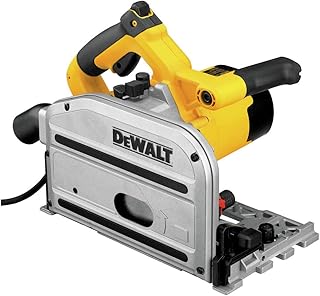


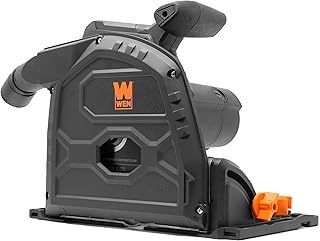

| Class | Typical blade | What it buys you | Best suited to |
|---|---|---|---|
| Compact cordless | 5-1/2 in. | Light weight, easy carry, shallow depth | Installers, thin ply, on-site work |
| Standard plunge saw | 6-1/2 in. | Around 2 in. of depth, full-sheet ripping, widest rail choice | Most cabinet and furniture work |
| Large capacity | 8-1/4 in. | Stacked sheets, thick slabs, solid core doors | Door shops, slab flattening |
| Circular saw plus rail | Varies | Cheapest entry, no plunge or riving knife | Occasional sheet breakdown |
| Guided cutting system | 6-1/2 in. | Rail with fence and stops for repeat cuts | Shops with no table saw |
What Separates the Best Track Saw From a Circular Saw on a Rail
Four features do the real work. The plunge action keeps the blade shrouded until you push it down, allowing controlled entry and stopped cuts for sink openings. The riving knife behind the blade on better saws holds the kerf open so the offcut cannot pinch and lift the tool. The zero-clearance splinter strip makes the cut line the rail edge, so alignment becomes place-and-cut rather than measure-and-offset. And the enclosed housing turns dust extraction into something close to complete with a vac attached, which matters more in a basement shop than any number on the box.
- ✔ Cut line sits at the rail edge, no offset math
- ✔ Near-zero tearout in veneered ply and melamine
- ✔ Breaks down full sheets solo on foam or sawhorses
- ✔ Doubles as a straight-line jointer for long edges
- ✘ Slower than a fence for repeat narrow rips
- ✘ Rails, clamps and connectors add real cost after the saw
- ✘ Bevels shift the kerf off the rail edge on most designs
- ✘ No practical dado or joinery capability
The Criteria We Judge Track Saws By
Base-to-rail fit
This predicts cut quality better than any spec. Good saws use two adjustable cams in the shoe that snug the base against the rail rib. With the battery out, slide the saw the length of the rail and feel for lateral rock or a tight spot; play here shows up as a wavy edge no blade upgrade will fix. Budget saws often rely on a molded shoe with no adjustment, and once that plastic wears there is nothing to take up.
Rail flatness and rigidity
Sight down the extrusion like a straightedge before you trust it. Thin-wall rails flex under clamp pressure, and cheap connectors leave a slight dogleg where two sections meet. If full-sheet rips are the goal, prefer a single long rail, or a connector system with two bars and set screws rather than one.
Depth stop and bevel detents
Repeatability separates a shop tool from a jobsite tool. The depth stop should return to a set value without creep, and the scale should already account for rail thickness. Detents at 0 and 45 degrees need to feel positive, and a small negative bevel is genuinely useful for closing cabinet miters.
Blade and dust path
Plenty of competent saws ship with an average general-purpose blade. A thin-kerf panel blade with a high tooth count transforms crosscuts in veneered plywood, and a lower-tooth blade keeps solid wood from burning, so budget for one extra blade. Confirm the dust port matches the hose you own instead of assuming an adapter exists.
Standard 6-1/2 in. plunge track saw
The sweet spot for most shops. Roughly two inches of depth covers doubled sheets and 8/4 stock, rail choice is widest, and cordless kits on the major platforms (DeWalt XR, Milwaukee FUEL, Makita LXT) save you another battery family. Check whether a rail is included, since many are sold bare.
Corded, Cordless, or a Rail for the Saw You Own
Cordless has effectively won panel work. Breaking down sheets is a series of short cuts with long pauses, an easy duty cycle for a brushless motor, and not dragging a cord across fresh plywood is worth more than people expect. Two-battery designs match corded power in 3/4 in. material; single-battery compacts are pleasant to carry and best kept to thinner stock.
Corded still makes sense for ripping hardwood on the rail or for long production days. If money is tight, an aluminum rail with a universal adapter for the circular saw you already own gets you most of the straightness for a fraction of the cost. You give up the plunge, the riving knife and the sealed dust path, so treat it as a stepping stone.
Guide rail and universal circular saw adapter
The honest budget answer. Clamp a rigid extrusion to the panel, set the adapter to your saw base, and cut straight today. Read the listing for rail length and the range of shoe widths supported, and plan to add your own zero-clearance edge.
The Rail Ecosystem Decides More Than the Saw
Rail profiles are not universal, and while some lines are widely reported to share an extrusion shape, the burden is on you to confirm fit before ordering. Practically: a rail around 55 in. handles crosscuts on a sheet, roughly 106 to 118 in. of combined length rips one lengthwise in a single pass, and T-slot clamps earn their keep on narrow offcuts. Parallel guides, a crosscut fence and a limit stop are what let a rail answer for a table saw. Cut over rigid foam or a torsion box so the panel is supported everywhere and the offcut cannot sag into the blade.
Long rails, connectors and clamps
Budget for the rail system, not just the saw. One long rail beats two joined short ones, and a pair of screw clamps stops the creep that ruins the last six inches of a cut. Match the profile to your saw line and read listed lengths closely.
Frequently Asked Questions
Can a track saw replace a table saw? For a shop built around plywood casework, largely yes. Panel breakdown, straight-lining rough edges and long crosscuts all go better on a rail. Repetitive narrow rips, dados and small parts still favor a table saw, so many shops pair a track saw with a router table and call it even.
Do I need the same brand of rail as my saw? Not always. Several lines use compatible profiles, and third-party rails advertise fit with specific brands. Verify the exact profile before ordering, because a rail slightly off in the rib dimension reintroduces the play the tool exists to eliminate.
Why is my cut still not square? Almost always the rail moved, the base has play, or the panel was not supported. Clamp the rail on short cuts, adjust the base cams, clean the anti-slip strips, and support the offcut so it cannot pinch the blade partway through.
Verdict
For most readers the best track saw is a standard 6-1/2 in. cordless plunge saw on the battery platform already in the shop, bought with a rail where possible, then paired with a good panel blade, rail clamps and enough rail length for the cuts you actually make. That package clears every criterion that matters: no base-to-rail play, a flat rigid rail, a repeatable depth stop and dust collection clean enough to work indoors. Step up to the 8-1/4 in. class only if thick slabs or solid core doors are routine, and treat a bare rail with an adapter as a legitimate start while you save. Judge candidates at the shoe and the rail, not on the label.
Check prices on Amazon →