Best Track Saw Kits of 2026: Saw, Rails, and Clamps Compared
What's inside
- Best Track Saw Kits of 2026: Saw, Rails, and Clamps Compared
- What matters when cutting a full sheet
- Kit comparison: what to verify before you buy
- Accuracy on a joined 8-foot rip: a useful reality check
- Choose by the job, not by the saw alone
- Budget for the complete cutting setup
- Ownership details that affect cut quality
- Bottom line
- Related Guides
- Best Track Saw Kits of 2026: Saw, Rails, and Clamps Compared
- What matters when cutting a full sheet
- Kit comparison: what to verify before you buy
- Accuracy on a joined 8-foot rip: a useful reality check
- Choose by the job, not by the saw alone
- Budget for the complete cutting setup
- Ownership details that affect cut quality
- Bottom line
- Related Guides
As an Amazon Associate I earn from qualifying purchases. This post may contain affiliate links at no extra cost to you.
Contents
- Best Track Saw Kits of 2026: Saw, Rails, and Clamps Compared
- What matters when cutting a full sheet
- Kit comparison: what to verify before you buy
- Accuracy on a joined 8-foot rip: a useful reality check
- Choose by the job, not by the saw alone
- Budget for the complete cutting setup
- Ownership details that affect cut quality
- Bottom line
- Related Guides
Best Track Saw Kits of 2026: Saw, Rails, and Clamps Compared
For most buyers, the best track saw kit is a package that includes enough connected rail to cross a 4×8 sheet, plus clamps and an intact splinter guard; among established options, the Festool TS 55 track-saw sets suit a premium, expandable system, while Makita’s SP6000J1 kit is a strong value when its included rail length fits your cuts. Kit contents can vary by retailer and region, so check the exact part number before buying—especially for rail length, connectors, and clamps.
What matters when cutting a full sheet
A 4×8 sheet is 48 inches wide and 96 inches long. To crosscut it, a rail needs to span the 48-inch width with enough extra length for the saw’s starting and stopping position. To rip the full length, one rail must be at least 96 inches long, or two shorter rails must be joined. A connector aligns the rails; it does not automatically make a joint perfectly straight.
As an Amazon Associate we earn from qualifying purchases at no extra cost to you.


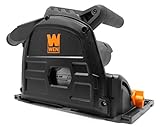
Accuracy also depends on the track’s splinter guard, blade condition, workpiece support, and how carefully the saw is set against the rail. A rail longer than the cut gives you room to position the saw without starting with the blade at the sheet’s edge.
Kit comparison: what to verify before you buy
| Kit or system | Rail coverage to look for | Clamps and connectors | Best fit |
|---|---|---|---|
| Festool TS 55 track-saw set | Common packages include a 55-inch rail; longer rails and a rail connector are generally separate unless listed in the specific bundle. | Clamps, connector, and spare splinter guard depend on the package. Confirm each item on the contents list. | Frequent use, precision-focused shops, and buyers who want an expandable system. |
| Makita SP6000J1 kit | Often sold with a 55-inch guide rail. A full 96-inch rip requires a second rail and connector. | Do not assume clamps or a connector are included; package contents vary. | Budget-conscious users who want a capable corded saw and can add accessories as needed. |
| DeWalt track-saw kit (DWS520 family) | Rail length and quantity vary by bundle. Check whether the package includes one rail or a joined, long-rail setup. | Verify clamps, rail connector, and replacement splinter guard individually. | Users already invested in compatible DeWalt tools or looking for a corded system. |
| Mafell MT 55 cc system | Rails are available in multiple lengths; the saw package may not include enough rail for a full-length rip. | Connector and clamping accessories are often separate or bundle-dependent. | Professional users prioritizing a high-end, serviceable system over lowest upfront cost. |
These are system-level comparisons, not guaranteed box inventories. Manufacturers and sellers change bundles, and a “kit” may mean saw plus case rather than saw plus a complete cutting setup. Compare the package’s itemized contents, not just its product title.
Accuracy on a joined 8-foot rip: a useful reality check
A maker’s rail-straightness specification is not the same as a guaranteed cut tolerance. The practical result comes from the setup. Here is a repeatable way to assess a 4×8 rip without treating a single measurement as a universal performance claim:
- Join and inspect the rails. Clean the mating ends, install the connector as directed, and align the rail sections on a flat surface. A tiny kink at the joint can steer the saw off line.
- Set the track on the sheet. Measure from the intended cut line at both ends. Clamp the rail, then recheck; clamps can shift it as they tighten.
- Make a shallow scoring pass. Use the saw’s scoring setting if available, or a shallow first pass. This helps limit veneer breakout, particularly on fragile plywood faces.
- Complete the cut and measure. Measure the resulting width at the near end, joint area, and far end. Record the largest difference. This separates rail alignment error from a cut that simply landed parallel but offset.
For example, if a panel intended to be 24 inches wide measures 24 1/16 inches at one end and 24 inches at the other, the cut varies by 1/16 inch across the length. That is a setup result, not a claimed tolerance for any saw in the table. For cabinet parts, check your own acceptable tolerance and verify the first cut before processing a stack.
Choose by the job, not by the saw alone
| Your situation | Practical choice | Why |
|---|---|---|
| Occasional sheet breakdown; tight budget | Makita SP6000J1 or another corded saw kit with a 55-inch rail | Start with crosscuts and shorter rips; buy a second rail and connector only when full-length cuts become routine. |
| Regular cabinet or furniture work | Festool TS 55 system or a comparable established rail platform | Frequent use makes compatible rails, replaceable guards, and accessory availability more valuable. |
| Limited storage space | Two shorter rails rather than a single long rail | Short sections are easier to store and transport, though the joint requires careful alignment. |
| Many full 8-foot rips | A matched pair of rails, connector, and clamps—or a compatible long rail | Having the full-length setup ready avoids repeated repositioning and reduces opportunities for alignment errors. |
Budget for the complete cutting setup
A saw-only price can make a kit look cheaper than it is. As a broad market guide, track-saw systems range from a few hundred dollars for entry-level corded setups to well over $1,000 for premium saw-and-accessory packages. Extra rails, connectors, clamps, and replacement guards add to the total; exact prices vary by region and bundle.
For a full-length rip, calculate the setup cost as: saw package + second rail (if needed) + connector + clamps (if needed) + spare splinter guard. If the kit includes a 55-inch rail, it takes more than one rail to cover a 96-inch cut. A joined pair may provide sufficient nominal length, but allow extra rail beyond the workpiece where possible.
Ownership details that affect cut quality
The splinter guard is a consumable: its edge is cut to match the saw’s blade path, and it can lose effectiveness if torn, contaminated, or trimmed incorrectly. Replace it when it no longer supports a clean edge. Keep the rail’s glide strips and underside free of dust and pitch; debris can make the saw drag or lift. Check the blade for resin buildup and dull teeth, since a dirty or worn blade can leave a rough edge even when the rail is aligned.
Common avoidable mistakes include using an incompatible connector, clamping over a panel that is bowed, assuming the rail’s printed edge is the cut line, and forcing the saw through a dull blade. Always confirm the saw and rail are compatible, and support the offcut so it cannot pinch the blade near the end of a cut.
Bottom line
Choose the Makita SP6000J1 for a lower-cost corded starting point if you are comfortable checking and adding accessories. Choose a Festool TS 55 package when you want a premium system with room to expand and can verify the bundle contents. For any brand, the best 4×8-ready track saw kit is the one whose itemized package—or planned add-ons—covers your cut length, joins securely, clamps reliably, and includes a usable splinter guard.