
Key takeaways
- Five reciprocating saw blades compared for pruning, clean wood and demolition work, covering tooth counts, blade lengths, materials and pack sizes.
What's inside
As an Amazon Associate I earn from qualifying purchases. This post may contain affiliate links at no extra cost to you.
A reciprocating saw is only as useful as the blade clamped into it, and wood work asks more of a blade than most people expect. Green branches pack wet chips into fine teeth, demolition lumber hides nails that strip a plain steel edge in a few strokes, and clean framing cuts need a tooth pattern that clears dry sawdust without wandering. Tooth count, blade length, and edge material decide which of those jobs a blade handles well and which ones leave it dull, bent, or bound up in the cut.
The five blades below cover the three jobs a woodworker or homeowner hands a reciprocating saw most often: pruning limbs, cutting clean wood, and tearing through demolition lumber with embedded hardware. Two use carbide teeth for long edge life, one is a bi-metal demolition blade rated for nail-embedded wood, and two are high-carbon steel pruning blades in the two most useful lengths. Every pick uses the common half-inch universal shank pattern, so fit is rarely the deciding factor.
As an Amazon Associate, we earn from qualifying purchases.
Contents
Quick answer
For heavy pruning and long blade life, the Diablo Demo Demon carbide blade leads this group. The EZARC carbide blade handles hard wood and demolition, Milwaukee The Ax covers nail-embedded wood, and the Bosch and Milwaukee high-carbon steel pruning blades round out the nine and twelve inch options for everyday branch work.
The five blades compared
Diablo Demo Demon Carbide Pruning Blade, 12 Inch, 3-Pack
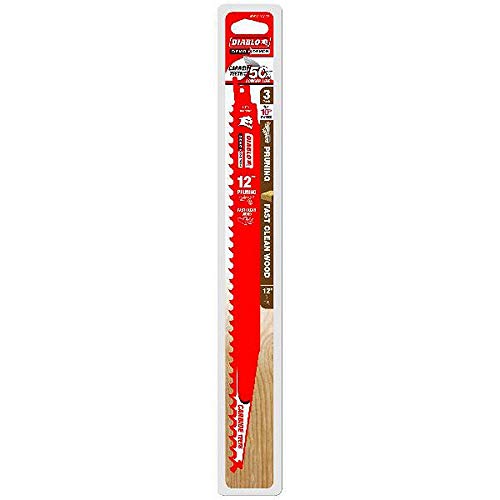
This is the premium pick for anyone who prunes thick limbs season after season. The teeth are tipped with Diablo’s TiCo Hi-Density carbide, and the maker rates that edge for far longer cutting life than a standard steel pruning blade, which matters when a single afternoon means dozens of cuts through hardwood branches. At three teeth per inch, the tooth pattern is the coarsest in this group, so it pulls through green wood quickly and clears chips instead of packing them between the teeth.
The twelve inch length reaches through limbs that stop a nine inch blade short, and the one inch oversized blade body resists the flexing that makes long blades wander in a deep cut. A Perma-SHIELD coating helps the blade shed pitch and resist the gumming that resinous species leave behind. The trade-off for all that durability is cut finish: three teeth per inch leaves a rough surface, so this blade belongs on limbs and rough stock, not on anything that will show.
Specs
- Length: 12 inches
- Tooth count: 3 TPI
- Teeth: TiCo Hi-Density carbide-tipped
- Coating: Perma-SHIELD non-stick
- Blade body: 1 inch oversized demolition body
- Pack size: 3 blades
- Shank: Not stated
EZARC Carbide Reciprocating Saw Blade, 9 Inch, 3-Pack

The EZARC R956HM Endurance blade is the demolition specialist of the group, built for hard wood and the mixed material that renovation work uncovers. Its carbide teeth hold an edge through dense lumber and incidental metal contact that would round over a steel tooth line quickly, and the six teeth per inch pattern balances cutting speed against control better than the very coarse pruning patterns do.
At nine inches long with a stated cutting length of 175 millimeters, it suits wall framing, pallet breakdown, and nail-embedded boards where a longer blade would flex too much to steer. The listing states fitment with the shank patterns used by Bosch, DEWALT, Milwaukee, Makita, and Hitachi reciprocating saws, which covers most saws a woodworker is likely to own. Buyers who cut mostly clean, soft lumber will not use the durability they are paying for here, but for mixed demolition loads this is the blade that keeps cutting after steel blades have given up.
Specs
- Length: 9 inches (225 mm)
- Cutting length: 175 mm
- Tooth count: 6 TPI
- Blade material: Carbide teeth
- Pack size: 3 blades
- Stated fitment: Bosch, DEWALT, Milwaukee, Makita, and Hitachi shank patterns
- Application: Hard wood and metal demolition
Milwaukee The Ax Bi-Metal Blade, 9 Inch, 5-Pack

Milwaukee sells The Ax as a general wood demolition blade rather than a pruning blade, and that is exactly why it earns a place here. The bi-metal construction pairs a flexible steel body with a hardened tooth line, and Milwaukee states plainly that the blade is ideal for wood with nails and bolts. Anyone who has cut into an old fence line, a remodel wall, or orchard wood with hardware grown into the bark knows how quickly that rating pays for itself.
The body is 0.062 inches thick, noticeably stouter than a standard pruning blade, so it resists bending and buckling when a cut binds in thick stock. Five teeth per inch keeps the cut moving through framing lumber without the grabby feel of a three tooth pattern. It lacks the deep, sap-clearing gullets of a dedicated pruning blade, so green wood loads it up faster than the Bosch or the Milwaukee pruning blade below, but for dry demolition lumber with hidden metal it is the most forgiving blade in this group.
Specs
- Length: 9 inches
- Tooth count: 5 TPI
- Material: Bi-metal
- Blade thickness: 0.062 inches
- Pack size: 5 blades
- Shank: 1/2 inch universal tang
- Maker rating: Suited to wood with nails and bolts
Bosch Pruning Blade, 12 Inch, 5-Pack

The Bosch RP125 is the mid-range workhorse for dedicated pruning, sized for the branches a nine inch blade cannot finish in one pass. Its five teeth per inch pattern uses Bosch Turbo-Teeth geometry on a high-carbon steel body, with a precision-ground edge that stays keen longer than a stamped edge of the same steel. Five blades per pack is a practical advantage for a full day of orchard or yard tree work, where one blade rarely survives every cut.
Twelve inches of length handles limbs in the range where a shorter blade leaves the tip buried and the saw shoe floating, and the five tooth pattern leaves a cleaner cut face on smaller branches than the three tooth Diablo. The limitation is the steel itself: high-carbon steel dulls faster than bi-metal or carbide, and it has no rating for embedded metal, so a hidden nail or fence staple ends a blade’s useful life on the spot. Kept on clean wood, it is a dependable and economical pattern to run.
Specs
- Length: 12 inches
- Tooth count: 5 TPI
- Material: High-carbon steel
- Tooth design: Turbo-Teeth with precision-ground edge
- Pack size: 5 blades
- Shank: Not stated
- Application: Pruning and green wood
Milwaukee Pruning Blade, 9 Inch, 5-Pack

This is the budget-friendly pruning blade of the group, and it is built specifically for limbs, branches, and green wood. The fleam-ground teeth cut in both directions of the stroke, which keeps the cut moving instead of only biting on the pull, and the extra deep gullets between teeth clear the wet, stringy chips that green wood produces before they can pack solid and stall the blade.
The teeth are induction hardened for longer life within the limits of high-carbon steel, and at nine inches the blade is easier to control one-handed inside a canopy or between close branches than either twelve inch option. The half-inch universal tang fits the standard quick-change chucks used across major saw brands. Like the Bosch above, it is a wood-only blade with no tolerance for embedded hardware, and the steel edge will need swapping sooner than a carbide blade under heavy daily use. For seasonal pruning and storm cleanup, five blades per pack keeps that from becoming a problem.
Specs
- Length: 9 inches
- Tooth count: 5 TPI
- Material: High-carbon steel
- Tooth design: Fleam-ground, induction hardened
- Gullets: Extra deep for fast chip clearing
- Pack size: 5 blades
- Shank: 1/2 inch universal tang
How to choose
Begin with tooth count, because it drives everything else. Coarse patterns from three to six teeth per inch cut fast and clear chips well, which is what pruning and demolition need. Finer patterns cut more smoothly but load up in green wood and feel slow in thick stock, so for the work covered here, stay at six teeth per inch or coarser.
Match length to the material, not to the saw. A blade should clear the far side of the cut with stroke room to spare: nine inch blades suit branches and framing up to roughly six inches thick, while twelve inch blades earn their keep on limbs beyond that. Longer blades flex more, so reach for extra length only when the cut demands it.
Then pick the edge material for the dirt and hardware in your wood. High-carbon steel is the budget tier and is fine for clean pruning. Bi-metal is the mid-range step up, adding shatter resistance and tolerance for nails. Carbide is the premium tier, holding an edge through hard, dirty, and mixed material far longer than either steel. Finally, weigh pack size against how you work: five-packs suit seasonal users who swap dull blades freely, while three-packs of carbide suit heavy users who expect each blade to last.
Who should skip
Skip this entire blade family if your work is finish carpentry. Reciprocating saw blades cut rough by design, and visible joinery, cabinet parts, and trim deserve a jigsaw or circular saw blade instead. Skip these picks as well if your cutting is mostly metal pipe, conduit, or sheet stock: those jobs need fine tooth metal blades with much higher tooth counts than anything listed here. Owners of older saws with a proprietary shank should confirm fitment before ordering, since every blade above assumes the common half-inch universal pattern. And if you prune once a year with a handsaw already in hand, a dedicated pruning set may be more tool than the job needs.
FAQ
What tooth count works best for pruning branches?
A coarse pattern between three and six teeth per inch works best. Coarse teeth clear the wet chips that green wood produces, while finer teeth pack solid and stall. Three teeth per inch cuts thick limbs fastest, and five teeth per inch leaves a cleaner face on smaller branches.
Can one blade handle both clean wood and demolition lumber?
A bi-metal or carbide blade can work across both, which is why The Ax and the EZARC blade appear in this group. Plain high-carbon steel pruning blades should stay on clean wood, because a single embedded nail can strip their teeth and end the blade’s useful life.
Do these blades fit every reciprocating saw brand?
Nearly all of them. The half-inch universal shank is the shared pattern across the major saw brands, and the EZARC listing names Bosch, DEWALT, Milwaukee, Makita, and Hitachi fitment directly. Older or proprietary chucks are the exception, so confirm your saw’s clamp style if it is an unusual model.
When should a blade be replaced instead of kept in rotation?
Replace a blade when it stops clearing chips and begins to smoke or wander, when teeth feel smooth along a section of the edge, or after any bend that leaves the blade visibly out of line. A bent or dull blade works the saw harder and cuts less safely than a fresh one.
Final verdict
For most readers, the Bosch RP125 five-pack is the sensible core purchase: the right length and tooth count for real pruning work, in a pack size that forgives a dull blade. Add the Diablo carbide three-pack if thick limbs and long seasons make edge life the priority, and keep The Ax or the EZARC carbide blade on hand for the demolition cuts where hidden hardware would ruin a steel edge. The Milwaukee pruning five-pack rounds out the set as the budget option for lighter, cleaner branch work.
Product and ASIN Reference
| Product | ASIN |
|---|---|
| Diablo Demo Demon Carbide Pruning Blade, 12 Inch, 3-Pack | B073WKWJ1R |
| EZARC Carbide Reciprocating Saw Blade, 9 Inch, 3-Pack | B08FR5H26N |
| Milwaukee The Ax Bi-Metal Blade, 9 Inch, 5-Pack | B00002248Y |
| Bosch Pruning Blade, 12 Inch, 5-Pack | B000FAPPAA |
| Milwaukee Pruning Blade, 9 Inch, 5-Pack | B000E8SZSC |
Related guides
More from Amazon
Programs that pair well with the guide above. Offers and eligibility are set by Amazon and may change.
A free business account with business pricing and bulk-buying tools for work, shop or home office.
Create a business accountFree shipping on eligible items, Prime Video and more. Eligible new members can start with a free trial.
Start a Prime free trialAudiobooks and podcasts to listen to on the go. Eligible new members can start with a free trial.
Try Audible freeAd-free music streaming. Eligible new subscribers can start with a free trial.
Try Music Unlimited freeAs an Amazon Associate we earn from qualifying purchases.

Write Your Review
No reviews yet. Be the first to share your experience!