Best Duck Covers Ultimate Multi-Piece Patio Cover Sets
What's inside
- Best Duck Covers Ultimate Multi-Piece Patio Cover Sets
- How the Ultimate fabric and fastening system suit outdoor furniture
- Compare common set types by layout and fit
- Pick by seating layout
- Measure and calculate before you buy
- Comparison checklist: coverage, fastening, and ownership
- Which set is the best fit for your situation?
- Bottom line
- Best Duck Covers Ultimate Multi-Piece Patio Cover Sets
- How the Ultimate fabric and fastening system suit outdoor furniture
- Compare common set types by layout and fit
- Pick by seating layout
- Measure and calculate before you buy
- Comparison checklist: coverage, fastening, and ownership
- Which set is the best fit for your situation?
- Bottom line
As an Amazon Associate I earn from qualifying purchases. This post may contain affiliate links at no extra cost to you.
Contents
- Best Duck Covers Ultimate Multi-Piece Patio Cover Sets
- How the Ultimate fabric and fastening system suit outdoor furniture
- Compare common set types by layout and fit
- Pick by seating layout
- Measure and calculate before you buy
- Comparison checklist: coverage, fastening, and ownership
- Which set is the best fit for your situation?
- Bottom line
Best Duck Covers Ultimate Multi-Piece Patio Cover Sets
The best Duck Covers Ultimate multi-piece set is the one whose individual covers match your furniture’s measured dimensions—not simply the set with the most pieces. Choose a dining set for a table and chairs, a conversation set for a sectional or sofa-and-chair arrangement, and a mixed set when your patio has several different furniture shapes. Before buying, verify the exact included pieces and cover dimensions: “multi-piece” does not guarantee that every item in a particular layout has a matching cover.
How the Ultimate fabric and fastening system suit outdoor furniture
Duck Covers’ Ultimate line is designed to protect patio furniture from weather and outdoor debris. Its covers use a multi-layer fabric construction intended to balance weather protection with breathability. That distinction matters: a cover that sheds rain but traps moisture against furniture can contribute to mildew, staining, or finish damage, especially when furniture is covered while damp.
As an Amazon Associate we earn from qualifying purchases at no extra cost to you.

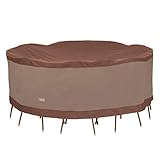


Ultimate covers generally use elasticized hems and adjustable straps with buckles to help keep them in place. The hem helps draw the cover around the furniture, while straps provide additional restraint in wind. These features help with a closer fit, but they do not make a loose or incorrectly sized cover storm-proof. A cover that balloons in gusts can still shift, strain seams, or expose furniture.
Check the product’s current listing for the precise fabric details, dimensions, and included pieces. Names and set configurations can vary by retailer or model, so don’t assume that every Ultimate set has identical specifications.
Compare common set types by layout and fit
The table below is a measuring guide, not a claim that every Duck Covers set is sold in these exact dimensions. Ultimate sets may bundle different cover shapes and sizes. Use the dimensions printed for the specific model you’re considering, then compare them with your furniture.
| Furniture situation | Useful measurement | Set type to look for | Fit check |
|---|---|---|---|
| Dining table and six chairs | Table: 72 × 42 in; chairs: about 24 × 24 in each | Dining set with a table cover and enough individual chair covers, or a table-and-chair cover combination | Allow room for chair backs and arms; confirm the set covers all six chairs |
| Compact bistro arrangement | Table: 30 × 30 in; chairs: about 22 × 22 in | Small dining or bistro set | A large dining-table cover may drag on the ground and catch wind |
| Sofa with two lounge chairs | Sofa: 78 × 35 in; chairs: 32 × 34 in each | Conversation set with separate sofa and chair covers | Check seat-back height and whether armrests add width |
| L-shaped sectional | Each leg: 90 in; overall depth: 35 in | Sectional-specific cover or compatible multi-piece set | Confirm whether the cover is shaped for an L or intended for separate sections |
| Mixed seating plus side table | Measure every item separately | Mixed set with covers matching each furniture type | Compare the item-by-item contents; a set may not include a side-table cover |
These example measurements are in inches and describe furniture, not cover specifications. For a practical fit, measure the furniture at its widest and tallest points, including arms, backs, and fixed cushions. Compare those measurements with the cover’s stated dimensions and shape. A small amount of clearance makes fitting easier, but excessive extra fabric is more likely to flap or collect water.
Pick by seating layout
For a conventional dining set
Look for a set that explicitly matches your table shape and chair count. A single large cover over the whole group can be convenient, but it may leave openings around the chairs or create a broad surface that catches wind. Individual covers take longer to put on, but let you cover only the pieces you’re storing outdoors. If the table has a market umbrella, check whether the cover accommodates it or whether the umbrella needs to be removed.
For a sofa-and-chair conversation area
A set with separate sofa and chair covers is usually easier to fit than trying to pull one oversized cover over an irregular cluster. Check the sofa’s total length and depth, not just the seat dimensions. Deep cushions, high backs, and wide arms can make a nominally similar sofa a poor match for a cover sized around a slimmer frame.
For a sectional or modular seating
Measure each section and the assembled footprint. If the set does not list a cover made for the sectional’s shape, separate covers for the individual modules may fit more reliably than a single rectangular cover. This approach also makes it easier to rearrange the seating, although it means more straps and seams to manage.
For a small patio or balcony
Choose covers close to the furniture’s actual size. Extra material can drag on a balcony floor, obstruct a walkway, or rub against a railing. A compact bistro set may be better served by its own small covers than by a bundle built around full-size dining furniture.
Measure and calculate before you buy
Use this simple check for each piece: cover length should accommodate the furniture’s longest horizontal dimension, cover width should accommodate its widest dimension, and cover height should clear its highest fixed point. For example, if a chair measures 31 inches wide at the arms, a cover listed at 29 inches wide is not a safe fit, even if its seat is narrower. Look for a larger compatible size rather than forcing the fabric over the arms.
Also check the cover’s stated shape. A rectangular cover may fit a rectangular table but sit poorly on a round one; a cover’s length and width alone don’t confirm a suitable fit. If your furniture has sloped backs or unusual contours, prioritize a compatible shape and fastening points over a close match to one measurement.
Comparison checklist: coverage, fastening, and ownership
- Coverage: Count the furniture pieces and confirm every cover is included. Bundles can vary, and a set name alone does not establish piece count.
- Weather protection: Match the cover to the exposure. A sheltered patio and a fully exposed, windy deck place different demands on fit and fastening.
- Fastening: Use the buckles or straps where provided and snug the elastic hem. Don’t overtighten straps against sharp furniture edges.
- Breathability: Let wet cushions and furniture dry before covering them. Even weather-resistant fabric cannot prevent moisture problems when damp items are sealed underneath.
- Drainage: Avoid leaving a broad, flat cover surface where rain can pool. Where the furniture design allows, keep the cover shaped so water can run off rather than settle in the middle.
- Wear points: Seams, corners, strap attachments, and areas rubbing against sharp edges typically deserve the closest inspection. Smooth or pad abrasive contact points before covering.
- Cleaning and storage: Follow the care instructions for the specific cover. Brush off debris and allow the fabric to dry before folding it away to reduce the chance of musty odors or mildew.
Which set is the best fit for your situation?
| Your situation | Better direction | Why |
|---|---|---|
| One fixed dining set, used outdoors daily | Dining bundle with a confirmed cover for each needed item | Consistent coverage is convenient when furniture stays in place |
| Furniture rearranged often | Separate covers for sofa, chairs, and tables | Individual pieces are easier to uncover or move independently |
| Irregular sectional layout | Sectional-specific cover or covers for separate modules | A standard rectangular cover can leave gaps or fit awkwardly |
| Wind-exposed patio | Close-fitting covers with usable straps and buckles | Fit and secure fastening matter more than excess coverage |
| Limited storage space | A set covering only the furniture you actually leave outside | Fewer oversized or unused covers are easier to store and maintain |
Bottom line
Among Duck Covers Ultimate multi-piece patio cover sets, the best choice depends on matching the bundle to your layout and verifying each cover’s dimensions and included pieces. Dining sets suit table-and-chair groups, separate conversation sets work well for sofas and lounge chairs, and sectionals usually need a shape-specific solution or individual module covers. Measure first, secure the straps without forcing the fit, and store covers dry: those steps do more to support long-term protection than choosing a bundle based on its piece count alone.