
Key takeaways
- Compare the best abrasive cleaning sticks for sanding belts, discs and drums, from full-size natural rubber sticks to compact multipacks for the shop.
What's inside
As an Amazon Associate I earn from qualifying purchases. This post may contain affiliate links at no extra cost to you.
A sanding belt rarely wears out before it clogs. Sawdust, pitch, gum, and glue pack into the spaces between the abrasive grains until the belt stops cutting and begins to burnish and burn the wood instead. An abrasive cleaning stick solves that problem in seconds: it is a solid block of natural rubber that you press lightly against a running belt, disc, or drum, and the soft rubber grabs the packed debris and pulls it out of the grit, leaving the abrasive cutting freely again.
Every pick below is the same basic tool in a different size or pack count, because that is what this product family offers. The real differences are stick length, cross-section, and how many sticks come in the pack, and those details decide how safely you can reach a wide drum, how long a stick lasts on a narrow belt, and whether a short stick suits a handheld sander. All five are natural rubber or rubber sticks sold for cleaning sanding belts and discs, and each one is used dry, with no liquid, brush, or soak involved.
As an Amazon Associate, we earn from qualifying purchases.
Quick answer
For most woodworkers, the POWERTEC 71002 is the default pick: a full-size 8-1/2 inch natural rubber stick sized for benchtop belt and disc sanders and wide drums. Choose the Peachtree two-pack if you run through sticks quickly, the short POWERTEC 71424-P2 four-pack for handheld sanders and detail work, and the TPmax or abrasticle single sticks as simple budget spares for a second sander station.
The picks
POWERTEC 71002 Abrasive Cleaning Stick, 8-1/2 Inch
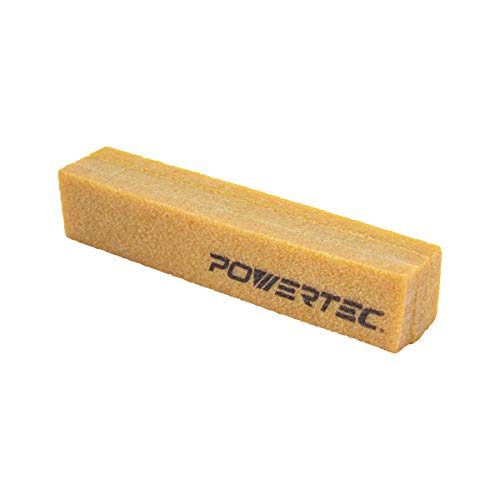
Specs
- :
- Dimensions: 8-1/2 x 1-1/2 x 1-1/2 inches
- Material: natural rubber
- Pack count: 1 stick
- Maker item number: 71002
- Intended abrasives: sanding belts, discs, and drums
The 71002 is the reference size in this family, and it earns the top spot on dimensions alone. The 8-1/2 inch length keeps your hand well back from a moving belt while the broad 1-1/2 inch square face covers a wide drum or a 6 inch disc in a few passes. POWERTEC positions it for belts, discs, and drum sanders, and the maker notes that it works best on cured or dry residue and is not intended for conveyor-feed sanders.
As a mid-range single stick, this is the one to leave mounted near a combination belt and disc sander, where clogging from pine and plywood glue lines is a daily event. The rubber wears down gradually as it cleans, so the generous cross-section gives it a long working life before it becomes too short to hold safely.
Peachtree Woodworking Supply Abrasive Cleaning Stick, 8 Inch, 2 Pack

Specs
- :
- Dimensions: 1-1/2 x 1-1/2 x 8 inches per stick
- Material: rubber
- Pack count: 2 sticks
- Intended abrasives: sanding belts and discs
Peachtree Woodworking Supply sells its cleaning stick as a two-pack of 8 inch blocks, which suits a shop with more than one sanding station. Keep one beside the benchtop belt sander and the second at the disc sander or in the drawer with the random orbit discs, and no station waits while a single stick is borrowed and forgotten elsewhere.
Each stick carries the same 1-1/2 inch square profile as the full-size singles above, so the cleaning face and the grip feel familiar. As a mid-range pack, it is the sensible buy for anyone who sands resinous stock often enough that a stick is a consumable rather than an occasional rescue tool.
TPmax Abrasive Cleaning Eraser Stick, 8 Inch

Specs
- :
- Dimensions: 8 x 1.5 x 1.5 inches (40 x 40 x 200 mm)
- Material: natural rubber
- Pack count: 1 stick
- Intended abrasives: sanding belts and discs
The TPmax stick matches the classic 8 inch format almost exactly: a natural rubber block with a square 1.5 inch cross-section. Its listing covers sanding belts and discs, and the same rubber face also freshens grip tape and rough tape, which makes it a handy crossover pick for a shop that shares space with other hobbies.
This is a budget-tier single with no extras, and that is its appeal. It cleans the same way the bigger-name sticks do, because the working material is the same natural rubber, and it drops into a toolbox drawer as a spare without taking up much room. If a stick goes missing or wears down mid-project, this is the low-commitment replacement.
abrasticle Abrasive Cleaning Eraser Stick, 8 Inch

Specs
- :
- Dimensions: 1-1/2 x 1-1/2 x 8 inches
- Material: rubber
- Pack count: 1 stick
- UPC: 703361439198
- Intended abrasives: sanding belts, discs, and sandpaper sheets
The abrasticle stick is another full-size 8 inch block, sold as a single and aimed at belts, discs, and sandpaper generally. Its published profile matches the standard square section, so it sits flat against a disc and tracks steadily along a belt without rocking onto an edge.
In the budget tier, the choice between this stick and the TPmax above comes down to which listing you find in stock on the day. Both do the same job with the same technique: light pressure, a moving abrasive, and a few passes until the grains show clean and sharp again. Having a second brand in the drawer also means a worn stick never delays a glue-up sanding session.
POWERTEC 71424-P2 Abrasive Cleaning Stick, 4-1/2 Inch, 4 Pack

Specs
- :
- Dimensions: 4-1/2 inch stick length
- Material: rubber
- Pack count: 4 sticks
- Maker item number: 71424-P2
- Intended abrasives: sanding belts and discs
Not every cleaning job wants a long stick. The 71424-P2 pack holds four sticks of 4-1/2 inches each, a handier length for handheld belt sanders, small disc sanders, spindle sleeves, and the tight quarters around a drill-press sanding drum. The shorter block is easier to control with one hand while the other steadies the tool.
Because the pack holds four, it also works as a staged supply: one in use, one trimmed square when the working end rounds over, and spares ready to go. Treat this as the premium multipack of the group in terms of sheer rubber volume, and the natural pick for detail sanding stations where a full-size stick feels clumsy.
How to choose
Begin with the abrasive you clog most often. Wide belts, 6 inch and larger discs, and drum sanders reward a full-size stick of 8 inches or more, because the long block bridges the surface and keeps fingers away from the moving abrasive. Handheld belt sanders, small discs, and spindle sleeves are easier to clean with the 4-1/2 inch sticks, which fit into tighter spaces and respond to lighter, more controlled pressure.
Pack count is the second decision. A single stick lasts a long time in a hobby shop that sands on weekends, since each cleaning pass shaves only a thin layer of rubber away. A production bench, a school shop, or anyone sanding pine, spruce, and plywood all week will move through sticks faster, and a two-pack or four-pack avoids a mid-job pause.
Technique matters more than brand. Run the sander, rest the stick lightly on the moving abrasive, and let the rubber do the work without forcing it; heavy pressure only wears the stick faster and can glaze the surface. Work across the full width so the abrasive cleans evenly, and switch the machine off before inspecting the result. The makers of these sticks are consistent on two limits: they work best on dry, cured residue, and they are not made for conveyor-feed wide-belt sanders, where the abrasive should be cleaned or changed following the machine maker’s own guidance.
Finally, retire a stick when it gets short. Once a block is down to a stub that brings your fingers near the belt, trim it for hand use on sheet abrasives or replace it, and never hold a stick in a way that lets the moving belt pull it from your grip.
Who should skip
Skip the cleaning stick entirely if your abrasives are torn, glazed from heat, or worn smooth; a stick removes packed debris, and it cannot restore grain that is gone. Torn belts and discs with bald patches need replacing, not cleaning. If you sand mostly metal, be aware that swarf behaves differently from sawdust and a rubber stick is a wood-shop tool first. And if your only sander is a conveyor-feed machine, follow the machine maker’s cleaning method instead, since these sticks are not intended for that equipment.
FAQ
How often should a sanding belt be cleaned with a stick?
Clean the belt as soon as cutting slows and the surface looks loaded with packed dust or shiny patches of pitch. A few light passes at that point restore the cut; waiting until the belt burns the wood means heat may already have damaged the abrasive.
Can a cleaning stick be used on sanding discs and drums?
Yes. Every pick above is sold for belts and discs, and the full-size sticks also suit drum sander abrasives. Use the same light pressure and keep the stick moving across the surface so one spot does not wear faster than the rest.
Does a cleaning stick work on wet or sticky residue?
The makers describe these sticks as working best on cured or dry residue. Fresh glue squeeze-out, wet finish, and uncured resin should be allowed to dry first, or removed by other means, because soft sticky material smears into the rubber instead of lifting out of the grit.
When is a cleaning stick worn out?
A stick is worn out when it becomes too short to hold safely clear of the moving abrasive, or when its face is so rounded and glazed that it no longer bites into the packed debris. Trimming a fresh flat face extends its life; a short stub can finish its days cleaning sheet abrasives by hand.
Final verdict
An abrasive cleaning stick is one of the simplest consumables in the shop, and the differences among these five are size and pack count rather than chemistry. The POWERTEC 71002 remains the best default for benchtop machines, the Peachtree two-pack covers multi-station shops, the POWERTEC 71424-P2 four-pack wins for handheld and detail sanders, and the TPmax and abrasticle singles are honest budget spares. Buy the size that matches your widest abrasive, clean early and lightly, and your belts and discs will cut far longer before they need replacing.
Product and ASIN Reference
| Name | ASIN |
|---|---|
| POWERTEC 71002 Abrasive Cleaning Stick, 8-1/2 Inch | B00AJW0CY8 |
| Peachtree Woodworking Supply Abrasive Cleaning Stick, 8 Inch, 2 Pack | B0DPJ3SJ34 |
| TPmax Abrasive Cleaning Eraser Stick, 8 Inch | B08CNNM96B |
| abrasticle Abrasive Cleaning Eraser Stick, 8 Inch | B08YCW8XZR |
| POWERTEC 71424-P2 Abrasive Cleaning Stick, 4-1/2 Inch, 4 Pack | B0CHVT64X1 |
Related guides
More from Amazon
Programs that pair well with the guide above. Offers and eligibility are set by Amazon and may change.
A free business account with business pricing and bulk-buying tools for work, shop or home office.
Create a business accountFree shipping on eligible items, Prime Video and more. Eligible new members can start with a free trial.
Start a Prime free trialAudiobooks and podcasts to listen to on the go. Eligible new members can start with a free trial.
Try Audible freeAd-free music streaming. Eligible new subscribers can start with a free trial.
Try Music Unlimited freeAs an Amazon Associate we earn from qualifying purchases.

Write Your Review
No reviews yet. Be the first to share your experience!