Best 1/4-Inch Router Bit Sets for Detail Work and Small Routers
What's inside
- Best 1/4-Inch Router Bit Sets for Detail Work and Small Routers
- Quick picks by situation
- What matters more than the piece count
- Comparison: match the set to the work
- When a 1/4-inch set is the right choice
- A simple way to avoid paying for unused bits
- Before buying: check these details
- Keeping small bits cutting cleanly
- Related Guides
- Best 1/4-Inch Router Bit Sets for Detail Work and Small Routers
- Quick picks by situation
- What matters more than the piece count
- Comparison: match the set to the work
- When a 1/4-inch set is the right choice
- A simple way to avoid paying for unused bits
- Before buying: check these details
- Keeping small bits cutting cleanly
- Related Guides
As an Amazon Associate I earn from qualifying purchases. This post may contain affiliate links at no extra cost to you.
Contents
- Best 1/4-Inch Router Bit Sets for Detail Work and Small Routers
- Quick picks by situation
- What matters more than the piece count
- Comparison: match the set to the work
- When a 1/4-inch set is the right choice
- A simple way to avoid paying for unused bits
- Before buying: check these details
- Keeping small bits cutting cleanly
- Related Guides
Best 1/4-Inch Router Bit Sets for Detail Work and Small Routers
The best 1/4-inch router bit set for detail work is a compact set that matches the profiles you’ll actually use, has sharp carbide cutting edges, and fits your router’s 1/4-inch collet without adapters. For most occasional projects, choose a modest set with straight, roundover, chamfer, and flush-trim bits; buy larger or more specialized sets only when a project calls for their extra profiles.
Quick picks by situation
- Small shop or first router: Choose a 10–15-piece set with common edge and straight-cutting profiles. It takes less space and avoids paying for duplicates or specialty bits.
- Furniture and cabinet details: Look for a set with several roundover sizes, a chamfer bit, a flush-trim bit, and a bearing-guided pattern bit. Check each bit’s cutting diameter and bearing arrangement before buying.
- Frequent production work: A smaller, higher-quality selection may be a better investment than a large assortment. Replace heavily used bits individually so one worn profile doesn’t dictate a full-set replacement.
- Router with only a 1/4-inch collet: Buy bits with a 1/4-inch shank. A 1/2-inch shank bit cannot be made compatible by using an adapter.
What matters more than the piece count
Profiles you’ll use
Sets often count every size of a profile as a separate bit. A 24-piece set may include several straight bits and multiple edge profiles, yet still lack the one flush-trim size your work requires. Before comparing counts, list your likely jobs: grooves, dados, laminate trimming, edge easing, or decorative edging. Then confirm the set includes the corresponding cutters and useful sizes.
As an Amazon Associate we earn from qualifying purchases at no extra cost to you.
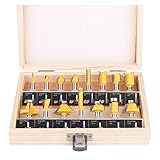
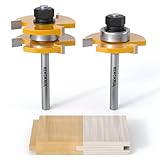


For general small-router work, a practical starter selection is a few straight bits, two or three roundovers, a chamfer, and one or two bearing-guided bits. If you mostly cut grooves, prioritize straight-bit diameters and cutting lengths instead of decorative profiles.
Carbide and cutting-edge quality
Many router bits use carbide-tipped edges brazed to a steel body. Carbide holds an edge longer than ordinary steel, but the word “carbide” alone doesn’t tell you how cleanly a bit is made or how long it will last. Look for consistent brazing, smooth shanks, cleanly ground edges, and a stated carbide construction. Micrograin carbide is commonly used for fine cutting edges; solid-carbide bits are a different construction, often found in smaller specialty cutters.
Wood species, feed rate, and heat matter as much as the set label. Dull edges, resin buildup, and rubbing from feeding too slowly can all contribute to burning. A clean, sharp mid-range bit used correctly may outperform a premium bit that is overheated or clogged.
Case organization
A useful case holds each bit securely, labels its profile and size, and leaves enough room to remove it without gripping the cutting edge. A case that identifies bits only by row makes replacement and setup slower. Check whether the layout records cutting diameter and cutting length, not just the profile name. Keep the manufacturer’s chart if the case markings are incomplete.
Comparison: match the set to the work
| Set type | Typical contents | Best for | What to check |
|---|---|---|---|
| Compact starter, about 10–15 pieces | Straight bits, roundovers, chamfer, basic bearing-guided cutter | Occasional repairs, shelves, small furniture, learning | Exact diameters, included flush-trim size, labeled storage |
| General-purpose, about 20–30 pieces | More straight-bit sizes and several edge profiles | Mixed shop projects with recurring routing tasks | Whether extra pieces add useful sizes or repeat profiles you own |
| Specialty profile set, often 6–12 pieces | Matched cutters for a specific joint or decorative edge | A planned project or repeated production detail | Required router speed, minimum material thickness, and setup instructions |
| Individual replacement bits | One selected profile and size | Replacing a worn cutter or filling a specific gap | Shank diameter, cutting dimensions, bearing size, and compatibility |
Piece counts vary by manufacturer, and some sets include accessories in the total. Treat the ranges above as shopping categories, not fixed product specifications. Compare the actual bit list and dimensions on the package.
When a 1/4-inch set is the right choice
A 1/4-inch shank is a natural fit for compact routers and many trim routers. It also makes sense for light-duty detail work where the router and cutter are appropriately sized for the task. The trade-off is reduced shank stiffness compared with a 1/2-inch shank, so avoid heavy cuts, excessive projection, or forcing a small router through thick stock. Take multiple shallow passes when the cut is substantial.
For shoppers searching for the best 1 2 inch shank router bit sets, the same selection principles apply, but those bits require a router with a matching 1/2-inch collet. A 1/2-inch shank generally offers more rigidity for larger cutters and demanding work. It is not an upgrade that fits every small router: confirm the router’s collet size before purchasing, and don’t assume a 1/4-inch collet accepts a larger shank.
A simple way to avoid paying for unused bits
Make a short project list and count the profiles you genuinely need. For example, suppose you expect to use only six profiles from a 24-piece set, and a compact set covers five of them. If the large set costs roughly $60–$100 and the compact option costs roughly $25–$50, the price difference buys little if the additional profiles will stay in the case. These are broad market ranges, not quotes; brand, materials, and set contents change prices.
Instead of dividing cost by total pieces, divide it by the bits you expect to use: a $72 set with six useful bits costs $12 per useful bit; a $36 set with five useful bits costs $7.20 per useful bit. That calculation doesn’t measure cutting quality, but it helps reveal when a large count is poor value for your workload.
Before buying: check these details
- Collet: Confirm the router accepts a 1/4-inch shank and that the collet is clean and undamaged. Insert the shank to the manufacturer’s recommended depth; don’t bottom it out.
- Dimensions: Compare cutting diameter, cutting length, and overall length with the router’s capacity and the job. A profile name alone isn’t enough to confirm fit.
- Bearings: For guided cuts, verify bearing location and diameter. A bearing that is too large or too small changes the cut relative to the template or workpiece edge.
- Router speed: Follow the bit and router manufacturers’ speed guidance. Larger-diameter cutters generally call for lower speeds than small bits.
- Contents: Check whether the set includes a useful storage case and a clear dimension chart. Don’t count a case or accessory as an additional cutting profile.
Keeping small bits cutting cleanly
Small cutters can dull or overheat quickly when pushed too hard. Use a stable workpiece, keep the cutter clean of pitch and resin, and make shallow passes rather than trying to remove too much material at once. Feed steadily: hesitation can leave burn marks, while forcing the router can strain the bit and motor. Disconnect the router before changing bits, and inspect the shank and cutting edges for damage.
For most buyers, the best 1 4 inch router bit set is not the largest one. It’s the set with the right handful of profiles, clear dimensions, sound carbide edges, organized storage, and a shank that matches the router. Choose by the work you do—not by the number printed on the case.