Best Router Bits for Guitar Bodies: Clean Templates and Contours
What's inside
- Quick choice: which bit suits your guitar project?
- Flush-trim versus pattern bits
- The specifications that matter most
- Recommended bit types by routing job
- A controlled setup for clean template routing
- Edge quality: bit choice is only part of the result
- Durability and ownership costs
- Bottom line
- Related Guides
- Quick choice: which bit suits your guitar project?
- Flush-trim versus pattern bits
- The specifications that matter most
- Recommended bit types by routing job
- A controlled setup for clean template routing
- Edge quality: bit choice is only part of the result
- Durability and ownership costs
- Bottom line
- Related Guides
As an Amazon Associate I earn from qualifying purchases. This post may contain affiliate links at no extra cost to you.
The best router bit for a guitar body is usually a 1/2-inch-shank flush-trim or pattern bit with a 1/2-inch-diameter bearing, a 1-inch to 1-1/4-inch cutting length, and a sharp carbide cutter matched to your template thickness.
As an Amazon Associate we earn from qualifying purchases at no extra cost to you.



Contents
- Quick choice: which bit suits your guitar project?
- Flush-trim versus pattern bits
- The specifications that matter most
- Recommended bit types by routing job
- A controlled setup for clean template routing
- Edge quality: bit choice is only part of the result
- Durability and ownership costs
- Bottom line
- Related Guides
Quick choice: which bit suits your guitar project?
| Situation | Best choice | Why | Main limitation |
|---|---|---|---|
| Template sits on top of the blank | Top-bearing pattern bit | The bearing follows the template while the cutters remove material below it | Template must be securely fixed and thick enough to support the bearing |
| Template sits beneath the workpiece | Bottom-bearing flush-trim bit | The bearing follows the template from underneath and leaves the top surface unobstructed | Requires safe access beneath the body and careful support |
| One bit must handle several template thicknesses | Long pattern bit, about 1-1/4 inches cutting length | Provides more usable height for thick templates and body blanks | More exposed cutter increases leverage, vibration, and tear-out risk |
| Small cavities, pickup routes, or tight contours | 1/4-inch-shank, 1/4-inch-diameter pattern bit | Compact cutter reaches smaller radii and is easier to control in confined areas | Less rigid than a 1/2-inch-shank bit and typically has a shorter cutting length |
| Frequent body building or hard woods | 1/2-inch-shank carbide pattern bit | Greater rigidity, heat capacity, and resistance to deflection | Needs a router with a compatible 1/2-inch collet |
Flush-trim versus pattern bits
For guitar bodies, “flush-trim bit” and “pattern bit” often describe nearly the same routing operation: the bearing follows a template and the cutters trim the workpiece to match it. The practical difference is usually bearing placement.
Top-bearing pattern bits
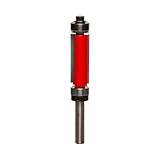
A top-bearing pattern bit places the bearing above the cutting edges, toward the router body. It is the natural choice when the template is fixed on top of the guitar blank. The bearing contacts the template, and the cutters reproduce its outline in the wood below.
This arrangement is useful for a first pass when the body blank is oversized. Remove most of the waste with a bandsaw or jigsaw, leaving roughly 2 to 3 mm outside the template. The router then has less material to remove, reducing heat, noise, and the chance of forcing the bit into the template.
Bottom-bearing flush-trim bits
A bottom-bearing flush-trim bit places the bearing below the cutters, toward the collet. It works well when the template is attached underneath the body blank or when the top surface must remain clear for clamping and inspection.
Bottom-bearing bits are also useful for copying a previously routed body or transferring a template from one side of a blank to the other. The disadvantage is visibility: the bearing and lower portion of the setup may be harder to see, especially on a large guitar body. Make sure the workpiece is fully supported and that clamps cannot enter the router’s path.
The specifications that matter most
Bearing diameter and cutting diameter
A 1/2-inch cutting diameter is a dependable general-purpose size for body outlines. A 1/2-inch bearing paired with a 1/2-inch cutter creates a true flush-trimming relationship: wherever the bearing touches the template, the cutter follows the same line.
Some bits use a smaller bearing than the cutter. These are not ordinary flush-trim bits. They can create a stepped or offset cut, which is useful for rabbets and decorative work but unsuitable when the body must exactly match the template. Check both diameters rather than assuming that a bit labeled “pattern” is automatically a zero-offset cutter.
Cutting length
Cutting length should cover the template, the body blank, and any intended overlap. Common useful lengths are:
- 1/2 to 3/4 inch: good for thin templates, pickup cavities, control routes, and shallow cleanup passes.
- 1 inch: a versatile size for many electric-guitar body blanks and standard template setups.
- 1-1/4 inches: useful when the template and blank together exceed 1 inch, or when you want to make the outline in multiple height-adjusted passes.
- 1-1/2 inches or more: specialized for thick assemblies; it demands especially careful setup because more cutter is exposed.
Do not plunge the entire cutting length into the wood simply because the bit has that capacity. A long bit should usually be used in staged passes. Exposing only the section needed for the current pass improves control and reduces the bending force on the shank.
Shank size
A 1/2-inch shank is the preferred choice for full-size guitar-body routing when your router accepts it. Compared with a 1/4-inch shank, it resists deflection and vibration better, particularly with long cutters, dense maple, ash, or repeated production work.
A 1/4-inch shank remains practical for compact routers, small cavities, and light template work. Keep the cutting length modest and avoid aggressive side pressure. A 1/4-inch shank is not automatically unsafe, but it provides less margin if the bit is extended far from the collet.
Recommended bit types by routing job
Body perimeter
Choose a 1/2-inch-diameter, 1/2-inch-shank pattern or flush-trim bit with a 1-inch cutting length for a standard body outline. If the template and blank are thicker, select a 1-1/4-inch version and divide the cut into two or more passes.
Pickup and control cavities
A 1/4-inch or 3/8-inch-diameter top-bearing pattern bit offers better access at corners and narrow cavities. A 1/2-inch bit removes material faster, but its radius may prevent it from reaching the square-looking corners of a pickup template. Remember that a round router bit cannot create a sharper internal corner than its own radius; finish those corners with a chisel if the design requires it.
Neck pocket
Use a short, rigid pattern bit for the final pocket dimensions. A bit with a 1/2-inch shank and approximately 3/4-inch cutting length is often easier to control than an unnecessarily long cutter. Make shallow depth passes and verify the neck fit before reaching final depth.
A controlled setup for clean template routing
- Secure the template. Use reliable clamps, screws in waste areas, or quality double-sided woodworking tape. The template must not shift when the bearing contacts it.
- Remove most waste first. Saw within 2 to 3 mm of the template line. Routing away a full band of waste places more load on the bit and increases the chance of burning.
- Set the collet correctly. Insert the shank fully, then withdraw it slightly—about 1 to 2 mm—so it does not bottom out. Tighten with the correct wrench and never operate with only a small portion of the shank engaged.
- Make shallow passes. For a thick body, remove approximately 3 to 6 mm per pass, depending on the wood, router power, and bit diameter. Keep the bearing in contact with the template throughout the cut.
- Route in the correct direction. With a handheld router, the normal safe feed is generally against the cutter’s rotation. A climb cut can pull the router forward and should be reserved for carefully controlled light cleanup situations, not broad body-outline cuts.
- Inspect after each pass. Look for bearing marks, fuzzy grain, burning, or a template gap before proceeding. Correcting a loose template early is easier than repairing an inaccurately shaped body.
Edge quality: bit choice is only part of the result
Sharp carbide edges produce cleaner cuts, but grain direction still controls tear-out. On convex outside curves, the safest feed direction can change relative to the grain. When a section begins to lift fibers, stop and approach that area from the opposite end, or leave a thin final allowance and make a light finishing pass.
Hard maple and figured woods deserve special care. A slower feed can improve the finish, but feeding too slowly while removing a heavy cut creates heat and burning. Use a sharp bit, a moderate depth of cut, and allow the router to maintain its normal operating speed.
A compression bit can help with laminated or veneered construction, but it is not a substitute for a bearing-guided template bit. For a solid guitar body outline, a conventional carbide pattern bit is usually simpler and easier to inspect.
Durability and ownership costs
The bearing commonly becomes the first part to show problems. Dust can contaminate its seals, while adhesive residue from template tape can increase friction. Before each project, spin the bearing by hand and check for roughness or side play. Do not lubricate it with a heavy oil that can attract abrasive dust; replace a noisy or loose bearing.
Carbide edges eventually dull, especially after routing abrasive woods, plywood glue lines, or dirty reclaimed material. Cleaning pitch and resin with a suitable bit cleaner can extend service life, but never scrape carbide with steel or expose it to a cleaner that damages brazing or bearing seals.
As a simple cost calculation, suppose a 1/2-inch-shank bit costs $35 to $70 and remains sharp for approximately 20 to 40 guitar-body projects under moderate use. Its cutter cost is roughly $0.88 to $3.50 per body, before sharpening or replacement. A cheaper bit that requires early replacement may cost more per usable cut than a well-made carbide bit with a replaceable bearing.
Bottom line
For most builders, the best router bit for guitar body outlines is a 1/2-inch-shank, 1/2-inch-diameter bearing-guided pattern bit with a 1-inch cutting length. Choose a top-bearing model when the template is on top, a bottom-bearing flush-trim model when the template is underneath, and a shorter 1/4-inch or 3/8-inch bit for cavities and tight details. Prioritize correct bearing placement, adequate but not excessive cutting length, a rigid shank, and staged passes over the longest or most aggressive cutter available.