
Key takeaways
- Compare the best dowel plates for sizing shop-made dowels, with hole counts, size ranges, steel grades and plate thickness for A2, HSS and carbide picks.
What's inside
As an Amazon Associate I earn from qualifying purchases. This post may contain affiliate links at no extra cost to you.
A dowel plate is a flat steel plate pierced with a row of accurately sized holes. You rip a blank slightly oversize, chamfer its corners, and drive it through the hole that matches your target diameter; the edge of the hole shaves the blank round as it passes. The result is a dowel in whatever species the project is built from, including offcuts of walnut, cherry or maple that no store-bought dowel rod will ever match.
The five plates below cover the formats a furniture shop is likely to meet. Four are classic bench plates with 17 holes in the English system, running from 1/8 to 5/8 inch, in A2 tool steel or high speed steel. The fifth is a lathe-mounted plate with carbide inserts that cuts metric dowels a different way. Every pick here is a dowel-making plate only, not a pin, a transfer plug or a drilling jig.
As an Amazon Associate, we earn from qualifying purchases.
Quick answer
For most shops, the DFM Tool Works plate is the first pick: A2 tool steel, 17 holes from 1/8 to 5/8 inch in fine 1/32 inch steps, made in the USA with mounting screws included. Choose the SYWAN or Sgifthome plates for the same layout in the budget tier, the Creker plate for high speed steel, and the Mavaol plate only if you work on a lathe in metric sizes.
The picks
DFM Tool Works Doweling Tool, English 17 Holes
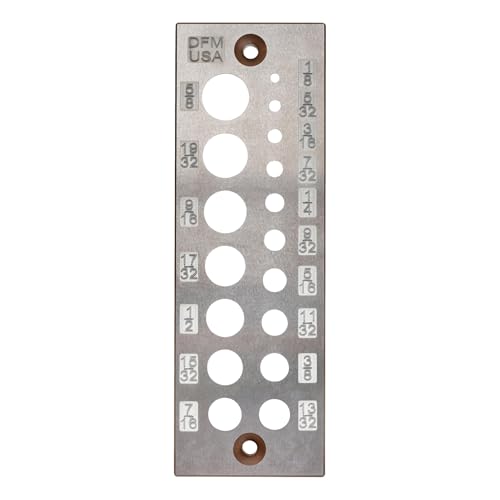
The DFM plate is the premium pick of this group and the one most often recommended for serious furniture work. It is machined from American-made A2 tool steel, a grade chosen because it hardens well and holds a clean cutting edge around each hole, and it is made in the USA. The layout carries 17 holes covering 1/8 to 5/8 inch, stepped finely enough that the diameter you need for a slip fit or a glue fit is almost always on the plate.
The listing includes mounting screws, so the plate can be fixed over a relief hole in a bench block or set over a dog hole for temporary use. At 15.5 ounces it has the heft of a tool meant to stay put under hammer work rather than skate across the bench. If you make dowels regularly, in hardwoods that dull lesser plates, this is the plate to buy once and keep.
Specs
- Holes: 17
- Size range: 1/8 to 5/8 inch, in 1/32 inch increments
- Material: A2 tool steel
- Origin: made in the USA
- Included components: mounting screws
- Item weight: 15.5 ounces
- Model: DFMA2STD17
- Brand: DFM Tool Works
SYWAN A2 Steel Dowel Plate, 17 Holes

The SYWAN plate follows the classic bench format at a mid-range tier. It is A2 steel with 17 holes running from 1/8 inch to 5/8 inch, so it covers the same spread of furniture dowel sizes as the premium pick above. The maker’s instructions describe the working method plainly: fix the plate to the bench, trim the blank close to straight with a chisel, chamfer the leading corners, then tap the blank through the nearest hole and step down hole by hole until the dowel reaches its finished size.
The published dimensions make it easy to plan a bench block around: 6 inches long, 2 inches wide and 0.39 inch thick, at 14.9 ounces. That thickness matters, because a thicker plate supports the blank over a longer cutting land and tends to produce a straighter dowel than a thin stamping. For a shop that makes dowels a few times a month rather than every day, this plate covers the work at a lower tier.
Specs
- Holes: 17
- Size range: 1/8 to 5/8 inch
- Material: A2 steel
- Plate dimensions: 6 x 2 x 0.39 inches
- Item weight: 14.9 ounces
- Brand: SYWAN
Sgifthome A2 Steel Dowel Plate, 17 Holes

The Sgifthome plate is the budget-tier route into the same 17-hole English layout. Its listing describes a high-grade A2 steel plate with holes from 1/8 to 5/8 inch in 1/32 inch increments, aimed at making slim dowels and peg plugs in matching sizes. The fine stepping is the detail to note at this tier, since many budget plates jump in coarse 1/16 inch steps and leave common sizes missing.
Published figures are limited to the package record: 7.01 x 2.4 x 0.87 inches packaged and 14.8 ounces in weight, in line with the other full-size plates in this group. Treat it as the plate for occasional dowel making, peg plugs for drawbore joints, and sizing bought dowel rod down to a true diameter.
Specs
- Holes: 17
- Size range: 1/8 to 5/8 inch, in 1/32 inch increments
- Material: A2 steel
- Package dimensions: 7.01 x 2.4 x 0.87 inches
- Item weight: 14.8 ounces
- Brand: Sgifthome
Creker High Speed Steel Dowel Plate, 17 Holes

The Creker plate is the high speed steel option in this group. High speed steel is the grade more often seen in cutting tools that run hot, and in a dowel plate it promises an edge that resists the abrasion of dense, silica-heavy hardwoods. The layout is the familiar English system set: 17 holes spanning 1/8 to 5/8 inch, so it swaps directly into the same bench block and the same workflow as the A2 plates above.
Because the published record for this listing is thinner than the others, the details printed here are the ones its record supports: the steel grade, the hole count and range, and its model designation. Shops that drive many dowels in white oak, hickory or tropical species, and who have watched a softer plate lose its bite, are the audience for this mid-range pick.
Specs
- Holes: 17
- Size range: 1/8 to 5/8 inch
- Material: high speed steel
- System: English
- Model: CR-HOME-026-027
- Brand: Creker
Mavaol Lathe Dowel Plate, 8 Holes with Carbide Inserts

The Mavaol tool takes the dowel plate idea onto the lathe. Instead of driving a blank through a fixed hole with a mallet, you mount this aluminium alloy plate on the lathe and turn stock down through one of eight holes, each fitted with an indexable carbide insert that does the cutting. Loosen a screw, set the holder to the diameter you need, lock it, and the insert shears the blank round as it turns.
The eight holes are metric, running 8, 9, 10, 12, 15, 16, 18 and 20 mm, which suits shops that already work in metric sizing or turners making dowels and pegs as part of a turning session. The inserts are a standard 15 x 15 x 2.5 mm format, so a dull edge can be rotated or replaced rather than honed in place, and the package includes a blade wrench, an adjusting wrench and fixing screws. It sits in its own format tier: not a bench plate at all, but the right shape of tool if your dowel making happens at the lathe.
Specs
- Holes: 8
- Size range: 8, 9, 10, 12, 15, 16, 18 and 20 mm
- Body material: aluminium alloy
- Cutting edges: indexable carbide inserts, 15 x 15 x 2.5 mm
- Finish: anodized
- Included: blade wrench, adjusting wrench, fixing screws
- Brand: Mavaol
How to choose
Hole count and stepping come first. A 17-hole plate that moves in 1/32 inch increments between 1/8 and 5/8 inch lets you sneak up on a diameter, driving the blank through a hole or two above the target before the final pass, which leaves a cleaner surface than one heavy cut. A plate with coarse steps forces the final hole to do all the work, and the dowel comes out rougher for it.
Steel grade comes second. A2 tool steel is the proven plate material: hard, tough, and able to be honed flat on a stone when the top face needs refreshing. High speed steel trades a little of that honing ease for abrasion resistance in gritty hardwoods. Either outlasts the unhardened mild steel found in the thinnest stampings, which can bell out at the hole mouths after heavy use.
Thickness and mounting come third. Look for a plate around 3/8 inch thick or better, and plan how it will sit: screwed over a relief hole in a bench block, or clamped over a dog hole. A plate that shifts under the mallet makes tapered dowels. Finally, match the system to your work: English plates suit shops whose bits and bought dowels are inch sized, while the lathe plate only makes sense if your sizing is metric and your workflow is at the lathe.
Who should skip
Skip dowel plates entirely if you use dowels only in the common bought sizes and your local supplier stocks them in the species you need, because a plate earns its keep by making sizes and woods that are not on the shelf. Skip them as well if your joinery runs on a doweling jig with bought pins, loose tenons or pocket screws, since none of those need shop-made rod.
Also skip the lathe plate if you do not own a lathe, and skip the fine-stepped 17-hole plates if you only ever need one or two diameters for pegs; a smaller, simpler plate covers that work. Finally, skip any plate whose largest hole falls short of the biggest dowel you plan to make, and check the top size on the listing before you buy.
FAQ
How do you make a dowel with a dowel plate?
Rip or plane a blank slightly larger than the finished diameter, chamfer the corners of the leading end, and set the plate over a relief hole in a bench block. Drive the blank through the largest hole that will accept it, then work down one hole at a time until it passes through the target hole, which shaves it to a round dowel of that size.
Why does a dowel plate have so many holes?
The extra holes are working steps, not just spare sizes. Stepping down gradually removes less wood per pass, so the dowel stays straighter and the surface comes off the plate smoother. The wide range also means one plate covers everything from thin 1/8 inch pegs to 5/8 inch stock for frame joinery.
Can a dowel plate resize a store-bought dowel?
Yes. Bought dowel rod is often slightly oversize or uneven, and passing it through the matching hole trues it to an exact diameter for a predictable fit. It also lets you take a rod down one step, for example from 3/8 inch to 11/32 inch, when a joint needs a looser glue fit than the shelf size gives.
How do you maintain a dowel plate?
Keep the plate oiled so the faces do not rust in a damp shop, and clear chips out of the holes after a session. If the cutting edges dull, the top face of an A2 or high speed steel plate can be lapped flat on a sharpening stone to restore the edge where the face meets each hole. Carbide inserts on a lathe plate are rotated or replaced instead.
Final verdict
For a plate that will live on the bench for years, the DFM Tool Works plate is the pick to buy first, with A2 steel, fine 1/32 inch stepping and mounting screws in the box. The SYWAN and Sgifthome plates deliver the same 17-hole English layout at mid-range and budget tiers, the Creker plate suits shops that want high speed steel for abrasive hardwoods, and the Mavaol plate is the format pick for turners who would rather cut metric dowels at the lathe than drive them at the bench.
Product and ASIN Reference
| Name | ASIN |
|---|---|
| DFM Tool Works Doweling Tool, English 17 Holes | B07Q4RY3T7 |
| SYWAN A2 Steel Dowel Plate, 17 Holes | B0BVFZLF9F |
| Sgifthome A2 Steel Dowel Plate, 17 Holes | B0CP7PXRB8 |
| Creker High Speed Steel Dowel Plate, 17 Holes | B084M65PH9 |
| Mavaol Lathe Dowel Plate, 8 Holes with Carbide Inserts | B0F8YT749V |
Related guides
More from Amazon
Programs that pair well with the guide above. Offers and eligibility are set by Amazon and may change.
A free business account with business pricing and bulk-buying tools for work, shop or home office.
Create a business accountFree shipping on eligible items, Prime Video and more. Eligible new members can start with a free trial.
Start a Prime free trialAudiobooks and podcasts to listen to on the go. Eligible new members can start with a free trial.
Try Audible freeAd-free music streaming. Eligible new subscribers can start with a free trial.
Try Music Unlimited freeAs an Amazon Associate we earn from qualifying purchases.

Write Your Review
No reviews yet. Be the first to share your experience!