Fixed Base Router Buying Guide: Best Models for Accurate Routing
What's inside
As an Amazon Associate I earn from qualifying purchases. This post may contain affiliate links at no extra cost to you.
The best fixed base router for most woodworkers is a 2.25-hp, variable-speed model with both 1/4-inch and 1/2-inch collets, a rigid base, and a fine height-adjustment system; choose a compact 1–1.25-hp router for edge work and a heavier model when you regularly cut dados or use a router table.
As an Amazon Associate we earn from qualifying purchases at no extra cost to you.


Contents
What is a fixed base router?
A fixed base router holds the motor at a set height while the bit spins. You adjust the cutting depth before routing, lock the motor in position, and guide the base along the workpiece, a straightedge, template, or router-table insert. Unlike a plunge router, it does not allow the bit to descend into the material during the cut.
That fixed geometry makes this type of router particularly predictable for rabbets, roundovers, chamfers, pattern trimming, edge profiles, and repeated cuts. It is also usually easier to mount in a router table than a plunge-only model.
Fixed base router choices by situation
| Typical situation | Recommended specification | Suitable example | Why it fits |
|---|---|---|---|
| Occasional edge work in a small shop | 1–1.25 hp, 1/4-inch collet, about 3–4 lb | Makita RT0701C or Bosch Colt PR20EVS | Light, maneuverable, and adequate for trim, hinge recesses, and small profiles |
| One general-purpose router for furniture work | 2.25 hp, variable speed, 1/4- and 1/2-inch collets | Bosch 1617EVS or DeWalt DW618 | Handles common bits, dados, joinery, and most edge profiles |
| Frequent large profiles or long dadoes | 2.25–3.25 hp, 1/2-inch collet, broad base | Makita RP2301FC or comparable 1/2-inch model | More torque and mass reduce bogging and improve control with large cutters |
| Permanent router-table installation | 2.25 hp or more, 1/2-inch collet, accessible power switch | DeWalt DW618 or Bosch 1617 motor/base system | Suitable for table mounting and repeated height changes, depending on lift compatibility |
Model specifications can vary by kit, voltage, and market. Confirm the included bases, collets, and adjustment hardware before purchase.
Head-to-head: compact versus full-size fixed base routers
Compact fixed base routers
A compact fixed base router is a small, usually one-handed router designed for light routing near an edge. Common examples include the Makita RT0701C, with a 1.25-hp motor and 1/4-inch collet, and the Bosch Colt PR20EVS, with a 1-hp motor and 1/4-inch collet.
These routers are excellent for trimming laminate, easing edges, cutting shallow sign lettering, routing hinge recesses, and making small roundovers. Their narrow bodies and low weight make it easier to see the bit and maintain a consistent feed rate. They are also less tiring when the workpiece must be held in an awkward position.
The limitation is cutter capacity. A compact router is not the right tool for deep dados in hardwood, large raised-panel bits, heavy mortising, or long production runs. Most accept only 1/4-inch shanks, so the available bit range is smaller and large cutters are generally off-limits.
Full-size fixed base routers
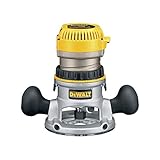
A full-size fixed base router typically produces about 2.25 hp and accepts both 1/4-inch and 1/2-inch shanks. The Bosch 1617EVS, DeWalt DW618, and similar models occupy this useful middle ground. They have enough power for furniture joinery while remaining manageable for hand-held edge work.
The additional mass improves stability, especially when a wide bit creates side pressure. The trade-off is greater fatigue and a larger base that can be harder to position on narrow stock. For workpieces smaller than the base, use auxiliary support or a template so the router cannot rock.
| Model or type | Motor rating | Collet capacity | Approx. weight | Best use |
|---|---|---|---|---|
| Bosch Colt PR20EVS | 1 hp | 1/4 inch | About 3.3 lb | Light trimming and small edge profiles |
| Makita RT0701C | 1.25 hp | 1/4 inch | About 3.9 lb | Compact edge work and template routing |
| Bosch 1617EVS | 2.25 hp | 1/4 and 1/2 inch | About 10 lb with fixed base | General furniture work and table mounting |
| DeWalt DW618 | 2.25 hp | 1/4 and 1/2 inch | About 10 lb with fixed base | Dados, rabbets, profiles, and repeated work |
| Makita RP2301FC | 3.25 hp | 1/2 inch | About 13 lb | Large cutters and demanding table or hand-held work |
Which specifications matter most?
Horsepower and speed control
Horsepower is useful, but it does not tell the whole story. A 2.25-hp router is usually the best balance for a homeowner or furniture maker. More power helps maintain speed in hardwood and with large bits, but the heavier motor increases fatigue and can make delicate work less controlled.
Variable speed matters when using large-diameter cutters. A broad cutter has a higher rim speed at the same motor RPM, so reducing speed helps keep the cut controlled and reduces heat. Follow the bit manufacturer’s maximum RPM rather than selecting speed by horsepower alone.
Collet size
A 1/4-inch collet is sufficient for most small edge bits. A 1/2-inch collet expands the available bit selection and provides a larger gripping surface for demanding cuts. If you plan to use raised-panel, large roundover, or heavy joinery bits, buy a router that includes a genuine 1/2-inch collet. Do not use an adapter to fit a 1/2-inch bit into a 1/4-inch router.
Insert the shank deeply without bottoming it out, then pull it back approximately 1/16 inch before tightening. Keep the collet and shank clean; dust or resin can prevent concentric clamping.
Depth adjustment
Look for a threaded height mechanism, a secure clamp, and a fine-adjustment feature. A scale is helpful for approximate settings, but make the final adjustment with a test cut because bit projection, base seating, and material thickness all affect the result.
For repeated parts, record the final setting or use a setup block. A 1/16-inch depth change can substantially alter the appearance of a roundover or the fit of a dado.
Base stability and visibility
A broad, flat base is valuable for straight cuts and wide profiles, while a smaller base is easier to control near an inside corner. Clear subbases improve visibility, but check that the opening does not allow a narrow base to rock or expose too much of the cutter.
Handles should let you keep both hands low and close to the work. A router that feels powerful but top-heavy is harder to guide accurately than a slightly less powerful model with better balance.
Mounting options
If a router table is part of your plan, verify the mounting pattern, base shape, motor diameter, and compatibility with the table insert or lift. Some fixed bases mount easily with supplied hardware; others require an adapter plate. A lift is convenient for above-table height changes, but not every motor fits every lift.
For occasional table use, a removable fixed base may be enough. For frequent production work, prioritize above-table adjustment, a reliable collet lock, dust collection, and an accessible emergency switch.
Fixed base versus plunge router
Choose a fixed base router for edge profiles, rabbets, dados started from an edge, pattern work, and router-table use. Choose a plunge router when the cut must begin in the middle of a panel, such as a stopped dado, mortise, or interior groove.
If you are deciding between fixed base or plunge router and can afford only one tool, a kit containing interchangeable fixed and plunge bases is often the most flexible compromise. It costs more than a single base, but avoids buying a second motor later. A fixed base remains preferable when maximum stability and simple depth repetition matter more than plunge entry.
Setup method for accurate routing
- Choose the bit and speed. Match shank size and maximum RPM to the cutter instructions.
- Install the bit correctly. Clean the collet, seat the shank deeply, withdraw it slightly, and tighten with the correct wrench.
- Set depth in stages. For a deep dado or rabbet, remove no more than about 1/4 inch per pass in hardwood unless the bit and router manufacturer specify otherwise.
- Secure the work. Clamps must not interfere with the base, and the router must have a broad, continuous support surface.
- Make a test cut. Use scrap from the same material and verify depth, edge position, and bit rotation before routing the finished part.
- Feed against the cutter’s rotation. For a conventional hand-held cut, this normally means moving right to left along the near edge. Take shallow passes and let the motor maintain speed.
Ownership costs and durability
A fixed base router’s first wear points are commonly brushes, collets, switches, base clamps, and bearings. Resin buildup can make height adjustment stiff, while dust packed around ventilation slots can cause overheating. Vacuum the router after use, brush debris from the collet area, and periodically clean threaded adjustment parts according to the manufacturer’s instructions.
Bits are the main consumable. A carbide-tipped profile bit may cost roughly $20–$80, while large specialty cutters can cost more. As a simple ownership calculation, a $180 router used for 60 projects costs $3 per project before bits; a $300 router used for 200 projects costs $1.50 per project. The more frequently you route, the more valuable smooth adjustment, replaceable parts, and a 1/2-inch collet become.
Do not force a dull bit, over-tighten the collet, or lift the router before the motor stops. Those mistakes increase heat, damage the workpiece, and shorten bearing life.
Bottom line
Buy a compact fixed base router for portability and light edge work. Choose a 2.25-hp dual-collet model such as the Bosch 1617EVS or DeWalt DW618 as the strongest all-around choice for furniture and general shop use. Step up to a 3.25-hp 1/2-inch model only when large cutters, deep cuts, or frequent router-table work justify the extra weight. The right combination of collet capacity, stable base, precise depth adjustment, and mounting compatibility matters more than the highest horsepower number.