Best 110 Volt Shop Heaters for Dusty Woodshops (2026)
What's inside
- Quick comparison of 110 volt shop heater types
- Why shop heaters are a fire-safety decision first
- The 1,500 watt ceiling
- Best for dusty shops: oil-filled radiators
- Best for fast warm-up: ceramic fan heaters
- Best for spot heating: carbon infrared panels
- For larger spaces without 240 volts: indoor-safe propane
- Sizing a 110 volt heater with numbers
- How to choose
- Running cost
- Frequently Asked Questions
As an Amazon Associate I earn from qualifying purchases. This post may contain affiliate links at no extra cost to you.
The best 110 volt shop heaters for a woodworking space are enclosed or low-surface-temperature electric models, such as a 1,500 watt oil-filled radiator or a ceramic fan heater with tip-over protection, rather than open-flame units, because wood dust and finishing materials make fire safety the first criterion. Every 110 volt heater is capped at about 1,500 watts, or roughly 5,100 BTU per hour, so these heaters suit a small shop or a work zone; the Dr. Infrared DR-968 infrared panel is a good spot-heating choice at a bench. This guide ranks the types by safety in a dusty shop, then sizes them.
As an Amazon Associate we earn from qualifying purchases at no extra cost to you.

Contents
- Quick comparison of 110 volt shop heater types
- Why shop heaters are a fire-safety decision first
- The 1,500 watt ceiling
- Best for dusty shops: oil-filled radiators
- Best for fast warm-up: ceramic fan heaters
- Best for spot heating: carbon infrared panels
- For larger spaces without 240 volts: indoor-safe propane
- Sizing a 110 volt heater with numbers
- How to choose
- Running cost
- Frequently Asked Questions
Quick comparison of 110 volt shop heater types
| Type | Example | Watts | BTU per hour | Surface heat | Best for | Price range |
|---|---|---|---|---|---|---|
| Oil-filled radiator | 1,500 W portable radiators | 1,500 | About 5,100 | Warm, no glowing element | Best for dusty shops | Budget to mid-range |
| Ceramic fan heater | Shop-style 1,500 W fan heaters | 1,500 | About 5,100 | Moderate | Quick warm-up of a small space | Budget |
| Carbon infrared panel | Dr. Infrared DR-968 | 1,500 | About 5,100 | Hot front panel | Spot heat at a bench | Budget to mid-range |
| Wall-mounted shop heater, 120 V | Small 120 V garage fan heaters | Up to 1,500 | About 5,100 | Moderate | Permanent corner installation | Mid-range |
| Indoor-safe propane (no outlet) | Mr. Heater Buddy, Big Buddy | None | 4,000 to 18,000 | Hot radiant face | Bigger spaces with ventilation | Mid-range |
Conversions use about 3.412 BTU per watt. Details come from the manufacturers’ listings; check the label on your specific model.
Why shop heaters are a fire-safety decision first
Wood dust that settles on a hot surface can smolder. Finishing materials, solvent-soaked rags, and lacquer thinner give off vapors that ignite from an open flame or a glowing element. Because of this, the risk with a heater in a woodworking shop is different from a living room. Prefer models with enclosed or low-temperature surfaces, tip-over shutoff, and overheat protection, and keep them out of finishing areas. Never run an open-flame heater while spraying or wiping finish, and keep the shop vacuumed so that dust does not accumulate on or around the unit. If in doubt, consult your local fire code or your insurance provider.
The 1,500 watt ceiling
A 110 volt, 15-amp circuit supplies 1,800 watts at most, and electrical practice limits continuous loads to 80 percent, or 1,440 watts. This is why portable heaters are 1,500 watts or less. If your shop shares a circuit with a saw, a dust collector, or a compressor, the heater and the tool together exceed the breaker rating. A dedicated circuit for the heater is the most effective fix.
Best for dusty shops: oil-filled radiators
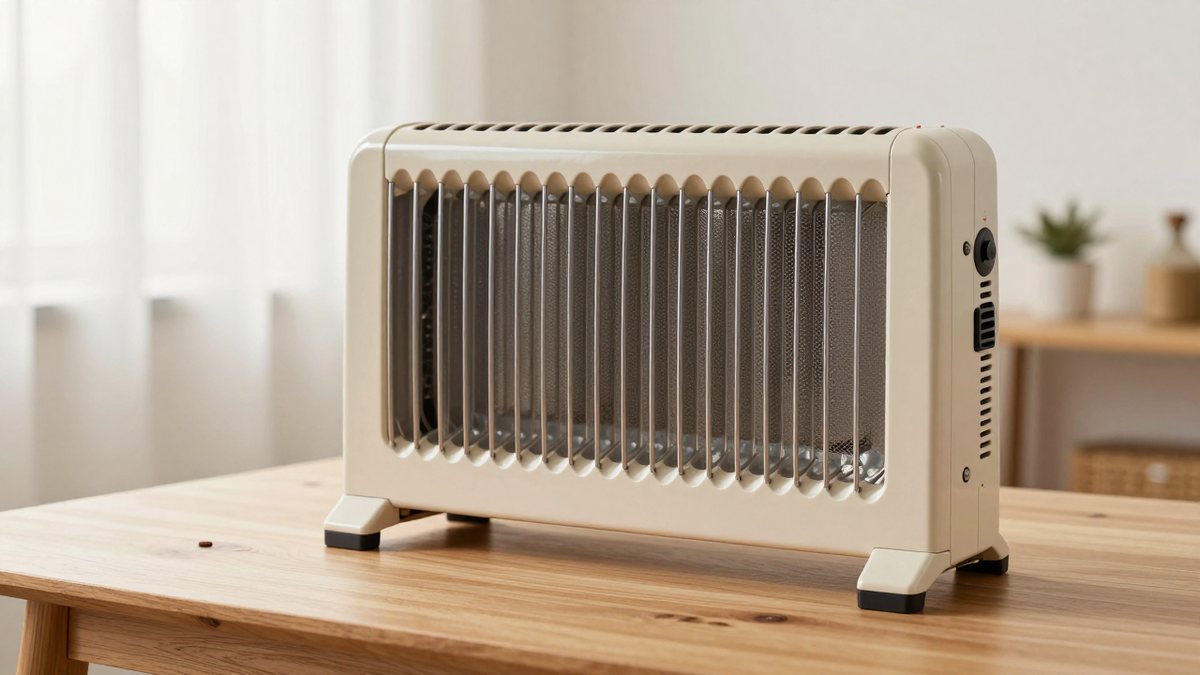
Oil-filled radiators heat a sealed oil reservoir and radiate warmth from fins. There is no fan to blow dust around and no glowing coil to catch it. They take 10 to 20 minutes to warm up and keep radiating after the thermostat cycles off, which suits a shop you occupy for several hours. They are heavy-ish, usually on casters. Their output is limited to 1,500 watts, so they work best in a small, insulated room of about 150 square feet.
Best for fast warm-up: ceramic fan heaters
A ceramic fan heater warms air quickly. They are inexpensive and portable, with tip-over shutoff and thermal cutoffs on most models. In a woodshop, clean the intake screen frequently, because dust clogs it and raises the internal temperature. Avoid them near fine dust sources such as sanding stations. Their fan is audible, but the tradeoff is speed.
Best for spot heating: carbon infrared panels
An infrared panel warms people and objects directly, so it works even in a drafty shop. The Dr. Infrared DR-968 is a 1,500 watt, 120 volt carbon infrared heater according to the brand. Place it a few feet from your bench and aim it at your torso and hands. It does not heat the air, so when you step away you feel the chill. The front panel gets hot, so keep sawdust and materials away from it.
For larger spaces without 240 volts: indoor-safe propane
If your shop is larger than about 150 square feet and you do not have a 240 volt circuit, a portable propane radiant heater avoids the 1,500 watt cap. Mr. Heater’s Buddy and Big Buddy have oxygen depletion sensors and tip-over shutoffs according to the manufacturer, and output from 4,000 BTU to 18,000 BTU. They use an open flame and consume indoor oxygen, so ventilate, install a carbon monoxide alarm, and never use them where finishes, solvents, or dust clouds are present. Many shop owners prefer to keep a propane heater out of the finishing area entirely.
Sizing a 110 volt heater with numbers
A common rule is 10 watts per square foot for an insulated space with an 8-foot ceiling, and 15 to 20 watts per square foot for a poorly insulated one. A 10 by 12 foot shop room (120 square feet) that is insulated needs about 1,200 watts, so a 1,500 watt unit works. A 12 by 16 foot room (192 square feet) needs 1,920 watts, which is above what a single 110 volt heater can supply continuously. In that case, choose a 240 volt heater, add insulation, or use the heater only as a supplement to keep a work zone warm.
| Shop room | Area | Insulated need (10 W/sq ft) | One 1,500 W heater? |
|---|---|---|---|
| Corner of garage | 100 sq ft | 1,000 W | Yes |
| Small shed shop | 120 sq ft | 1,200 W | Yes, with insulation |
| One-car garage | 250 sq ft | 2,500 W | No, marginal |
| Two-car garage | 450 sq ft | 4,500 W | No, use 240 V or gas |
How to choose
Safety features
Tip-over switch, overheat shutoff, a cool-touch housing, and a grounded plug are the baseline. UL or ETL listing is a good sign.
Heating method
Oil-filled and ceramic types warm the air. Infrared warms objects and people. Match the method to whether you stay in one spot.
Thermostat
A thermostat avoids overheating and saves power. Mechanical dials are reliable. Digital thermostats are more accurate.
Placement
Keep at least three feet of clearance on all sides, avoid placing on sawdust-covered surfaces, and keep cords off the floor where tools roll.
Insulation first
Weatherstripping the garage door and sealing gaps lowers heat loss, which is worth more than a stronger heater.
Running cost
At full output, a 1,500 watt heater uses 1.5 kilowatt-hours per hour. At 16 cents per kilowatt-hour, that is 24 cents an hour. Over a four-hour session, a thermostat that cycles on half the time could bring it under 50 cents.
Frequently Asked Questions
What is the safest heater for a woodworking shop?
An enclosed electric heater such as an oil-filled radiator, kept free of dust and used with tip-over and overheat protection, is generally considered a safer choice than an open-flame heater. Keep finishing materials away from any heater.
Can a 110 volt heater warm a two-car garage?
Not by itself. The 1,500 watt limit means it can supplement or warm a work zone, but a two-car garage typically needs 4,000 watts or more.
Is 110 volt the same as 120 volt?
Yes. They describe the same standard household outlet. Labels vary by manufacturer.
Can I leave a space heater on overnight in my shop?
It is not advised. Turn heaters off and unplug them when you leave the shop, especially where wood dust and finishing products are present.
Do infrared heaters work in a drafty shop?
They do, because they heat you and your tools directly rather than the air. But their warmth is directional, so you must stay within their line of sight.