Best Disk Sanders for Fast, Accurate Wood Shaping
What's inside
- Best Disk Sanders for Fast, Accurate Wood Shaping
- Disk sander types compared
- Disc diameter and motor power: the practical trade-off
- Table angle range and accuracy
- Dust collection is a capacity issue, not just a cleanliness feature
- Choosing between a dedicated disk sander and a belt disk sander
- Decision matrix for different workshops
- Abrasive changes and ongoing ownership
- Bottom line
- Best Disk Sanders for Fast, Accurate Wood Shaping
- Disk sander types compared
- Disc diameter and motor power: the practical trade-off
- Table angle range and accuracy
- Dust collection is a capacity issue, not just a cleanliness feature
- Choosing between a dedicated disk sander and a belt disk sander
- Decision matrix for different workshops
- Abrasive changes and ongoing ownership
- Bottom line
As an Amazon Associate I earn from qualifying purchases. This post may contain affiliate links at no extra cost to you.
Contents
- Best Disk Sanders for Fast, Accurate Wood Shaping
- Disk sander types compared
- Disc diameter and motor power: the practical trade-off
- Table angle range and accuracy
- Dust collection is a capacity issue, not just a cleanliness feature
- Choosing between a dedicated disk sander and a belt disk sander
- Decision matrix for different workshops
- Abrasive changes and ongoing ownership
- Bottom line
Best Disk Sanders for Fast, Accurate Wood Shaping
The best disk sander for most home workshops is a 10- to 12-inch benchtop model with a 3/4- to 1-horsepower motor, a tilting table, and a dust port that matches your extractor; choose a 6-inch mini disk sander only when bench space and small workpieces matter more than capacity.
A disk sander is excellent for shaping end grain, refining curves, squaring short edges, and removing material with predictable control. The right choice depends less on maximum sanding speed than on the relationship between disc diameter, motor power, table adjustment, dust handling, abrasive changes, and the space available around the machine.
As an Amazon Associate we earn from qualifying purchases at no extra cost to you.


Disk sander types compared
| Type | Typical disc | Motor range | Typical footprint | Best for |
|---|---|---|---|---|
| Mini benchtop disk sander | 5–6 in | 1/4–1/2 hp or 2–5 amps | 12–18 in wide, 10–14 in deep | Small parts, light shaping, occasional use |
| Standard benchtop disk sander | 8–12 in | 3/4–1 hp | 18–25 in wide, 16–22 in deep | General furniture and hobby work |
| Floor-standing disk sander | 12–20 in | 1–3 hp | 24–36 in wide, 24–32 in deep | Frequent shaping and larger workpieces |
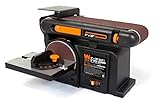
| Belt and disk sander | 6–12 in disc plus 4 x 36 or 6 x 48 in belt | 1/2–1.5 hp | 20–30 in wide, 18–25 in deep | One machine for edge and end-grain work |
These are useful buying ranges rather than universal specifications. A belt disk sander often occupies less floor space than two separate machines, but its belt assembly can reduce access to the disc and make abrasive changes less convenient.
Disc diameter and motor power: the practical trade-off
A larger disc gives you more usable sanding area and keeps a larger portion of the workpiece supported by the table. A 12-inch disc is more comfortable for cabinet components, wide trim, and repeated edge shaping than a 6-inch disc. It also tends to maintain a more consistent surface speed across the working area.
Motor power determines how well the machine maintains speed under pressure. Small 6-inch models are suitable for narrow stock and short sessions, but pushing a large hardwood piece into the disc can stall a low-powered motor or leave burn marks. For regular hardwood work, 3/4 horsepower is a sensible minimum, while 1 horsepower offers more reserve without requiring the electrical and floor space of an industrial machine.
Do not treat horsepower alone as a guarantee of performance. A rigid table, balanced disc, sealed bearings, and a well-designed dust shroud can matter just as much. Excess vibration makes accurate shaping difficult even when the motor is powerful.
Table angle range and accuracy
Most useful models tilt from 0 to 45 degrees, allowing bevels, chamfers, and angled joinery. A table that tilts in both directions is more flexible, but a single-direction table can be perfectly adequate if the stop and scale are easy to read.
- 0 degrees: best for squaring ends and producing repeatable flat edges.
- 15–30 degrees: useful for controlled chamfers and many small angled parts.
- 45 degrees: useful for substantial bevels and certain joinery operations.
Look for a cast-metal table, a positive locking mechanism, and minimal play in the angle adjustment. Scales printed on thin sheet metal are convenient but should be checked with a digital angle gauge or reliable bevel gauge. For repeated work, set the table against a physical stop rather than trusting the printed scale alone.
Dust collection is a capacity issue, not just a cleanliness feature
Sanding produces fine dust that can quickly fill the disc housing and clog abrasive. A 1-1/2-inch port is common on compact machines; larger models may use a 2-1/2-inch port or a 4-inch connection. A shop vacuum can work well with a small port, while a dust collector is better suited to a 4-inch outlet and extended use.
Check whether the port actually sits near the dust stream. A large connector attached to a poorly sealed housing will not collect effectively. A removable shroud is valuable because it lets you clear packed dust around the disc and inspect the abrasive.
Fine sanding dust can escape through gaps even when collection is connected. Wear appropriate eye and hearing protection, keep the guard installed, and use respiratory protection suitable for fine wood dust when ventilation and collection do not control airborne particles.
Choosing between a dedicated disk sander and a belt disk sander
A dedicated electric disk sander is the better choice when you already own a separate edge sander or when disc access and accuracy are priorities. Its simpler layout usually provides a larger, clearer table and fewer parts to adjust.
A belt and disk sander is more versatile. The belt can flatten faces, smooth long edges, and remove material in a straight line, while the disc handles end grain and smaller profiles. The compromise is footprint: the belt assembly may extend behind or above the disc, and changing between operations can take longer. Confirm that the belt table and disc table can each lock securely; a machine that flexes during belt use is frustrating for precision work.
Decision matrix for different workshops
| Your situation | Recommended specification | Why |
|---|---|---|
| Very limited bench space | 5–6 in disc, under 20 in wide, 1/4–1/2 hp | Easy to store and adequate for small parts |
| First serious stationary sander | 8–10 in disc, 3/4 hp, 0–45 degree table | Good balance of capacity, control, and cost |
| Frequent hardwood shaping | 12 in disc, 1 hp or more, rigid cast table | Maintains speed and gives greater working area |
| One machine for many tasks | 4 x 36 or 6 x 48 belt plus 8–12 in disc | Handles both long edges and end-grain shaping |
| Occasional craft projects | Mini disk sander with hook-and-loop abrasives | Lower purchase cost and simpler abrasive changes |
For a rough space calculation, allow at least 12 inches of clear working space in front of the table and 8–12 inches beside the disc for holding a workpiece. A machine measuring 20 inches deep may therefore need roughly 32 inches of usable bench depth. This clearance matters more than the machine’s listed footprint.
Abrasive changes and ongoing ownership
Hook-and-loop discs are the easiest to replace and remove cleanly, making them attractive for users who switch between coarse and fine grits. Pressure-sensitive adhesive discs can be less expensive and may sit very flat, but removing them can leave adhesive on the backing plate. Some machines use proprietary-sized discs, so check replacement availability before buying.
Use coarse grits such as 60 or 80 for shaping, 120 for general refinement, and 180 or finer for final preparation when the project requires it. Do not use a worn disc to force a cut: dull abrasive creates heat, increases pressure, and makes the motor work harder.
- Vacuum the housing, table underside, and motor vents regularly.
- Inspect the disc for lifting edges, torn paper, or exposed backing.
- Check table locking hardware after moving or tilting the table.
- Keep the workpiece moving to avoid grooves and localized burning.
- Replace a disc that has become glazed rather than pressing harder.
The parts that usually wear first are abrasive discs, hook-and-loop backing, belt surfaces on combination machines, and table-locking hardware. Bearings and motors can last for years when dust is controlled, but packed dust and excessive downward pressure shorten their service life.
Bottom line
Choose a mini disk sander for small work and restricted storage, an 8- to 12-inch dedicated model for accurate everyday shaping, and a belt disk sander when versatility is worth the larger footprint. Prioritize a rigid tilting table, suitable motor reserve, practical dust collection, and readily available abrasives over a headline horsepower figure. Those details determine whether the machine remains accurate and convenient after the first few projects.