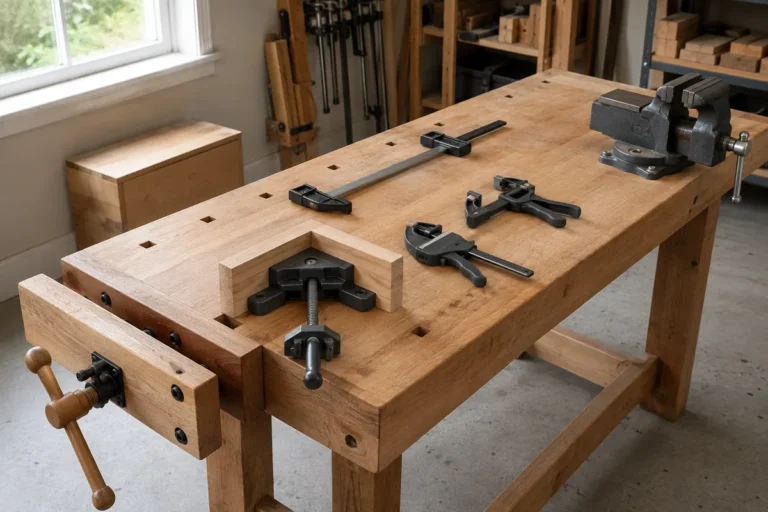
Best Router Table Stands for Stability, Storage, and Easy Setup
What's inside
As an Amazon Associate I earn from qualifying purchases. This post may contain affiliate links at no extra cost to you.
The best router table stand for most workshops is a height-adjustable steel stand with a 34–36-inch working height, at least a 200-pound load rating, adjustable feet, and either a folding frame or lower shelf sized for dust collection and router accessories.
A router table stand does more than hold a tabletop. It determines whether the router table stays level during cuts, whether the fence can be adjusted confidently, and whether the whole setup can be stored without consuming valuable floor space. The right choice depends on the table’s footprint, the router’s weight, how often you use it, and whether you need a permanent workstation or a portable one.
As an Amazon Associate we earn from qualifying purchases at no extra cost to you.


Contents
Router Table Stand Comparison
| Stand type | Typical height | Typical load capacity | Foldability | Storage | Best for |
|---|---|---|---|---|---|
| Basic tubular-steel stand | 28–34 in. | 100–150 lb. | Usually flat-folding | Little or none | Budget and occasional use |
| Heavy-duty adjustable stand | 30–38 in. | 200–300 lb. | May fold or knock down | Lower shelf or accessory hooks | Frequent routing and heavier tables |
| Cabinet-style base | 32–36 in. | 250–400 lb. | Not foldable | Enclosed storage | Permanent shop installations |
| Mobile stand with casters | 32–38 in. | 200–400 lb. | Rarely foldable | Usually good | Shared workshops and large tools |
| Universal folding workstation | 28–36 in. | 100–200 lb. | Folds or collapses | Small shelf or none | Small garages and job sites |
These are useful comparison ranges rather than a guarantee for every model. Always confirm the stand’s published rating and dimensions against the actual router table, fence, lift, router, and dust-collection equipment.
What to Prioritize When Choosing a Stand
Height and ergonomics
A working height between 34 and 36 inches suits many users because it keeps the workpiece near a comfortable standing position without forcing the shoulders upward. Taller woodworkers may prefer 37 or 38 inches, while a compact bench-height setup can be practical for seated work or limited storage.
Measure from the floor to the top of the router table, not merely to the stand’s upper rails. If the stand is 32 inches high and the tabletop is 2 inches thick, the finished work height is approximately 34 inches. Add a thick mounting plate, lift, or sacrificial top when calculating.
A stand that is too tall is difficult to correct safely. A stand that is slightly short can often be raised with a properly designed base or leveling feet, but improvised blocks can reduce stability. Prefer threaded feet or a stand with multiple height positions.
Weight capacity and rigidity
Calculate the working load before buying. Add the tabletop, router, lift or mounting plate, fence, dust hose, featherboards, and the heaviest workpiece you expect to support. For example:
- Table and mounting hardware: 45 lb.
- Router and lift: 25 lb.
- Fence and accessories: 20 lb.
- Supported workpiece: 50 lb.
- Safety margin: 60 lb.
This produces a required capacity of 200 pounds. A stand rated at 200 pounds is technically adequate, but a 250- or 300-pound rating provides a more useful margin for vibration and accidental loading.
Look for wide legs, cross-bracing, welded joints, and a top frame that supports the tabletop around its perimeter. Thin, narrow legs can carry a static load yet still flex when a large panel is pushed across the table. Flexing changes the cut and makes fence adjustments less predictable.
Leveling and floor contact
Adjustable feet are one of the most important features on an uneven concrete floor. Four threaded feet let you remove rocking and bring the tabletop into a level plane. Lock nuts are valuable because vibration can gradually loosen unprotected adjusters.
Casters are convenient, but they should lock both rotation and wheel movement. For the most rigid setup, use retractable casters that lift the stand’s fixed feet off the floor only when you need to move it. A stand resting permanently on small swivel wheels may be easy to reposition but less stable during edge work.
Foldability versus permanence
A folding router table stand is the better choice when the table must share space with a vehicle, assembly bench, or lawn equipment. Check the folded dimensions, not just the open dimensions. A frame that folds to 8 inches thick but remains 48 inches long may still need dedicated wall space.
Folding joints should have positive locking pins or substantial bolts. Avoid relying on friction knobs alone. Inspect the hinge area periodically for looseness, especially if the stand is carried between locations.
A fixed cabinet base wins when the router table is used several times per week. It eliminates folding hardware, offers more mass, and gives you a place for bits, wrenches, featherboards, dust fittings, and hearing protection. The trade-off is a larger footprint and less flexibility if your workshop layout changes.
Storage space and dust collection
Open shelves are useful for a dust extractor, router wrenches, and a box of accessories, but they can collect chips. Enclosed cabinets keep tools cleaner and can reduce airborne dust if the cabinet is designed around the dust outlet.
Before choosing a shelf, measure the dust collector or vacuum canister that you actually use. Allow at least 2 inches of clearance around the hose connection and enough space to remove the container without dismantling the router table. A shelf that technically fits a vacuum but blocks its filter or exhaust is not useful storage.
Best Choice by Workshop Situation
| Your situation | Recommended stand | Why |
|---|---|---|
| Small garage, shared floor space | Folding steel stand, 100–200 lb. capacity | Stores vertically or against a wall and sets up quickly |
| Frequent weekend routing | Adjustable heavy-duty stand with shelf | Balances rigidity, reasonable cost, and accessory storage |
| Permanent professional-style setup | Cabinet base or mobile cabinet | Provides mass, enclosed storage, and better dust management |
| Large panels or raised-panel work | Wide, braced stand rated at least 250 lb. | Reduces rocking and offers better outfeed support |
| Job-site or occasional use | Light folding workstation | Lower transport weight matters more than cabinet storage |
| Uneven floor | Stand with four leveling feet and lock nuts | Corrects rocking without unsafe shims |
Matching a Stand to a Router Table
Start with the tabletop’s length and width. The stand’s upper frame should support the table without interfering with the router’s adjustment mechanism, dust port, or lift handle. A universal stand may accept several table sizes, but “universal” does not mean every hole pattern will align.
For a tabletop around 27 by 18 inches, a compact stand with a similar upper frame is usually adequate. Tables around 32 by 24 inches need a wider base, especially when routing long boards. If the stand is narrower than the table, the overhang should be modest and symmetrical. A large unsupported overhang can make the table feel unstable even when the stand itself is strong.
Confirm how the table attaches. Through-bolts provide a more secure connection than small self-tapping screws, but they require access underneath. If the table has a proprietary mounting pattern, verify compatibility before ordering. Products such as the Bosch RA1181 are compact benchtop router tables rather than complete floor stands, so a separate support must match the table’s base and bolt pattern. Kreg’s Precision Router Table systems are designed as integrated table-and-base solutions, but individual configurations still vary in size and features.
Setup Steps That Improve Stability
- Position the stand on its final floor area. Keep enough clearance behind the table for the fence, dust hose, and long stock.
- Install the tabletop before final leveling. The table’s weight changes the stand’s contact points.
- Attach all fasteners loosely. Align the tabletop and frame first, then tighten bolts gradually in alternating corners.
- Set the feet or casters. Press opposite corners of the table. If it rocks, adjust one foot at a time until all four corners stay planted.
- Check the tabletop with a straightedge or level. Confirm that the table is not twisted relative to the fence.
- Test with a scrap board. Run a short piece across the table before routing a valuable workpiece. Watch for movement, fence shift, or hose interference.
Do not level a rocking stand by tightening one tabletop bolt excessively. That can twist the top or damage a mounting insert. Correct the stand’s feet and frame alignment instead.
Ownership Realities
The parts most likely to need attention are caster locks, folding hinges, threaded leveling feet, shelf fasteners, and rubber foot pads. Sawdust can clog threads, so brush or vacuum the adjusters before applying a small amount of dry lubricant. Avoid oily lubricants where dust can adhere and form an abrasive paste.
Recheck fasteners after the first few sessions and whenever the stand has been folded or moved. A loose frame may not be obvious until a large board contacts the fence. Keep the tabletop clean and inspect the dust hose for kinks; a restricted hose can pull against the table and contribute to instability.
For a budget-conscious buyer, spending more on bracing and leveling is usually more valuable than paying for decorative panels. For a frequent user, the extra cost of a cabinet or mobile base can be recovered in saved setup time and better storage. For a small workshop, a reliable folding stand remains the most practical solution if it locks firmly, supports the table evenly, and can be stored without becoming a daily obstacle.