Best Router Table Tops for Building a Custom Routing Station
What's inside
- Best Router Table Tops for Building a Custom Routing Station
- Quick picks by woodworking situation
- What matters most when choosing router table tops
- Flatness is more important than surface appearance
- Insert plate compatibility and router-lift fit
- Mounting options for a custom routing station
- Dust collection: plan the airflow before building
- Worked sizing example: selecting a top for a small shop
- Ownership realities and maintenance
- Final buying recommendation
- Related Guides
- Best Router Table Tops for Building a Custom Routing Station
- Quick picks by woodworking situation
- What matters most when choosing router table tops
- Flatness is more important than surface appearance
- Insert plate compatibility and router-lift fit
- Mounting options for a custom routing station
- Dust collection: plan the airflow before building
- Worked sizing example: selecting a top for a small shop
- Ownership realities and maintenance
- Final buying recommendation
- Related Guides
As an Amazon Associate I earn from qualifying purchases. This post may contain affiliate links at no extra cost to you.
Contents
- Best Router Table Tops for Building a Custom Routing Station
- Quick picks by woodworking situation
- What matters most when choosing router table tops
- Flatness is more important than surface appearance
- Insert plate compatibility and router-lift fit
- Mounting options for a custom routing station
- Dust collection: plan the airflow before building
- Worked sizing example: selecting a top for a small shop
- Ownership realities and maintenance
- Final buying recommendation
- Related Guides
Best Router Table Tops for Building a Custom Routing Station
The best router table tops for most custom stations are 27-by-43-inch laminated MDF tops with a replaceable insert plate, while cast iron is the better choice for frequent heavy routing and maximum long-term flatness.
Quick picks by woodworking situation
| Situation | Best top type | Recommended specification | Why it fits |
|---|---|---|---|
| First router table or limited budget | High-pressure laminate over MDF | 24 x 32 to 27 x 43 inches; 1 inch thick; 3/8-inch plate opening | Affordable, smooth, reasonably light, and easy to mount in a homemade cabinet |
| Frequent cabinet and furniture work | Large laminated MDF or phenolic top | 27 x 43 inches or larger; replaceable insert plate; at least 1-1/2-inch MDF core | Provides more infeed and outfeed support and resists everyday wear |
| Heavy production-style routing | Cast iron | 27 x 43 inches; approximately 1 inch thick; precision-machined surface | Excellent mass, vibration control, and resistance to seasonal movement |
| Small shop or portable station | Compact laminate top | 24 x 32 inches or smaller; compatible with a lift or insert plate | Uses less floor space and is easier to store, but offers less support for long stock |
| Occasional routing on a budget | DIY laminated MDF | Two 3/4-inch MDF layers with a replaceable wear surface | Low material cost, easy to customize, but requires careful sealing and flattening |
What matters most when choosing router table tops
Dimensions and usable work area
Size affects both safety and accuracy. A 24-by-32-inch top is adequate for small boxes, edge profiles, and short trim. A 27-by-43-inch top gives substantially better support for cabinet parts, rails, stiles, and long boards. The extra length is useful because the workpiece remains supported before it reaches the bit and after it passes the fence.
As an Amazon Associate we earn from qualifying purchases at no extra cost to you.


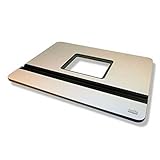
Measure the space around the station, not just the top itself. A 43-inch table needs additional room for the fence, dust hose, electrical cord, and the operator’s position. In a compact shop, a 24-by-32-inch top on locking casters may be more useful than a larger station that must be constantly moved.
For a custom build, leave at least 6 inches of clear area around the insert plate where possible. This gives room for mounting hardware and makes it easier to remove the plate without dismantling the cabinet.
Laminate, phenolic, or cast iron?
Laminate over MDF is the most practical general-purpose construction. The laminate creates a low-friction surface, while the MDF core keeps the top relatively affordable and easy to drill. Its weaknesses are moisture sensitivity and the possibility of sagging if the top is insufficiently supported.
Phenolic tops are usually thinner and more moisture-resistant than MDF. They are attractive for portable stations, although some can transmit more vibration than a heavy cast-iron top. Check the underside for adequate ribbing or a support frame before spanning a wide cabinet.
Cast iron offers excellent mass and dimensional stability. It is well suited to daily routing, large cutters, and operations where vibration is troublesome. The trade-offs are weight, higher cost, and the need to protect the surface from rust. A cast-iron top also makes a mobile station harder to move unless the base has robust casters.
Flatness is more important than surface appearance
A shiny surface does not guarantee a flat one. A router table top should remain flat enough that the workpiece does not rock as it crosses the bit. For most woodworking, a deviation of about 0.005 inch across the working area is a useful target; tighter is preferable for precision joinery.
Check flatness with a reliable straightedge in several directions: front to back, side to side, and diagonally. Place feeler gauges beneath the straightedge to identify gaps. Check again after the top has acclimated to your workshop, particularly if it has an MDF core.
MDF tops can swell at exposed edges and around poorly sealed mounting holes. Seal cut edges with finish, paint, or a suitable hardening coating. Do not rely on laminate alone to protect drilled holes from humidity.
Insert plate compatibility and router-lift fit
The insert plate is the serviceable center of the system. It supports the router or lift, provides bit-clearance rings, and allows the motor to be removed without taking the entire table apart. Before buying a top, confirm the plate’s outside dimensions, corner radius, thickness, and mounting-hole pattern.
Common plate formats are approximately 9-1/4 by 11-3/4 inches and 8-1/4 by 11-3/4 inches, but there is no universal standard. A plate that is 3/8 inch thick may sit correctly in one recess and sit proud or low in another. The plate should be flush with the tabletop; even a small step can catch a thin workpiece.
Also verify compatibility with the router lift or fixed-base router you intend to use. Some lifts are designed around specific plate openings, while others require drilling. A lift that can accept multiple plate rings is preferable because small rings leave less unsupported material near the bit.
Choosing the opening size
A large opening gives more clearance for larger bits but leaves less support near the cutter. A smaller opening improves support for ordinary edge-profile work. Use insert rings sized as closely as practical to the bit’s diameter while maintaining safe clearance. Never use an opening or ring that can contact the rotating cutter.
Mounting options for a custom routing station
The simplest approach is bolting the top directly to a rigid cabinet. Use oversized clearance holes or slotted mounting holes when attaching a wood-based top, allowing for modest seasonal movement. Tight, fixed fasteners across a wide MDF panel can contribute to bowing or cracking.
A metal frame or perimeter support is preferable for a heavy cast-iron top. Support the top continuously or at multiple points rather than relying on four corner bolts. Leveling screws can help align the top with an adjoining workbench, but they must be locked after adjustment.
For a portable station, a removable top mounted with threaded inserts is convenient. Install the inserts into solid reinforcement rather than directly into a thin MDF edge. Confirm that the fasteners cannot protrude into the bit cavity or interfere with the router lift.
Dust collection: plan the airflow before building
Dust collection works best when the fence and cabinet capture dust together. A fence port commonly uses a 2-1/2-inch hose, while a cabinet port may use a 2-1/2- or 4-inch connection. The larger port can move more air, but only if the collector and ducting can supply it.
Build a mostly enclosed cabinet with a removable access panel. Seal unnecessary gaps, but provide a controlled opening for cooling air around the router motor. A completely airtight cabinet can trap heat and fine dust. The fence should direct chips toward the port without narrowing the passage around the bit.
Keep the hose path short and avoid sharp bends. A long flexible hose can reduce airflow enough that the enclosure appears connected but collects poorly. If the station shares a collector with a table saw, use a blast gate so suction is concentrated at the active tool.
Worked sizing example: selecting a top for a small shop
Suppose the available wall-to-wall space is 60 inches, and you need 8 inches behind the station for a dust hose and 18 inches in front for operator clearance. A 27-by-43-inch top leaves about 17 inches of width beyond the top for hose routing and access if the table is placed lengthwise. If that clearance is not available, a 24-by-32-inch top may be the better choice.
The smaller top sacrifices 11 inches of length and 3 inches of width. For short workpieces, that may have little practical effect. For a 72-inch cabinet side, however, the smaller table leaves less stable support and makes auxiliary infeed and outfeed tables more important.
Ownership realities and maintenance
- Laminate wear: The surface usually outlasts the exposed edges, drilled holes, and area around the insert plate. Repair chipped laminate rather than continuing to run stock over a sharp edge.
- MDF swelling: Water, coolant-like cleaning products, and workshop humidity can damage unsealed edges. Wipe spills promptly and seal every cutout.
- Cast-iron rust: Clean pitch and resin with a non-abrasive cleaner, dry the surface, and apply a compatible paste wax or rust-preventive protectant. Reapply when the surface begins to feel dry.
- Insert rings: Rings collect dust and can loosen over time. Keep their mating surfaces clean and replace damaged rings rather than shimming them with tape.
- Fence alignment: A flat top cannot compensate for a twisted fence. Check that the fence is square to the table and that both halves are coplanar before precision work.
- Support underneath: Store heavy material on the station only if the cabinet and top were designed for that load. Permanent weight can eventually deform a poorly supported MDF top.
Final buying recommendation
Choose a 27-by-43-inch laminated MDF top with a replaceable insert plate if you want the best balance of cost, capacity, and customization. Choose cast iron when the station will see frequent heavy use and you value mass and long-term flatness more than portability. For a small or occasional-use setup, a 24-by-32-inch laminate or phenolic top is sufficient, provided the base is rigid and the plate, router, fence, and dust-collection connections are compatible.
Whichever construction you select, prioritize verified flatness, a replaceable plate system, solid support beneath the top, and a dust path that can be cleaned. Those details have more effect on day-to-day routing than a decorative finish or an oversized bit opening.