Best Folding Router Tables for Portable Woodworking
What's inside
- Quick comparison of the leading portable options
- Best overall: Bosch RA1141
- Best for budget storage: SKIL RAS900
- Best for fence control: Kreg PRS2100
- Folded size versus useful working size
- Decision matrix: which folding design fits your shop?
- Setup details that determine stability
- Ownership realities and common failure points
- Final verdict
- Related Guides
- Quick comparison of the leading portable options
- Best overall: Bosch RA1141
- Best for budget storage: SKIL RAS900
- Best for fence control: Kreg PRS2100
- Folded size versus useful working size
- Decision matrix: which folding design fits your shop?
- Setup details that determine stability
- Ownership realities and common failure points
- Final verdict
- Related Guides
As an Amazon Associate I earn from qualifying purchases. This post may contain affiliate links at no extra cost to you.
The best folding router table for a small or mobile shop is the Bosch RA1141 for quick setup, while the Kreg PRS2100 is the better choice when a rigid work surface and precise fence adjustment matter more than the smallest folded package.
A folding router table has to do two jobs that conflict with each other: collapse into something manageable for storage or transport, then become stable enough to guide a workpiece safely. The important comparison is not simply table size. Folded dimensions, setup time, surface rigidity, fence movement, and leg stability determine whether the table is useful after the novelty wears off.
As an Amazon Associate we earn from qualifying purchases at no extra cost to you.

Contents
- Quick comparison of the leading portable options
- Best overall: Bosch RA1141
- Best for budget storage: SKIL RAS900
- Best for fence control: Kreg PRS2100
- Folded size versus useful working size
- Decision matrix: which folding design fits your shop?
- Setup details that determine stability
- Ownership realities and common failure points
- Final verdict
- Related Guides
Quick comparison of the leading portable options
| Model or type | Approx. working size | Approx. weight | Folded or stored advantage | Best suited to |
|---|---|---|---|---|
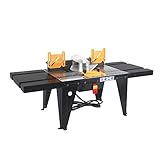
| Bosch RA1141 | 27 x 18 in. | About 30 lb | Folding legs and compact benchtop storage | Fast setup, trim work, and occasional routing |
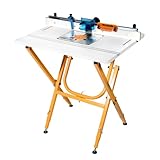
| SKIL RAS900 | About 26 x 16 in. | About 32 lb | Folding legs and integrated accessory storage | Budget-conscious users and small workshops |
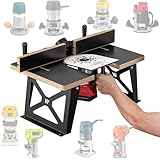
| Kreg PRS2100 | About 30 x 20 in. | About 26 lb | Foldable support legs; relatively easy to carry | Precise fence adjustment and frequent benchtop use |
| Portable benchtop table with separate folding stand | 24–32 x 16–24 in. | 25–55 lb total | Stand and table can be stored separately | Users who need better height and leg stability |
| Compact router-table insert in a workbench | Typically 18–24 x 12–16 in. | Varies | Nothing to fold; stores flush in the bench | Small shops with a permanent workbench |
Dimensions and weights can vary slightly by production revision and included accessories. Treat the figures as planning numbers, and confirm the current manual before designing a storage shelf or transport case.
Best overall: Bosch RA1141
The Bosch RA1141 is the most balanced choice when “portable” means the router table must be unpacked and put away regularly. Its folding legs reduce the storage footprint without requiring a separate stand, and the table includes the basic components needed for general edge profiling, rabbets, and joinery.
Its main advantage is setup speed. A user who leaves the fence and insert arrangement mostly unchanged can usually unfold the support, attach the router, connect dust collection, and check the fence in roughly five minutes. That is considerably more practical than assembling a shop-built stand each time.
The compromises are typical of compact folding designs. The laminated work surface is adequate for ordinary boards but is not as resistant to deflection as a heavy cast-iron or thick phenolic top. The fence is suitable for routine work, but adjustment is less refined than a split fence with independently adjustable faces and fine-positioning hardware. Use both fence locks and clamp the table to a solid bench when routing wide or heavy stock.
Best for budget storage: SKIL RAS900
The SKIL RAS900 is appealing when the table will be used occasionally and must fit into a crowded garage or apartment workshop. Folding legs, accessory storage, and a relatively small footprint make it easy to keep on a shelf rather than permanently occupying a bench.
It is best with smaller routers and moderate-sized workpieces. The table’s lighter construction makes careful positioning more important: pushing hard against the fence can shift a lightweight setup if it is not clamped down. Its fence is functional for basic operations, but users who frequently change bit sizes or work with different stock widths may find the adjustment slower than on a more substantial table.
For a beginner, the RAS900 can be a sensible entry point if the total cost includes clamps, a dust hose, and suitable router bits. A low purchase price does not eliminate those operating costs.
Best for fence control: Kreg PRS2100
The Kreg PRS2100 is a stronger candidate for users who value a stable, accurate benchtop platform more than the absolute smallest folded package. Its large work area and rigid top give long boards more support, while the fence system is easier to adjust for repeatable cuts than the simplest one-piece portable fences.
The fence’s independent faces are useful for closing the opening around a bit and for aligning the outfeed side during jointing-style operations. That does not turn the table into a dedicated jointer, but it gives the user more control over stock support and chip clearance.
The Kreg is not the lightest option once the router, dust hose, and clamps are attached. Its foldable support legs improve storage, but it still benefits from a permanent bench or a heavy auxiliary platform. Choose it when the table will be used weekly and fence consistency matters more than carrying it across a jobsite.
Folded size versus useful working size
Measure the complete storage route, not just the table. A table that is 18 inches wide when folded may still need room for the fence, power cord, wrench, router lift components, and dust hose. Allow at least 2 inches of clearance on each side of the stored table and 4–6 inches above it for lifting and removing accessories.
There is also a practical workpiece limit. A 26-inch-wide table does not provide 26 inches of comfortable support on both sides of the bit. The fence, bit guard, and the operator’s hand position consume part of that space. For cabinet sides, long rails, or wide panels, an auxiliary outfeed or side support is often more important than another few inches of tabletop.
Decision matrix: which folding design fits your shop?
| Your situation | Best direction | Why |
|---|---|---|
| Under $200 budget and fewer than 10 routing sessions per year | SKIL RAS900 or similar compact folding table | Low storage burden and sufficient capability for light work |
| Weekly use, limited floor space | Bosch RA1141 | Fast folding setup with a useful balance of size and portability |
| Frequent profile work and repeated fence changes | Kreg PRS2100 | More controlled fence adjustment and a larger support area |
| Transport between locations several times a month | Light folding table with separate clamps | Lower lifting weight and fewer permanently attached parts |
| Heavy hardwood, wide panels, or long production runs | Rigid bench-mounted table or folding table on a heavy stand | Stability and surface flatness matter more than quick storage |
Setup details that determine stability
Use this sequence whenever the table is unfolded:
- Open every leg fully and confirm that each locking mechanism has engaged.
- Place the table on a flat surface and press down on opposite corners. Any rocking should be corrected before the router is switched on.
- Clamp the table to the bench, even if the legs appear stable. Two clamps near the front corners usually control movement better than one clamp in the center.
- Install the router with the collet accessible and the bit fully seated according to the router manufacturer’s instructions.
- Align the fence faces, set the opening as close to the bit as practical, and check that the workpiece cannot catch on a protruding edge.
- Connect dust collection and test the switch before feeding material.
This process normally takes about 6–10 minutes after the first few setups. If a folding table takes much longer, the likely cause is repeated disassembly of the fence or a storage arrangement that mixes clamps and accessories in separate locations.
Ownership realities and common failure points
The first parts to wear are usually fence locking knobs, leg hinges, insert rings, and the sacrificial fence faces—not the tabletop itself. Keep hinge pivots free of packed dust, tighten loose fasteners without crushing plastic parts, and replace damaged inserts rather than routing around a chipped opening.
Do not use the table as a general assembly bench. Hammering, clamping across the fence, or storing heavy boards on the folded unit can bend supports and make later leg alignment unreliable. Clean resin from the tabletop with a suitable non-abrasive cleaner, then use a dry woodworking-safe surface treatment if recommended by the manufacturer. Avoid slippery coatings that could make stock harder to control.
Plan for consumables: insert rings, replacement fence faces, dust-collection adapters, clamps, and router bits. A useful budgeting calculation is cost per use. A $150 table used 15 times costs $10 per session before bits and accessories; a $300 table used 100 times costs $3 per session. That makes the more rigid table economical for a frequent user, while the cheaper folding model may be the better decision for occasional projects.
Final verdict
Choose the Bosch RA1141 when rapid folding, reasonable rigidity, and straightforward setup are the priorities. Choose the SKIL RAS900 when price and compact storage dominate the decision. Choose the Kreg PRS2100 when precise fence adjustment and a more substantial working surface justify a slightly less minimal portable setup. For heavy stock or frequent production work, a folding router table should be treated as a space-saving compromise and mounted to a rigid bench or heavy stand whenever possible.