Best Universal Router Tables for Different Routers and Shops
What's inside
As an Amazon Associate I earn from qualifying purchases. This post may contain affiliate links at no extra cost to you.
Contents
Best Universal Router Tables for Different Routers and Shops
The best universal router table is the one whose insert plate accepts your router’s mounting pattern, leaves room for height adjustment, and connects cleanly to your dust collector—not simply the table with the largest top.
For most home workshops, the Bosch RA1181 is a sensible compact choice; the Kreg PRS1045 is better for frequent, accuracy-focused work; and the SKIL RAS900 suits beginners who want a complete, inexpensive station. Owners of premium lifts or several router models should instead choose a table with a replaceable plate and a documented mounting template.
As an Amazon Associate we earn from qualifying purchases at no extra cost to you.

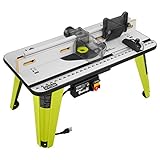
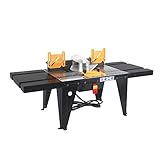

Quick comparison
| Router table | Table or work surface | Plate and mounting approach | Fence adjustment | Dust collection | Best fit |
|---|---|---|---|---|---|
| Bosch RA1181 | 27 x 18 in; aluminum top | Large replaceable insert plate; compatible with many Bosch and third-party routers, but drilling may be required for some patterns | Face shifts side to side; featherboards included | 2.5-in port on fence | Compact general-purpose shop |
| Bosch RA1171 | About 25 x 15.5 in; laminated MDF-style top | Pre-drilled plate intended for common Bosch mounting patterns | Split fence with independent faces | 2.5-in port in enclosed cabinet | Lower-cost cabinet-style setup |
| SKIL RAS900 | About 26 x 16 in; laminated surface | Pre-drilled universal-style plate for common compact and full-size routers | Adjustable fence with featherboards | 2.5-in port | First router table and occasional use |
| Kreg PRS1045 | 32 x 24 in; 1-in-thick MDF top | Large insert plate designed around Kreg’s lift and compatible with many other lifts and routers | Micro-adjustable, split fence; roughly 4 in of face height | 2.5-in port in fence | Frequent use and larger workpieces |
Dimensions and included hardware can vary by package and production year. Before ordering, compare the current manufacturer drawing with your router’s base and mounting-hole pattern.
How to choose a universal router table
1. Check insert-plate compatibility first
“Universal” usually means that the table accepts a removable plate, not that every router bolts on without modification. The important measurements are plate diameter, plate thickness, opening diameter, hole spacing, and the location of the router’s height-adjustment mechanism.
A good plate should be flat enough that a straightedge does not rock across the joint between plate and tabletop. It should also have interchangeable throat rings. Small rings reduce the gap around a narrow bit and support the workpiece; larger rings are needed for panel-raising or other large-diameter cutters.
For a Bosch, DeWalt, Makita, Milwaukee, Porter-Cable, or Triton router, download the model’s base drawing where available. Place the router upside down on the plate, confirm that the screws do not interfere with the motor housing, and ensure that the collet can extend above the table far enough to grip the bit shank properly. Never assume two routers from the same brand share the same hole pattern.
2. Match the mounting range to the router you own
Full-size 2-1/4- to 3-1/4-horsepower routers are useful in a table because they handle long cuts and larger bits, but they are also heavier and often require a lift or above-table adjustment. Compact 1-1/4-horsepower routers can work well for roundovers and small joinery, provided the plate has a secure mounting pattern and the switch can be operated safely.
Look for these features:
- Replaceable insert plate: essential if you may change router brands or install a dedicated lift later.
- Enough opening diameter: the opening must clear the router’s collet and nut, while throat rings keep the unused area closed.
- Above-table height adjustment: valuable for repeat work, but only when the router or lift is designed for it.
- Accessible controls: use the table’s switched outlet only when the router is compatible and the switch can be locked on as directed by its manual.
- Positive fastening: use the supplied machine screws or correctly sized hardware, not wood screws driven into plastic.
3. Evaluate fence adjustability, not just fence height
A fence that slides across the table sets the cut location, but a split fence does more. Its two faces can be aligned independently, allowing the outfeed side to support a small amount of material removal during edge jointing. This is useful when the router table is standing in for a jointer.
For general routing, a fence with about 3 to 4 inches of face height supports boards securely. For tall raised panels, check the maximum opening and fence height rather than relying on a featherboard alone. Micro-adjustment is especially useful when fitting a groove or rabbet by trial cuts: a small knob movement is easier to repeat than tapping a long fence by hand.
Also inspect the fence faces. MDF faces are easy to replace and can be resurfaced, while aluminum faces stay rigid but may need auxiliary wooden faces for certain cuts. The fence should lock at both ends; a single-point clamp can let the far end drift under pressure.
Best choice by shop situation
| Your situation | Most suitable type | Why | Compromise |
|---|---|---|---|
| Under $200, occasional projects, limited floor space | Compact benchtop table such as the Bosch RA1181 or SKIL RAS900 | Small footprint and adequate support for trim, grooves, and edge profiles | Less mass and smaller work area; clamp it securely |
| Beginner with one compact or mid-size router | Complete table with pre-drilled plate and featherboards | Fewer compatibility decisions and faster setup | Future router upgrades may require a new plate |
| Weekly furniture or cabinet work | Large table with split, micro-adjustable fence | Better repeatability, edge support, and room for longer stock | Higher cost and permanent bench or stand space |
| Several router brands or a premium lift | Table with a replaceable, standardized insert plate | Lets you change mounting hardware or install a compatible lift | Plate and lift costs may approach the table price |
| Dust-sensitive indoor shop | Enclosed cabinet or a table with both under-table and fence extraction | Captures dust below the cutter and behind the fence | Two hoses or a splitter may be needed |
Dust collection: what the port size does and does not tell you
Most portable router tables use a 2-1/2-inch dust port. That is convenient for a shop vacuum, but the port alone does not guarantee clean collection. A fence port mainly captures chips thrown backward; dust escaping through the plate opening needs airflow from beneath the table as well.
For a practical setup, connect a shop vacuum to the fence port first and close unused openings with a sliding cover or removable throat ring. If the table has an enclosed cabinet, seal large gaps around the door and power-cord opening. A high-volume dust collector can work better under the table, while a shop vacuum often provides stronger suction at the narrow fence port.
As a sizing example, a 2-1/2-inch hose has a cross-sectional area of about 4.9 square inches. A 4-inch hose has about 12.6 square inches—roughly 2.6 times as much area. That does not mean a 4-inch collector will automatically collect 2.6 times more dust, because hose length, bends, filters, and leaks reduce airflow. It does explain why a small vacuum can struggle when asked to serve a large under-table enclosure through a restrictive adapter.
Setup details that prevent common problems
- Level the plate. Adjust the plate screws until a straightedge passes smoothly from tabletop to insert. A lip can catch a narrow board.
- Mount the router without stressing the base. Tighten opposing screws gradually and verify that the motor body is not touching the plate opening.
- Use the smallest suitable throat ring. This supports the stock close to the cutter and reduces chip escape.
- Square and lock the fence. Measure both ends from the miter slot or table edge. If the readings differ, correct the alignment before routing.
- Set featherboards with light pressure. They should guide the stock without making feeding difficult or pushing it away from the fence.
- Make a test cut. Confirm bit height, fence position, grain direction, and dust collection on scrap from the same material.
Feed the workpiece against the bit’s rotation—normally from right to left when facing the fence. Take shallow passes rather than forcing a full-depth cut, especially with a large bit or hardwood.
Ownership realities
The parts that usually wear first are the fence faces, throat rings, insert-plate screws, featherboard fingers, and the router’s collet or brushes. Keep the plate and fence free of resin and pitch; a dry lubricant on adjustment threads is preferable to oily products that attract dust. Empty the vacuum before airflow drops, and clean its filter according to the manufacturer’s instructions.
MDF tops can swell if exposed to water or damp storage, while aluminum tops resist moisture but can develop burrs around damaged openings. Do not use a router table as a substitute for a spindle moulder with cutters beyond the table’s rated size. Check bit condition regularly: a dull cutter increases feed pressure, heat, vibration, and the chance of burning the work.
Bottom line
Choose the Bosch RA1181 for a compact, adaptable benchtop station, the SKIL RAS900 when low initial cost and simple setup matter most, or the Kreg PRS1045 when a larger surface and better fence adjustment justify the space and expense. Whichever table you select, confirm the exact insert-plate pattern, router weight, collet clearance, fence locking method, and dust-collection path before buying. Those details determine whether a “universal” router table remains useful after your first router upgrade.