Best Overhead Garage Storage Racks
What's inside
As an Amazon Associate I earn from qualifying purchases. This post may contain affiliate links at no extra cost to you.
The best overhead garage storage racks for most homeowners are 4-by-8-foot adjustable wire racks with a 600-pound rated capacity, while smaller 4-by-4-foot or 45-by-45-inch racks are better for limited ceiling space and lighter seasonal storage.
As an Amazon Associate we earn from qualifying purchases at no extra cost to you.


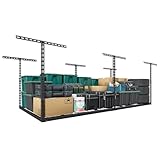

Contents
Best overhead garage storage racks by situation
- Best for maximum capacity: SafeRacks 4-by-8-foot overhead rack, rated up to 600 pounds when correctly mounted to structural framing.
- Best for a large, organized storage zone: NewAge Products Bold Series 4-by-8-foot ceiling rack, with a steel wire platform and adjustable drop height.
- Best for a smaller garage or beginner installation: HyLoft 45-by-45-inch overhead storage rack, which occupies less ceiling area and is easier to position around lights and garage-door hardware.
- Best for modular coverage: Several 4-by-4-foot racks rather than one large rack, especially when posts, ductwork, or a garage door divide the ceiling into separate usable areas.
Capacity alone should not decide the purchase. The rack must fit between the garage door’s travel path and the ceiling, attach to joists or approved blocking, and leave enough room to lift storage bins safely. A rack that holds 600 pounds but cannot be mounted to suitable framing is not a 600-pound storage solution.
Ceiling rack comparison
| Rack type or example | Platform size | Published capacity | Typical height adjustment | Mounting requirement | Assembly difficulty |
|---|---|---|---|---|---|
| SafeRacks 4-by-8-foot rack | 48 by 96 inches | Up to 600 pounds | About 22 to 42 inches below the ceiling, depending on configuration | Ceiling joists or solid structural blocking; concrete mounting requires appropriate anchors | Moderate; large platform benefits from two or three installers |
| NewAge Products Bold Series 4-by-8-foot rack | 48 by 96 inches | Up to about 600 pounds in the heavy-duty configuration | Commonly adjustable through roughly 27 to 42 inches | Structural joists or properly installed blocking; not drywall alone | Moderate to difficult because of the wide frame and multiple brackets |
| SafeRacks 4-by-4-foot rack | 48 by 48 inches | Up to 600 pounds, depending on the kit and installation | Usually adjustable in the same general 22-to-42-inch range | At least two suitable joists or structural blocking | Moderate; easier to level than an 8-foot rack |
| HyLoft 45-by-45-inch rack | Approximately 45 by 45 inches | Up to 250 pounds | Approximately 17 to 28 inches in many configurations | Ceiling joists or other approved structural support | Easy to moderate; smaller frame is easier to handle |
Dimensions and capacities can vary by kit revision, retailer package, and mounting method. Check the current manual before drilling. Some manufacturers state a maximum capacity based on evenly distributed weight, not a concentrated stack placed in the middle of the platform.
How the leading choices differ
SafeRacks: capacity and configuration flexibility
SafeRacks is a strong choice when the priority is storing several large totes, ladders, camping containers, or boxed household items. Its 4-by-8-foot platform uses a wire-grid deck that allows light to pass through and gives some visibility beneath the rack. The long platform can use otherwise wasted space above a vehicle, but it also requires careful planning around the garage door tracks and opener.
The main trade-off is installation. An 8-foot frame is awkward to hold while brackets are being attached and leveled. The rack is also easy to overload at one end. Use the largest containers on the joist-supported portions, distribute weight across the grid, and avoid treating the stated capacity as permission to store dense materials such as bricks, engine parts, or bags of concrete overhead.
NewAge Products Bold Series: a polished, heavy-duty option
NewAge Products’ Bold Series overhead racks suit garages where appearance and a coordinated storage system matter. The steel platform and powder-coated finish are intended for normal garage conditions, and the adjustable suspension lets the installer work around ceiling height and garage-door clearance.
Its 4-by-8-foot footprint is valuable for high-volume storage, but the size can be excessive in a one-car garage. Before buying, mark a rectangle on the floor with painter’s tape that represents the platform’s footprint. Then check whether the vehicle doors, hood, hatch, and walking paths remain usable. A rack that technically fits above the car may still be frustrating if it blocks a light fixture or forces you to stand beneath a low edge.
HyLoft: easier fit for light seasonal storage
HyLoft’s smaller 45-by-45-inch format is better for holiday decorations, empty luggage, lightweight totes, and occasional-use items. Its lower capacity is a useful constraint: it discourages storing dense, dangerous loads overhead. The compact platform can fit in a corner or between ceiling obstructions where a 4-by-8-foot rack cannot.
Choose it when your real storage need is one or two dozen light containers rather than maximum cubic footage. It is also a sensible choice for a first overhead-rack installation, although joist attachment and safe loading still matter just as much as with a larger system.
Clearance: the measurement that prevents the most mistakes
Measure three heights before selecting a rack:
- Ceiling to the highest obstruction: include garage-door tracks, the opener, lights, sprinklers, ducts, and attic-access panels.
- Rack drop: add the manufacturer’s minimum suspension distance to the depth of the stored bin.
- Vehicle clearance: measure with the tallest vehicle parked in its normal position, including an open hatch or liftgate.
For example, suppose the ceiling is 108 inches high, a rack hangs 24 inches below it, and a storage tote is 16 inches tall. The bottom of the tote will sit approximately 68 inches above the floor: 108 – 24 – 16 = 68 inches. If your raised hatch reaches 75 inches, that arrangement is not safe even though the rack itself clears the vehicle. Select a higher mounting position, a shallower container, or a different storage location.
Mounting and safety features to look for
Prefer racks with a steel perimeter frame, cross-bracing, positive-locking bolts, and a raised lip or retaining edge around the platform. Wire decking is useful because it reduces dust accumulation and lets you see whether a box has shifted. Adjustable vertical posts are valuable when ceiling obstructions differ from one side of the rack to the other.
Mount the ceiling brackets into joists, engineered framing, or properly installed blocking. Drywall anchors are not an adequate primary support for a suspended rack. In a finished ceiling, use a stud finder and confirm joist locations with a small pilot hole. If the joists run in an inconvenient direction, install structural blocking only if you understand how it will transfer the load; otherwise consult a qualified contractor.
Use the supplied hardware where it is appropriate for the structure, but do not assume one fastener type works for every ceiling. Wood framing, concrete, and steel framing require different attachment methods. For concrete, use anchors specifically rated for overhead loads and follow the anchor manufacturer’s hole depth and torque requirements.
Decision matrix
| Your situation | Recommended direction | Why |
|---|---|---|
| Budget-conscious, light seasonal items | 45-by-45-inch rack | Lower material cost and simpler handling; adequate for lighter loads |
| Large garage, frequent access, many totes | 4-by-8-foot rack with adjustable height | More platform area and fewer gaps between storage zones |
| Several ceiling obstructions | Two 4-by-4-foot racks | Each platform can be positioned around lights, tracks, and the opener |
| First overhead installation | Smaller rack with a lower stated capacity | Easier to level and less tempting to overload |
| Dense tools or machinery | Floor cabinet or shelving instead | Overhead racks are better for bulky, relatively light items than concentrated loads |
Assembly, loading, and long-term ownership
Plan on two people for a small rack and at least three for an 8-foot platform. Assemble the frame on the floor, loosely tighten the connections, and measure diagonals before final tightening. Equal diagonals indicate a square frame; if they differ, the rack may be difficult to level overhead.
Install the ceiling brackets first, verify joist locations, and use a temporary support or lifting platform while attaching the suspension posts. Do not improvise with a ladder as the sole support for a large frame. After installation, apply a modest test load, inspect for movement, and then increase the load gradually while checking every connection.
The parts most likely to cause ownership problems are loose fasteners, bent wire decking from point loads, and overloaded plastic bins whose bottoms bow through the grid. Use lidded containers with flat bases, place heavy items low and near the support lines, and label bins from the floor rather than climbing onto the rack. Vacuum dust from the platform periodically, especially if the garage contains sawdust, and inspect bolts and brackets at least twice a year.
For most garages, the best overhead storage rack is not the one with the biggest number on the box. Choose a 4-by-8-foot model when you have structural support, generous clearance, and a real need for high-volume storage; choose a 4-by-4-foot or 45-by-45-inch model when maneuverability, easier assembly, and lighter seasonal loads matter more.