Best 4-Post Car Lifts for Home Garages
What's inside
As an Amazon Associate I earn from qualifying purchases. This post may contain affiliate links at no extra cost to you.
The best 4-post car lifts for home garages in 2026 are the BendPak HD-9 series for all-around reliability and accessory support, the Triumph NSS-8 for tighter budgets, and the Advantage SS-11000-WD for heavier trucks and SUVs—but the right pick depends on your ceiling height, vehicle weight, and whether you’re parking under the lift or working on it.
As an Amazon Associate we earn from qualifying purchases at no extra cost to you.


Contents
What Actually Matters When Choosing a 4-Post Lift
A 4-post lift is a permanent-ish fixture, so the decision criteria matter more than brand loyalty. Four specs determine whether a lift fits your garage and your vehicles:
- Rated capacity. Most home-garage lifts run 8,000–9,000 lbs, which covers cars and crossovers. Half-ton trucks and full-size SUVs push 6,000–7,000 lbs curb weight, leaving little margin on an 8,000-lb lift once you add cargo. Step up to 11,000–14,000 lbs for trucks.
- Runway length and width. Standard runways (~165–174″) fit wheelbases up to about 135″. Long-wheelbase trucks need extended runways (188″+).
- Rise height and lock positions. Typical maximum rise is 70–75″, with locking positions every 3–6″. More lock positions mean finer control over working height.
- Ceiling clearance. The math is simple and unforgiving—worked example below.
Comparison Table: Top 4-Post Lifts for Home Garages
| Model | Capacity | Max Rise | Runway Length | Min. Ceiling (typical sedan below) | Lock Positions | Typical Price Range |
|---|---|---|---|---|---|---|
| BendPak HD-9 | 9,000 lbs | ~72″ | ~174″ | ~10’6″ | 13+ | $3,000–$3,800 |
| Triumph NSS-8 | 8,000 lbs | ~70″ | ~165″ | ~10’4″ | 10 | $2,200–$2,800 |
| Advantage SS-11000-WD | 11,000 lbs | ~74″ | ~188″ | ~11′ | 12+ | $4,000–$5,000 |
| Dannmar Commander 7000X | 7,000 lbs | ~68″ | ~160″ | ~10′ | 10 | $2,000–$2,600 |
| BendPak HD-14T (extended) | 14,000 lbs | ~78″ | ~200″+ | ~12’+ | 14+ | $6,000–$8,000 |
Specs vary slightly by configuration—verify exact numbers against current manufacturer sheets before ordering, since brands revise runway and lock geometry between generations.
Will It Fit? The Ceiling Height Calculation
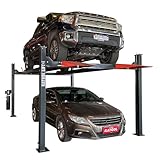
This is where most buyers get surprised. A 4-post lift’s minimum ceiling height isn’t just the column height—it’s column height plus the height of the vehicle parked underneath, or the raised vehicle, whichever is taller.
Worked example (storage use):
- Lift max rise to locks: 72″
- SUV stored on top: 70″ tall
- Sedan parked underneath: 57″ tall
- Column/runway overhead clearance buffer: ~4–6″
- Required ceiling: 70″ (top vehicle) + 57″ clearance for raising ≈ 128–130″ minimum, call it 11 feet
Practical rule: an 8-foot ceiling rules out vehicle stacking entirely (you can still use a lift for service work at partial rise). A 10-foot ceiling handles a car over a low sports car. Stacking two SUVs or a truck over anything realistically demands 12 feet. Also check garage door tracks and openers—a raised vehicle frequently collides with them, and many owners end up buying a high-lift door conversion or wall-mount opener.
Which Lift for Which Garage
| Your situation | Best fit | Why |
|---|---|---|
| Standard 2-car garage, 10′ ceiling, cars/crossovers, occasional wrenching | Triumph NSS-8 or Dannmar Commander 7000X | Enough capacity and rise without paying for truck-rated hardware |
| Long-term ownership, mixed fleet, want rolling jacks and drip tray accessories | BendPak HD-9 | Deepest accessory ecosystem (bridge jacks, jack trays, casters) and wide dealer network |
| Half-ton truck or full-size SUV, 11’+ ceiling | Advantage SS-11000-WD | 11,000-lb rating and ~188″ runways handle long wheelbases safely |
| Heavy-duty trucks, lifted vehicles, commercial-adjacent use | BendPak HD-14T or equivalent 14K-class | Headroom on both capacity and runway length |
| 8′ ceiling, service only (no stacking) | Any 8–9K lift, used at partial rise | Lock positions below max rise still give comfortable working height |
Safety Locks, Caster Kits, and What Listings Don’t Tell You
Locks. Every reputable 4-post lift uses mechanical ladder locks that engage automatically as the runways rise—always park on the locks, never on hydraulic pressure. Differences that matter: single-point release (one handle disengages all four corners—standard on BendPak and Challenger) versus per-corner release, and lock spacing. Tighter spacing (every ~3″) lets you drop onto a lock closer to your ideal height rather than settling 6″ too high or too low.
Storage vs. service. For pure parking storage, you need drip trays (the upper vehicle will leak eventually—budget for them). For under-car service, rolling bridge jacks (typically 3,500–5,000 lbs each, $400–$700 per jack) are required to lift wheels off the runways for brake and suspension work. A lift without bridge jacks can’t do wheel work—this is the most common post-purchase regret.
Mobility. Caster kits (~$300–$500) let you reposition an unloaded lift, useful if you can’t dedicate a permanent bay. “Portable” is generous—an 8,000-lb lift weighs 1,500–1,900 lbs assembled.
Ownership Realities
- Concrete is the hidden cost. Most manufacturers require 4″ minimum of 3,000 PSI concrete, no cracks within a few feet of anchors. Anchor bolts cost little; finding out your slab is 3″ after delivery costs a lot.
- What wears first. Cable sheaves and the cables themselves—inspect every 3–6 months for fraying, replace cables roughly every 5–8 years depending on cycle count. Hydraulic seals weep eventually; a seal kit is cheap, labor is the annoying part.
- Power. Most lifts run on a standard 110V circuit; heavier 11K+ models often want 220V. Confirm before buying.
- Shipping and install. Freight delivery on a 1,700-lb lift typically runs $300–$600, often with liftgate and residential surcharges. DIY assembly is realistic for two people with an engine hoist; professional install adds $500–$1,000.
- Common mistake. Buying capacity to the vehicle’s curb weight exactly. Rate your lift for curb weight plus 20–25% margin—tools, fuel, and modifications add up.
FAQ
Do I need to bolt a 4-post lift to the floor?
Most manufacturers recommend anchoring, and some warranties require it. Caster-kit setups are designed to operate unanchored, but anchoring is the safer default for daily storage use.
Can a 4-post lift do wheel and brake work?
Only with rolling bridge jacks spanning the runways. The runways hold the wheels, so suspension and brake jobs need the vehicle lifted off the runways by its frame.
Is a used 4-post lift worth it?
Often yes—the steel structure lasts decades. Inspect cables, sheaves, and lock pawls for wear, and confirm the brand still sells replacement parts before buying.
Bottom line: measure your ceiling first, weigh your heaviest vehicle second, then pick capacity with margin. For most home garages, the BendPak HD-9 is the safest default; budget builds do fine on the Triumph NSS-8; trucks need the 11K+ class.