Best Scroll Saws for Precise Woodworking
What's inside
As an Amazon Associate I earn from qualifying purchases. This post may contain affiliate links at no extra cost to you.
The best scroll saws in 2026 are the DeWalt DW788 for dependable all-around work, the Excalibur EX-21 for demanding intricate projects, the JET JWSS-22B for maximum throat capacity, and the WEN 3921 for occasional use on a limited budget.
Your choice should follow the work rather than the largest advertised throat: a 16-inch saw is sufficient for most fretwork and small intarsia, while a 20- to 22-inch machine is more useful for large plaques, long interior cuts, and thick hardwood. Variable speed, tool-free blade changes, low vibration, and a useful dust port matter as much as nominal capacity.
As an Amazon Associate we earn from qualifying purchases at no extra cost to you.

Contents
Best scroll saws at a glance
| Model | Throat depth | Speed range | Maximum material thickness | Approx. weight | Best suited to |
|---|---|---|---|---|---|
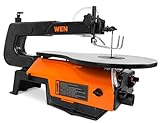
| WEN 3921 | 16 in. | 550–1,600 SPM | 2 in. at 90° | About 25 lb | Beginners, small shops, occasional projects |
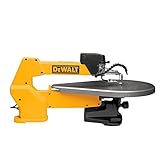
| DeWalt DW788 | 20 in. | 400–1,750 SPM | 2 in. at 90° | About 56 lb | General woodworking and frequent use |
| Excalibur EX-21 | 21 in. | About 400–1,550 SPM | 2 in. at 90° | About 70 lb | Fine fretwork and serious hobby shops |
| JET JWSS-22B | 22 in. | About 400–1,550 SPM | 2 in. at 90° | About 70 lb | Large patterns and maximum reach |
Published specifications can vary slightly by production revision and market. The thickness figures are maximum capacities, not recommendations for clean, detailed cutting. For intricate work, blade choice and feed rate usually become the limiting factors first.
Which saw fits your situation?
| Your situation | Best match | Why | What to accept |
|---|---|---|---|
| Under roughly $250, occasional use, little bench space | WEN 3921 or another 16-inch entry-level saw | Compact footprint, adequate capacity, low initial cost | More vibration, less refined blade clamps, and a narrower usable speed range |
| Weekly use, mixed hardwoods and plywood | DeWalt DW788 | 20-inch reach, broad speed control, established blade-changing system | Large footprint and a higher market price, generally about $500–$700 |
| Mostly intricate fretwork and inside cuts | Excalibur EX-21 | Rigid design, useful low-speed control, and convenient upper-arm access | Heavy, expensive, and better suited to a permanent stand or sturdy bench |
| Large signs, plaques, or unusually wide patterns | JET JWSS-22B | 22-inch throat provides the greatest clearance in this group | Extra reach only helps if your work actually needs it; the machine consumes shop space |
Head-to-head: what separates the leading choices?
DeWalt DW788: the safest all-around recommendation
The DW788 remains a strong choice when a woodworker wants one scroll saw for ornaments, toys, lettering, thin hardwood, and occasional thicker stock. Its 20-inch throat handles most home-shop patterns, and its variable-speed range of approximately 400 to 1,750 strokes per minute covers both delicate hardwood work and faster cuts in softwood.
Its parallel-arm design is valued for relatively smooth operation and reduced blade deflection. The upper arm lifts for easier interior blade insertion, and the blade clamps are familiar to many users. It is not a small machine: allow room for the table, rear clearance, and a comfortable position for feeding a large panel. Typical 2026 market pricing is roughly $500–$700, depending on configuration and availability.
Excalibur EX-21: best for intricate, frequent work
The Excalibur EX-21 is aimed at users who spend substantial time on fretwork, portrait patterns, and tight internal curves. Its 21-inch throat is only one inch deeper than the DeWalt’s, but the rigid arm arrangement and accessible upper arm can make repeated blade changes less frustrating.
The low end of its speed range is useful when cutting brittle veneer, thin plywood, or dense hardwood with a fine blade. Its weight helps suppress movement, but that advantage becomes a disadvantage if the saw must be stored after every session. Budget approximately $800–$1,100 for this class of machine, and reserve a stable stand or heavy bench location.
JET JWSS-22B: choose it for reach, not simply prestige
The JET JWSS-22B offers a 22-inch throat and is the logical pick when patterns regularly approach the limits of a 16- or 20-inch saw. The added reach helps with wide plaques and long interior cuts, while variable speed around 400–1,550 SPM gives reasonable control over different materials.
For small ornaments, however, its extra capacity does not automatically improve accuracy. A large, heavy saw still needs correct tension, a flat table, and a rigid stand. Expect a premium market price, commonly around $700–$1,000, and measure the available footprint before buying.
WEN 3921: practical entry point with compromises
The WEN 3921 is appropriate for learning scroll-saw technique, making holiday decorations, and cutting thin plywood or softwood a few times a month. Its 16-inch throat is enough for many beginner projects, and the roughly 550–1,600 SPM range provides useful flexibility.
The trade-off is refinement. Entry-level saws commonly transmit more vibration, have less polished blade clamps, and provide less effective dust collection than heavier machines. They can still produce accurate work, but the operator must use a sturdy surface, moderate feed pressure, and appropriately sized blades. General market pricing is often about $150–$250.
How to compare the features that affect actual cuts
Throat depth and project size
Throat depth is the distance from the blade to the rear frame. It determines how far a workpiece can rotate, not the maximum width of every possible cut. A 16-inch saw can cut a broad panel if the pattern stays near an edge, but a centered design may require more reach.
Measure the largest pattern you expect to cut and add clearance for turning the workpiece. If your typical design is 14 inches wide, a 16-inch saw may be adequate. If it is 18 to 20 inches, choose a 20-inch model rather than relying on the published maximum.
Variable speed and material thickness
High speed suits softwood and fast rough shaping; lower speed gives better control in dense hardwood, thin veneer, plastic, and heat-sensitive materials. Thick stock also benefits from a blade with suitable tooth spacing and a slower feed rate. A broad speed range is valuable, but it cannot compensate for a dull or incorrectly tensioned blade.
Blade changes
Frequent interior cuts make blade-changing design a major productivity factor. Look for an upper arm that lifts or stays accessible, clamps that hold the blade without excessive tightening, and a table opening that does not obstruct the lower clamp. Pinless blades are preferred for fine fretwork because they pass through small drilled holes; pinned blades can be convenient for quick, less intricate cuts.
Vibration and shop space
Vibration is reduced by a rigid frame, balanced drive components, sufficient machine mass, and a solid stand. It affects more than comfort: excessive movement makes fine lines wander and can enlarge small holes. Place the saw on a level surface, tighten the stand, and avoid a hollow bench that acts as a resonating box.
Allow roughly 30 inches of operating width in front of the machine, plus space to rotate large workpieces. Heavy models are difficult to relocate, so a compact entry-level saw may be the better choice in a shared garage even when a larger machine offers more capacity.
Dust control
Scroll saws produce fine dust directly at the cut, where it can obscure the pattern. A built-in blower can clear the line, while a dust port can connect to a shop vacuum. These features work best together: use gentle airflow aimed across the blade and vacuum suction that does not pull the workpiece downward or disturb delicate offcuts.
Check the port diameter and hose routing before purchase. A nominal dust port is of limited value if the hose blocks access to the lower clamp or if the blower scatters dust around the bench.
Setup and maintenance that improve accuracy
- Mount the saw on a rigid, level surface. A moving machine cannot maintain a consistent cut.
- Square the table to the blade using a small machinist’s square. Recheck after transporting the saw.
- Install the correct blade for the stock. Use finer teeth for thin material and coarser teeth for thicker material, while keeping several teeth engaged in the work.
- Tension the blade until it produces a clear, moderately high note when plucked. Excessive tension can damage clamps or the blade; insufficient tension causes wandering.
- Set the speed low enough to prevent burning and let the teeth cut. Pushing harder than the blade can handle increases deflection.
- Vacuum dust from the table, lower arm, and ventilation openings after each session. Fine dust can restrict airflow and work into moving parts.
- Replace blades at the first signs of wandering, burning, or frayed teeth. Blades are inexpensive consumables, and continuing with a dull blade strains both the motor and the operator.
Bottom line
Buy the WEN 3921 if low cost and occasional use matter most. Choose the DeWalt DW788 for the broadest balance of reach, speed control, usability, and long-term ownership. Step up to the Excalibur EX-21 for frequent precision fretwork, or select the JET JWSS-22B when your patterns genuinely require a 22-inch throat. In every case, prioritize a stable stand, accessible blade clamps, and effective dust control over an oversized capacity you will rarely use.