Best Airbrush Kits for Woodworking and Crafts
What's inside
As an Amazon Associate I earn from qualifying purchases. This post may contain affiliate links at no extra cost to you.
Contents
Best Airbrush Kits for Woodworking and Crafts
The best airbrush kits for woodworking and crafts depend on the finish you need: choose a dual-action gravity-feed kit with a 0.3 mm nozzle for detail, a 0.5 mm or larger setup for broader coverage, or a simple single-action kit for occasional craft use.
An airbrush is useful for shading, stencils, model work, small parts, and thin color coats. It is not a practical replacement for a spray gun when finishing a large tabletop or furniture panel. Before choosing a kit, check what it actually includes: some bundle a compressor, hose, and cleaning tools, while others sell the brush alone. Nozzle size, adjustable pressure, and how easily the brush comes apart matter more in daily use than a long accessory list.
As an Amazon Associate we earn from qualifying purchases at no extra cost to you.

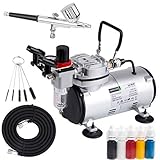


Compare the main airbrush kit types
| Setup | Typical nozzle | Typical working pressure | Best fit | Cleanup burden |
|---|---|---|---|---|
| Fine-detail gravity-feed, dual-action | 0.2–0.3 mm | 10–25 psi | Shading, lettering, small decorations | Moderate; small passages need careful flushing |
| General-purpose gravity-feed, dual-action | 0.3–0.5 mm | 15–30 psi | Crafts, model work, small wood pieces | Moderate; usually a good balance of capacity and control |
| Larger-nozzle or siphon-feed brush | 0.5–0.8 mm | 20–40 psi | Broader color coats and thicker compatible paints | Higher; more paint path and container to rinse |
| Single-action craft kit | Often 0.3–0.5 mm | 15–30 psi | Stencils, basic color application, occasional use | Low to moderate; simpler controls, but still requires flushing |
These are useful starting ranges, not universal settings. Actual operating pressure varies with the brush, paint viscosity, hose, and desired spray pattern. Always follow the manufacturer’s limits, and test on scrap before spraying a finished workpiece.
Best picks by situation
For fine detail: Iwata Eclipse HP-CS
The Iwata Eclipse HP-CS is a gravity-feed, dual-action airbrush with a nominal 0.35 mm nozzle. It is a strong choice for controlled detail and small-to-medium craft surfaces, especially when paired with a regulated compressor. The dual-action trigger lets you control air and paint separately, which helps when fading a color or tapering a line.
This is an airbrush, not a complete compressor kit, so budget for the air source, hose, and any cleaning tools you need. A gravity cup holds less paint than many siphon-feed jars, which is convenient for small jobs and reduces leftover paint, but means more refills on larger pieces. Fine passages also make paint straining and prompt cleaning important.
For a flexible starter setup: Paasche Talon TG-3F
The Paasche Talon TG-3F is a dual-action, gravity-feed brush commonly supplied with multiple head sizes, including approximately 0.25, 0.38, and 0.66 mm options. That range makes it more adaptable than a kit locked to one fine nozzle: use the smaller setup for detail and the larger one for broader patterns or less restrictive paint flow, within the paint maker’s guidance.
Check the package contents before buying. Bundles can vary, and a brush set does not necessarily include a compressor. Changing nozzle assemblies adds versatility but also creates more small parts to keep clean and avoid losing. For many woodworkers, the middle-size setup is the most useful starting point.
For occasional crafts and a compact bundle: Timbertech airbrush compressor kits
Timbertech sells bundled airbrush-and-compressor sets aimed at hobby use. These can be convenient when you want a compact starting package rather than selecting every component separately. Bundle specifications vary, so verify the included brush, nozzle size, hose connections, regulator or pressure gauge, and whether the compressor has a tank.
A small compressor without a tank may pulse more noticeably during spraying; a tank can smooth delivery, though it adds size. These kits are best considered for intermittent craft work, not as a substitute for a shop compressor and spray gun for furniture finishing. If a bundle lists only maximum pressure, look for its usable regulated range too.
For broader coverage: choose a larger nozzle, not just a higher-pressure compressor
If you regularly coat small boxes, ornaments, or panels, a brush with a 0.5–0.8 mm nozzle can pass suitable paints more readily than a fine-detail brush. A larger nozzle does not automatically make the spray pattern wide, but it can make broader, faster application more practical. For large surfaces, an HVLP or conventional spray gun is usually the better tool.
Choose by paint, workspace, and frequency
| Your situation | What to prioritize | Reasonable direction |
|---|---|---|
| First airbrush; a few craft projects a month | Simple parts, included hose, easy-to-find replacement needles | Single-action or basic dual-action bundle |
| Small detail work several times a month | Dual-action control, gravity feed, 0.3–0.4 mm nozzle | Midrange gravity-feed brush with a regulated compressor |
| Switching between detail and broader coats | Interchangeable heads or a second brush in a larger size | Multi-nozzle dual-action set |
| Limited bench space | Compact compressor, hose storage, manageable noise | Small hobby compressor; check dimensions and duty guidance |
| Using thicker paint or covering larger pieces | Paint compatibility, larger fluid passage, suitable spray gun | Consider a 0.5 mm-plus airbrush or a separate spray gun |
Water-based airbrush paints are generally easier to flush than many solvent-based finishes, but “water-based” does not mean every paint is airbrush-ready. Follow the paint manufacturer’s thinning and spraying instructions. Thick, gritty, or poorly strained material can clog a small nozzle. Some clear coats and wood finishes are not formulated for airbrush use at all.
For wood, surface preparation matters as much as the airbrush. Sand consistently, remove dust, and test color on a piece of the same wood: grain and absorbency can change how a transparent color looks. Apply light passes rather than trying to build full coverage at once. Let each coat dry as directed, and check that the material is compatible with any sealer or topcoat you plan to use.
Compressor pressure: what the numbers do—and don’t—tell you
Many hobby airbrush tasks start in the 15–25 psi range. Fine lines or thin, well-prepared paint may work at the lower end; broader patterns or more viscous paint may need more pressure. Set pressure while air is flowing, if the compressor regulator allows it, because a static reading can differ from working pressure.
More pressure is not a universal fix for sputtering. It can increase overspray, dry paint on the tip, or cause paint to bounce back from a small surface. If the spray is inconsistent, first check paint consistency, clogs, needle seating, and the air connection. A compressor with a regulator and gauge is more useful than one advertised only by its maximum pressure.
Cleanup and ownership: the cost of small passages
Airbrushes need cleaning each time you change color and after every session. A workable routine is:
- Empty the cup or jar: Return usable paint only if the paint maker permits it and it has not been contaminated.
- Flush promptly: Use the cleaner recommended for the paint. Spray into a proper cleaning pot or other suitable capture setup, not into open air.
- Wipe the cup and nozzle area: Use a soft brush or swab; avoid forcing hard tools into the nozzle.
- Disassemble only as needed: Follow the manual, protect the needle tip, and do not overtighten delicate threaded parts.
- Inspect consumables: Needles and nozzle assemblies can wear or bend. Replace damaged parts rather than trying to force a poor spray pattern back into shape.
For woodworkers, the most common ownership frustrations are dried paint in the nozzle, a bent needle from careless handling, and seals or parts damaged by an incompatible cleaner. Keep a spare needle/nozzle set if the brush is used often, and confirm replacements are available before choosing an obscure bundle. A cleaning pot, compatible thinner or cleaner, and paint strainers can be more valuable than extra jars you rarely use.
Bottom line
For fine decorative work, start with a dual-action gravity-feed brush around 0.3–0.35 mm and a compressor with a regulator. For a single setup that can span detail to broader craft coats, look for interchangeable nozzle sizes. For infrequent stencil work, a basic bundle may be enough—provided its compressor and included parts are clearly specified. If your goal is finishing furniture-sized surfaces, put the airbrush aside and compare spray guns instead.