Best Jointers for Milling Cherry and Walnut Stock
What's inside
As an Amazon Associate I earn from qualifying purchases. This post may contain affiliate links at no extra cost to you.
Cherry and walnut are excellent jointer stock, but they expose a machine’s weaknesses quickly. Both woods are valuable, hard enough to punish dull knives, and prone to tearout when grain direction changes. A good jointer must leave a flat face and a straight edge without forcing you to remove more material than necessary.
As an Amazon Associate we earn from qualifying purchases at no extra cost to you.


Contents
What Makes a Good Jointer for Cherry and Walnut
For most small shops, a 6-inch jointer is the minimum practical size. Its tables are usually long enough for cabinet parts, drawer stock, and furniture components, while the machine remains affordable and manageable. A 6-inch cutter width also handles common 4/4 and 5/4 boards without requiring a second pass across the width.
An 8-inch jointer is a better long-term choice if you regularly mill wide walnut boards, table parts, or rough lumber from a local sawmill. The extra capacity matters, but so does the heavier construction that commonly comes with it. Longer infeed and outfeed tables make it easier to straighten boards over 6 feet long. A 12-inch or wider machine is generally excessive for a typical home shop unless you routinely process slab or wide architectural stock.
Look for long, rigid cast-iron tables, a fence that locks square without movement, and a cutterhead that stays parallel to the tables. A jointer can have a powerful motor and still produce poor results if the tables sag or the fence shifts under pressure.
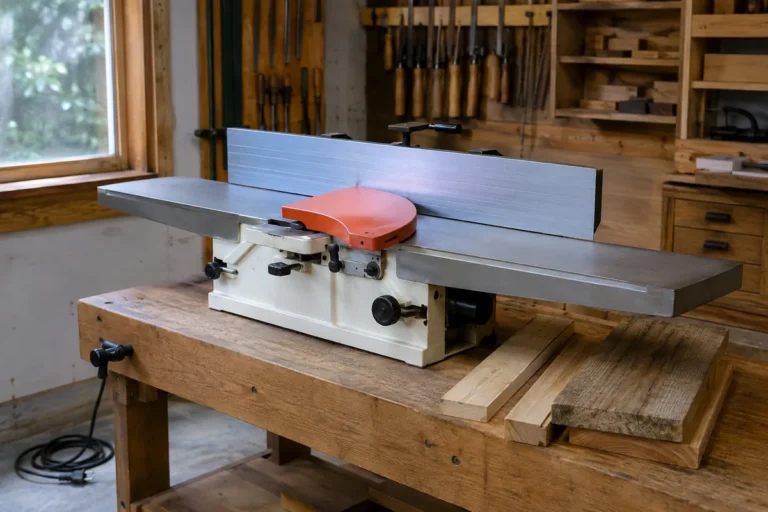
These 6-inch jointers are suitable for most furniture-sized cherry and walnut. Choose an 8-inch machine when your stock regularly exceeds 6 inches in width or you need more table length and mass.
Spiral and Helical Cutterheads Versus Straight Knives
Modern spiral or helical cutterheads are the easiest choice for figured cherry and walnut. Their small carbide inserts take lighter, angled cuts, reducing long strips of tearout. When one insert gets nicked, you rotate or replace that insert instead of removing and sharpening an entire knife set.
That does not make them tearout-proof. Feed direction still matters, and a badly chosen cut can lift grain on either cutterhead style. Helical heads also cost more initially and may leave faint transition marks if the inserts are not aligned correctly. Those marks usually disappear with a light finishing pass, but they are not acceptable if you expect the jointer to produce a final surface straight off the machine.
Straight-knife jointers remain a reasonable budget choice. New knives are inexpensive, and a properly set three-knife head can produce an excellent surface in straight-grained cherry or walnut. The failure mode is more abrupt: one hidden nail, mineral deposit, or knot can nick a knife and create a noticeable ridge across every board. Knife changes and alignment also take more time than rotating carbide inserts.
| Feature | Straight-knife jointer | Spiral or helical jointer |
|---|---|---|
| Upfront cost | Lower | Higher |
| Figured-grain performance | Good with careful feed direction | Usually better and more forgiving |
| Maintenance | Knife removal and alignment | Rotate or replace individual inserts |
| Noise | Usually louder | Usually quieter |
| Best value | Straight-grained stock and occasional use | Frequent hardwood milling and figured grain |
The Best Jointer Types for a Small Shop
A benchtop jointer is inexpensive and easy to store, but it is a poor match for serious cherry and walnut milling. Short tables make it difficult to straighten long boards, and many benchtop designs have limited fence adjustment and less effective dust collection. They can flatten short drawer parts or narrow trim, but they are not the best primary jointer.
A floor-standing 6-inch jointer offers the best balance for many woodworkers. It has enough table length for general furniture work, a more stable fence, and typically better dust collection. A spiral-head version is particularly useful if you work in batches or regularly buy rough lumber with unpredictable grain.
An 8-inch floor-standing machine is worth the added cost when you have the space and electrical capacity. Confirm the motor requirements before buying; some larger machines need a 240-volt circuit. The machine will also require a larger dust collector, especially if it has an 8-inch cutterhead and an enclosed base.
For comparing current options, start with 8-inch helical-head jointers if capacity is your priority. If you only mill narrow boards and already own a capable planer, a less expensive 6-inch floor model is often the more sensible purchase.
Specifications That Matter More Than Horsepower
Do not choose based on motor horsepower alone. A nominal 1-1/2 or 2 horsepower motor is sufficient for normal cuts, provided the machine maintains speed. More important specifications include table length, cutterhead width, fence height, and maximum depth of cut.
Use a 1/16-inch cut as a normal starting point on cherry and walnut. A 1/8-inch cut is useful for removing twist or saw marks, but it increases resistance and tearout risk. With figured material, start at 1/32 to 1/16 inch and make additional passes. Trying to remove 1/8 inch in one pass often creates a torn surface that takes longer to repair than several light cuts would have taken.
A long table is especially important when jointing an edge for glue-up. Short tables can follow the board’s existing bow instead of correcting it. As a practical target, look for roughly 60 inches or more of combined table length on a floor-standing 6-inch machine. More is better for long boards, but only if the tables are accurately aligned.
How to Joint Cherry and Walnut Without Tearout
Inspect every board for nails, grit, and loose bark before it reaches the cutterhead. Walnut often contains embedded mineral streaks, and reclaimed cherry can hide fasteners. Mark the best face and edge, then joint with the grain whenever possible. If grain direction changes across the board, take a light cut and test a scrap first.
Keep the board firmly against the fence and apply downward pressure over the infeed table at the beginning of the cut. As more of the board reaches the outfeed table, move pressure forward. Pressing down on the unsupported infeed end can force a hollow into the board instead of producing a flat face.
Joint one face flat, then use the planer to bring the opposite face parallel. The jointer is not a thicknessing machine. If you need a straight edge for the table saw, joint only enough to remove the bow, then rip the opposite edge parallel. Removing excessive stock wastes expensive hardwood and can expose defects you did not need to reach.
What I Would Buy
For occasional furniture work, a solid 6-inch straight-knife floor jointer is fine if the tables are coplanar and you are willing to maintain the knives. Spending the savings on a good sharpening setup and dust collection may produce better results than buying a poorly built machine with a fashionable cutterhead.
For frequent cherry and walnut milling, choose a floor-standing 6-inch or 8-inch jointer with a helical cutterhead, long cast-iron tables, and a rigid fence. These helical cutterhead jointers cost more, but reduced noise, simpler maintenance, and better performance in changing grain can justify the premium. Before ordering, verify replacement-insert availability, table alignment, dust-port size, and whether the machine fits your shop’s electrical service.