Best Jointers for Accurate Bevels on Furniture Components
What's inside
As an Amazon Associate I earn from qualifying purchases. This post may contain affiliate links at no extra cost to you.
Contents
What a jointer can—and cannot—do
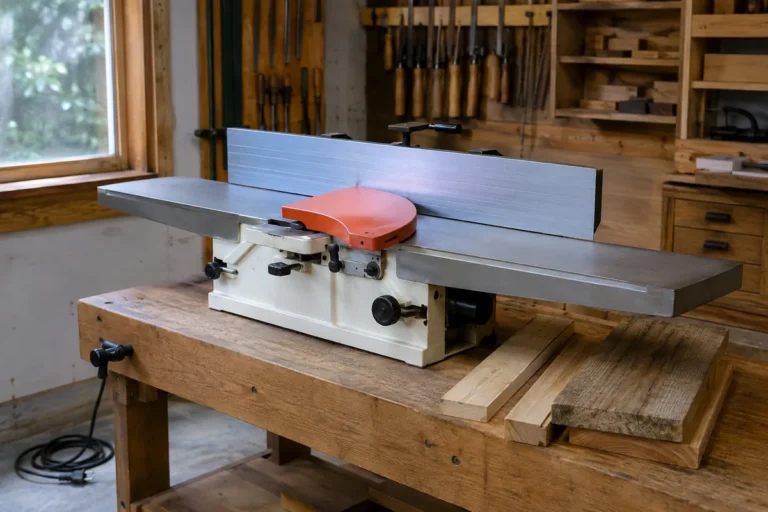
A jointer makes a board’s face flat or its edge straight. It can also cut a bevel along an edge by tilting the fence, which is useful for furniture parts such as tapered legs, chamfered rails, and bevel-edged panels. It does not reliably create a precise bevel across a board’s width, and it is not a substitute for a planer when you need two parallel faces.
For accurate bevels, look for a fence that locks firmly at repeatable angles, tables long enough to support the work, and a cutterhead that leaves a consistent surface. The right machine depends on the size of the parts. A benchtop jointer can handle short, narrow components; longer stock benefits from a heavier floor-standing machine.
As an Amazon Associate we earn from qualifying purchases at no extra cost to you.


Choose the machine around your parts
Most benchtop jointers have a 6-inch cutting width and tables roughly 28 to 45 inches long. They are easier to move and cost less, but short tables make it harder to control long furniture rails. Many floor-standing models have 8-inch or wider beds and substantially longer tables. That extra support matters more than extra width when beveling a long edge.
Measure the longest component you expect to joint, not just the width of your boards. A 48-inch rail is much easier to keep steady on a machine with long infeed and outfeed tables than on a compact bench model. If your parts are usually under 30 inches, the cheaper benchtop option may be entirely adequate. Browse 6-inch benchtop jointers for compact shops, or compare 8-inch floor-standing jointers if you routinely work with long or wide stock.
Which jointer type fits bevel work?
| Type | Best suited to | Main trade-off |
|---|---|---|
| 6-inch benchtop | Short rails, narrow legs, small shops | Short tables and lighter construction demand careful support |
| 8-inch floor-standing | Long furniture components and frequent use | Higher cost, weight, and space requirements |
| Helical-head jointer | Frequent work, figured wood, quieter cutting | Higher purchase cost; inserts still need inspection |
| Knives-head jointer | Occasional beveling and budget-conscious shops | Knives need careful setting and may leave more tear-out |
A helical head is a comfort and finish upgrade, not a requirement for bevel accuracy. A well-adjusted straight-knife machine can cut cleanly. If the budget is tight, put money toward a rigid fence, adequate table length, and dust collection before paying extra for a cutterhead style.
Check the fence before buying
Bevel accuracy depends heavily on the fence. It should lock without shifting, stay square to the table when returned to zero, and have a clear angle scale. A scale alone is not enough: test the setting with a reliable bevel gauge or digital angle gauge, then make a shallow test cut on scrap. Even a small fence error becomes obvious on a long component.
Also check how the fence adjusts across its length and whether its face is tall enough to support your stock. A flexible or narrow fence can let a board tip during a cut. Look for accessible infeed-table depth adjustment and a clear means of checking the cutterhead knives or inserts. For a range of sizes and fence styles, see jointers with tilting fences; confirm the actual fence range and table dimensions in the product specifications.
Set up the bevel safely
Mark the bevel angle on the end of the board and set the fence with a gauge rather than trusting a stamped scale. Joint the reference edge flat first if it is rough or bowed. Then tilt and lock the fence, set a shallow cut—about 1/32 inch is a sensible starting point—and test on scrap of the same thickness. Several light passes are safer and easier to control than one heavy cut.
Feed with steady pressure against the fence and down toward the table, keeping hands clear of the cutterhead. Use push blocks, especially on narrow stock, and do not joint pieces too short for the machine’s manual to permit. A jointer’s guard must return over the cutterhead; never hold it open by hand. Support long stock at table height, but do not let a roller stand lift the work or change its angle.
Common errors and when another machine is better
If the bevel varies along the length, first check that the fence is locked and the stock stayed against it. A concave or twisted edge may need flattening before beveling. Snipe at the ends often comes from uneven feed pressure or inadequate support; make light passes and keep pressure over the tables rather than pushing down on the unsupported end.
For bevels across a board’s face, or for repeated compound angles, use a table saw with a tilting blade and a suitable jig, or a router setup designed for the cut. A jointer removes material from one edge; it is not a safe way to balance a broad panel on its face. Likewise, if the parts are already dimensioned and you need only a small decorative chamfer, a router may waste less material and require less setup.
For most furniture shops, the practical choice is a 6-inch benchtop jointer for short components and occasional work, or an 8-inch floor-standing jointer when long rails and regular production justify the space and cost. Prioritize table support and a dependable fence. Those features do more for repeatable bevels than a wider cutting capacity you rarely use.