Best Jointers for Squaring Short Furniture Components
What's inside
As an Amazon Associate I earn from qualifying purchases. This post may contain affiliate links at no extra cost to you.
Contents
Choosing a Jointer for Short Furniture Parts
Squaring short furniture components—drawer parts, table aprons, cabinet rails, stretchers, and small trim blocks—puts unusual demands on a jointer. The machine must remove material evenly without allowing the workpiece to tip into the cutterhead or become trapped between the tables. A wide table is useful, but accurate tables, a sharp cutterhead, and a safe way to hold the stock matter more than maximum width.
For most furniture work, a 6-inch jointer is the practical starting point. It can flatten and edge-join boards up to roughly 5 1/2 inches wide, while remaining smaller and less expensive than an 8-inch machine. An 8-inch jointer is worthwhile if you routinely prepare wide cabinet parts or glue-up stock, but its extra capacity does not automatically make it better for short pieces. The longer tables and heavier fence can actually make a compact shop harder to arrange.
As an Amazon Associate we earn from qualifying purchases at no extra cost to you.


The Best Jointer Types for Short Components
| Jointer type | Best use | Main advantage | Main drawback |
|---|---|---|---|
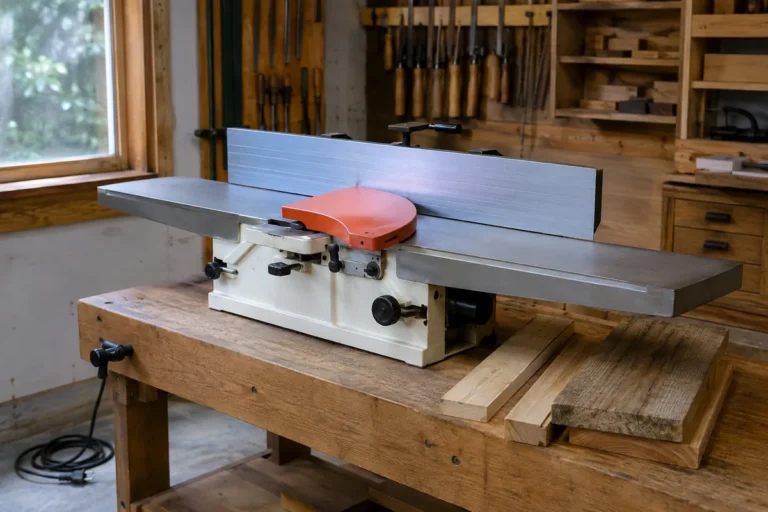
| 6-inch benchtop | Occasional small parts and limited shops | Low cost and easy storage | Shorter tables, lighter fences, less stability |
| 6-inch floor-standing | General furniture making | Better support and adjustment | Uses permanent floor space |
| 8-inch floor-standing | Wide boards and frequent production | More capacity and mass | Higher cost and larger footprint |
| Spiral or helical cutterhead | Quiet operation and difficult grain | Less tear-out and easier insert replacement | Higher purchase price |
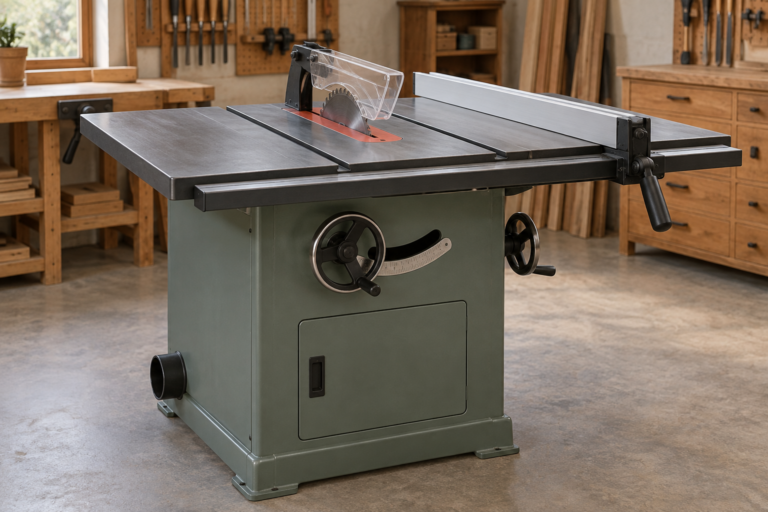
A 6-inch floor-standing jointer is the safest general recommendation for a dedicated furniture shop. Its heavier base reduces movement, and its longer infeed and outfeed tables support a part more predictably. Look for tables at least 40 inches long if you routinely work on rails or stretchers in the 24- to 36-inch range.
A benchtop machine can be perfectly adequate when the components are short, narrow, and already close to flat. It is the sensible cheaper option for someone making a few drawers or small boxes each year. However, many benchtop jointers have tables around 28 to 30 inches long. A 30-inch workpiece can be jointed, but there is little room for a stable handoff from the infeed table to the outfeed table. That increases the chance of tapering the part.
Features That Matter More Than Marketing
Table coplanarity is the first priority. Both tables must remain in the same plane when the machine is adjusted. If the outfeed table is low at the cutterhead, the end of the workpiece drops and the machine removes too much material near the trailing end. If it is high, the part may not touch the knives consistently and the cut becomes uneven.
Prefer a jointer with a rigid cast-iron table and a fence that locks square without shifting. A fence that moves a fraction of a degree can turn a supposedly square edge into a wedge. The fence should tilt for bevel work but lock firmly at 90 degrees. A long, straight fence is especially helpful on narrow rails, where there is little surface area to keep the piece upright.
For short furniture parts, a helical or spiral cutterhead is useful but not essential. Its small carbide inserts generally leave less tear-out in reversing grain, and a damaged insert can be rotated or replaced individually. A conventional three-knife cutterhead usually costs less and gives a fine finish when the knives are sharp and aligned. If the budget is tight, spend first on a rigid machine and accurate setup rather than paying extra for carbide inserts.
Dust collection is not optional. A 1 1/2- to 2-horsepower collector with a clean filter and a 4-inch hose is a reasonable target for a stationary jointer. Chips left around the cutterhead can interfere with the workpiece and create a slipping hazard. A basic 2 HP woodworking dust collector is adequate for many small shops, although a high-quality cyclone separates chips more effectively.
Short-Stock Limits and Safe Technique
Do not treat the jointer’s stated width as a recommendation for very short work. A practical minimum length is about twice the distance from the cutterhead to the end of the outfeed table, or roughly 12 inches on many floor-standing machines. For stock under 12 inches, use a router sled, shooting board, or other method instead. Some manufacturers specify a longer minimum; follow the manual when it is more restrictive.
Never joint a piece so short that your hands must pass over the cutterhead. The guard should cover the unused portion of the knives, and a push block or push shoe should keep hands above and behind the cutterhead. For a narrow rail, use a tall push block that presses the work against the fence. Apply downward pressure over the infeed table before the cutterhead, then transfer pressure to the outfeed table as soon as enough jointed edge is available.
Take light cuts. A 1/32-inch cut is a sensible starting point for furniture stock, and 1/16 inch is about the upper limit for ordinary hardwood preparation on a properly adjusted machine. Short parts often need only a few passes. Removing 1/8 inch in one pass increases the chance of a catch, snipe, or a part that exits with a tapered edge.
Keep the board face firmly against the table when jointing an edge, and mark the reference face and edge with a pencil. If the edge is short enough to rock, clamp it to a longer carrier board or use a different operation. Do not try to stabilize a tiny workpiece by placing a hand close to the knives.
Buying Recommendations by Shop Size
For occasional small projects, a 6-inch benchtop jointer is the economical choice. Confirm that the tables are flat, the fence locks square, and replacement knives or inserts are readily available. The lower price is fine when you can work around shorter tables and do not need to flatten wide boards.
For regular furniture construction, choose a floor-standing 6-inch machine with cast-iron tables, a reliable guard, a 90-degree fence stop, and a usable dust port. An 8-inch jointer earns its cost when you frequently joint boards wider than 6 inches or need the extra mass for long production sessions. It is not a shortcut for unsafe short-stock handling.
If your main work consists of components under 12 inches long, the best purchase may not be a larger jointer at all. Use the jointer for longer stock, then cut the finished rails and blocks to length. This approach is safer, produces more consistent parts, and avoids asking a stationary cutterhead to do a job it was never designed to do.