Planer vs Jointer for Preparing Short Furniture Parts
What's inside
As an Amazon Associate I earn from qualifying purchases. This post may contain affiliate links at no extra cost to you.
For short furniture parts, a planer and a jointer solve different problems. A planer makes a board the same thickness from one end to the other. A jointer creates a flat reference face and a straight, square edge. The machine you should buy depends on whether your lumber already has one reliable flat face and what kinds of parts you make.
As an Amazon Associate we earn from qualifying purchases at no extra cost to you.


Contents
What Each Machine Actually Does
A jointer cuts the underside of a board flat as you push it across the tables and cutterhead. Once one face is flat, you can run that face down on a planer to make the opposite face parallel. The jointer’s fence also lets you straighten and square an edge for table-saw ripping or panel glue-ups.
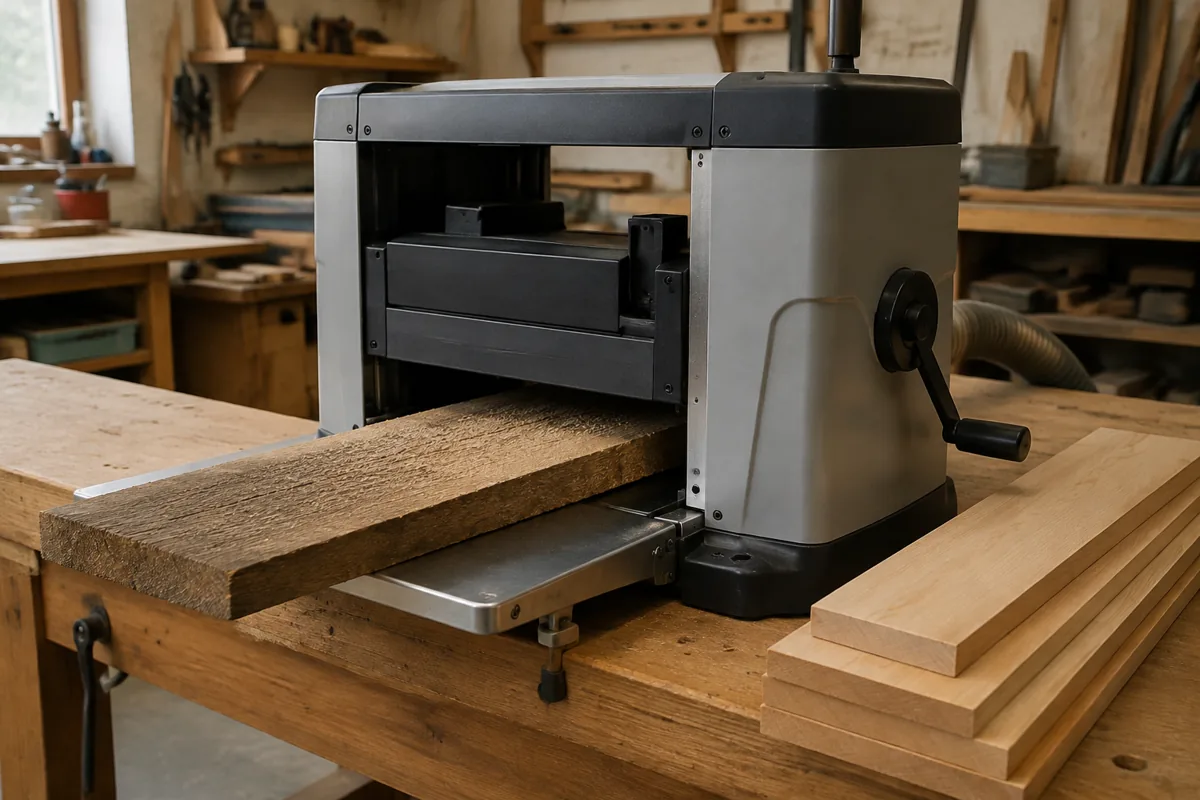
A planer, sometimes called a thickness planer, references the board from its top surface and cuts the bottom to a consistent thickness. It does not automatically flatten a cupped or twisted board. If the board rocks on the planer bed, the cutterhead simply follows that movement and produces a board that is evenly thick but still bowed or twisted.
For drawer parts, cabinet rails, table aprons, and short frame components, consistent thickness is often the most important result. That makes the planer the more useful first purchase for many small shops—provided the lumber is already reasonably flat.
Planer Versus Jointer for Short Parts
| Task | Best machine | Important limitation |
|---|---|---|
| Make both faces parallel | Planer, after one face is flat | It cannot correct serious twist without a sled |
| Flatten one face | Jointer | Short stock can be unsafe and difficult to control |
| Straighten one edge | Jointer | Requires careful fence setup and stable pressure |
| Make drawer sides or rails consistent | Planer | Very short pieces may be rejected or damaged |
| Prepare badly cupped rough lumber | Jointer, then planer | Both machines remove waste and reduce usable thickness |
A jointer is particularly valuable when you mill rough-sawn boards from a lumberyard. It establishes the reference face and a straight edge before the planer sets final thickness. A planer is more convenient when you buy surfaced lumber, use a table saw to create a reference edge, or mainly build from short, manageable parts.
Why Short Stock Is Tricky
Short pieces are not automatically easier. On a jointer, a part must be long enough for your hands to keep firm control while it crosses the cutterhead. A practical minimum is often around 12 inches, but the machine manual should decide the limit. Pieces shorter than that can tip into the cutter, catch, or leave your hands too close to the knives. Use push blocks, keep your hands above the cutterhead, and never joint end grain as though it were ordinary face grain.
Planers also have minimum-length requirements. Many portable machines work poorly with pieces under roughly 12 to 14 inches, though the exact number varies. A short part can enter at an angle, lift into the cutterhead, or become trapped between the feed rollers. The result may be a gouged end, a cracked part, or severe snipe.
When making several short components, mill a longer board first and crosscut the finished parts afterward. This is usually safer and produces better surfaces. For example, plane a 36-inch board to final thickness, then cut it into six 6-inch drawer components. You also avoid losing material to the planer’s unusable lead and trailing sections.
When a Planer Is the Better Buy
Choose a planer first if you need repeatable thickness more than you need to flatten rough boards. It is useful for bringing drawer sides to 1/2 inch, cabinet parts to 3/4 inch, or matched table components to a common thickness. A benchtop planer also takes less floor space than a jointer and is easier to store.
Look for a machine with a width capacity of at least 12 inches if you build ordinary furniture. A 13-inch capacity gives more room for cabinet sides and wide rails. A two-speed feed or a good cutterhead can improve finish quality, but neither feature fixes poor stock preparation. Take light cuts—about 1/32 inch for finishing passes—and support long boards so their weight does not lever them upward or downward.
If a board is cupped but otherwise usable, a planer sled can hold it flat while the first face is cut. Use a rigid sled, shim the board so it cannot rock, and secure the setup against shifting. After one face is flat, remove the sled and plane the other face. This works, but it adds setup time and reduces the maximum finished thickness. For occasional short furniture parts, that trade-off is often cheaper than buying a jointer.
A practical starting point is a 13-inch thickness planer. Budget for dust collection and replacement knives or cutterhead inserts; planers produce a large volume of chips quickly.
When a Jointer Is Worth the Space
Buy a jointer first if you regularly process rough lumber or need straight, square edges for glue-ups. A 6-inch jointer handles many furniture parts, but it cannot flatten a face wider than its tables. An 8-inch machine offers more capacity but costs more and demands more floor space.
For short parts, a jointer’s advantage is often edge work rather than face flattening. You can joint one edge straight, then rip the opposite edge on a table saw. This is useful for narrow drawer sides and rails, even when the parts are too short for comfortable face jointing. Do not use the jointer to remove tiny amounts from a finished part if you cannot maintain full support on both tables.
If you already own a table saw and buy mostly surfaced boards, a 6-inch jointer may be unnecessary. A straightedge, careful table-saw setup, and planer can cover many furniture tasks. If you process rough hardwood every week, however, that cheaper approach becomes slow and wasteful.
A Practical Buying Decision
Choose the planer for consistent thickness, compact storage, and surfaced lumber. Choose the jointer for rough stock, flat reference faces, and straight edges. If your budget allows only one machine, buy the one that removes your most frequent bottleneck—not the one that performs the more complete milling sequence.
For most short-part furniture work, the economical path is a planer plus a sled for occasional cupped boards. Add a jointer when you routinely buy rough lumber, make wide glue-ups, or spend more time correcting edges than building the furniture. Whichever machine you choose, follow its published minimum stock length and mill longer blanks whenever the design allows.