Best Planers for Minimizing Snipe on Short Furniture Parts
What's inside
As an Amazon Associate I earn from qualifying purchases. This post may contain affiliate links at no extra cost to you.
Contents
Why short parts get snipe
Snipe is a shallow dip cut into the top face near one or both ends of a board. It happens when the planer’s feed rollers press a workpiece down against the bed unevenly. At entry, the leading end lifts slightly before both rollers control it; at exit, the trailing end can lift after it leaves the first roller. The cutterhead then takes a deeper bite at the end.
Short furniture parts are especially awkward. A narrow rail or a 10-inch drawer component may be long enough to pass through a benchtop planer but too short to stay securely under both rollers at once. Some manufacturers specify a minimum workpiece length; check the manual rather than assuming a short piece is safe. Never put a part through if it falls below that limit.
As an Amazon Associate we earn from qualifying purchases at no extra cost to you.

Buying a different machine can help, but setup and handling often matter more than price. For parts that must be snipe-free, leave them slightly overlength and cut them to final length afterward. That is usually cheaper and more reliable than paying a large premium for a planer.
Which planer type makes sense?
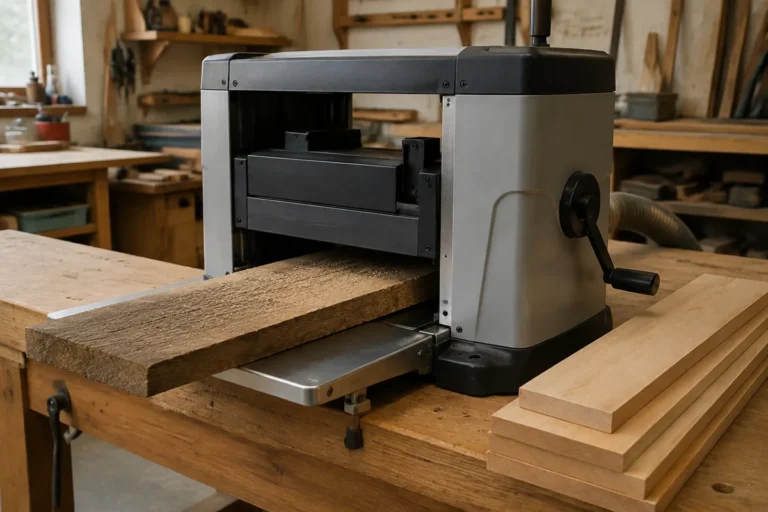
Portable thickness planers are the usual choice for furniture shops with limited space. They are affordable and can produce good surfaces, but their spring-loaded rollers and short beds make them more sensitive to setup and workpiece length. Longer infeed and outfeed support, careful bed alignment, and consistent feeding can reduce the problem.
For frequent work on short, valuable parts, consider a stationary planer with a segmented infeed roller or other short-stock-friendly feed system. Segmented rollers can maintain pressure on uneven or shorter stock while feeding neighboring pieces. That does not make every short piece safe, nor does it guarantee zero snipe; the machine’s minimum-length rule still applies. These machines cost more, weigh more, and need more shop space.
A helical or spiral cutterhead is not, by itself, a snipe cure. It can improve cut quality and reduce tearout in difficult grain, but snipe is chiefly a feed-pressure and support issue. If choosing between a cutterhead upgrade and a better-supported feed system specifically to address snipe, prioritize the latter.
Compare the practical options
| Option | Best for | Snipe trade-off | Cost and space |
|---|---|---|---|
| Benchtop planer with long supports | Occasional furniture work and longer stock | Can be controlled with setup and sacrificial ends, but short parts remain challenging | Lowest cost; portable and compact |
| Benchtop planer with careful technique | Small shops processing a few short parts at a time | Often good enough if parts can be overlength or paired with a same-thickness carrier | Low cost; takes time and attention |
| Stationary planer with segmented feed roller | Regular production of short furniture components | Better support for short or irregular stock, subject to the machine’s minimum length | Higher purchase price; needs a permanent footprint and dust collection |
| Send parts to a shop | One-off jobs or very short pieces below a planer’s limit | A practical way to avoid unsafe feeding and costly setup | Low equipment cost; adds travel or service expense |
What to look for when buying
Start with the manual’s minimum workpiece length, not the advertised cutting width. A planer that accepts a 13-inch-wide board may still require stock several times longer than your furniture parts. Ask the manufacturer or dealer for the stated limit and whether it changes with a segmented roller or optional support equipment.
Next, check the bed and roller arrangement. A rigid, well-aligned bed and stable feed pressure matter more for snipe than a high motor-horsepower figure. Adjustable tables or extensions can help support long boards, but they do not make a part that is too short safe. Look for accessible depth adjustment and repeatable height settings if you run many components to the same thickness.
For a first planer, a benchtop thickness planer is a reasonable purchase if most workpieces are long enough and you can trim their ends. If short parts are a regular production requirement, compare stationary planers with segmented infeed rollers and confirm the minimum length directly. The premium is hard to justify for occasional short runs, but downtime and rework can outweigh it in a busy shop.
Reduce snipe with the machine you have
Set the infeed and outfeed tables according to the manual, then test on scrap of similar width and thickness. A long board can reveal whether snipe is occurring at entry, exit, or both. A typical adjustment is a very slight upward support at the ends of the tables, but large changes can create other problems, including poor feeding or a board that rocks. Make small adjustments and test again.
Feed stock with the grain direction consistent, support it level, and avoid pushing down on one end as it enters or exits. If several boards are the same thickness, feeding them close together can help keep the rollers engaged—provided each piece is within the manufacturer’s minimum length and is handled safely. Do not force a short board or use a loose carrier that could shift into the cutterhead.
The simplest reliable method is to plane pieces a little long, then crosscut away the snipe. If the design does not allow extra length, a same-thickness sacrificial board can sometimes keep the rollers engaged before and after the workpiece. Test the arrangement first and follow the manual; a carrier must not create a kickback or feeding hazard.
When not to use a thickness planer
If a part is shorter than the stated minimum, do not try to compensate by holding it, clamping it to another board, or feeding it by hand. The cutterhead can grab stock, and the rollers may not control it. Use a safer method suited to the part, such as sanding with a rigid thicknessing jig, or have a cabinet shop plane it. For a handful of components, that service can cost less than buying a larger machine.
In short, buy a planer for the stock you process most—not for a promise of zero snipe. A basic benchtop machine is fine when you can trim ends and work within its limits. A stationary machine with a short-stock-friendly feed system earns its cost when short parts are routine and their finished lengths cannot change.