Best Planers with Automatic Bed Locking for Consistent Thickness
What's inside
As an Amazon Associate I earn from qualifying purchases. This post may contain affiliate links at no extra cost to you.
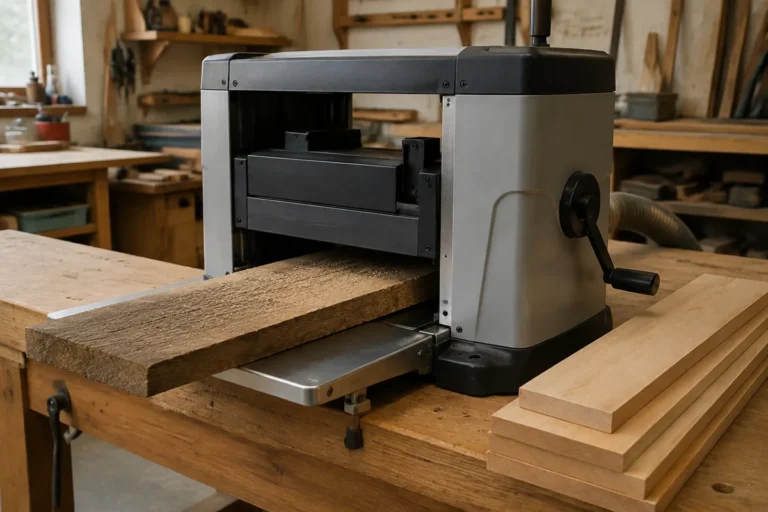
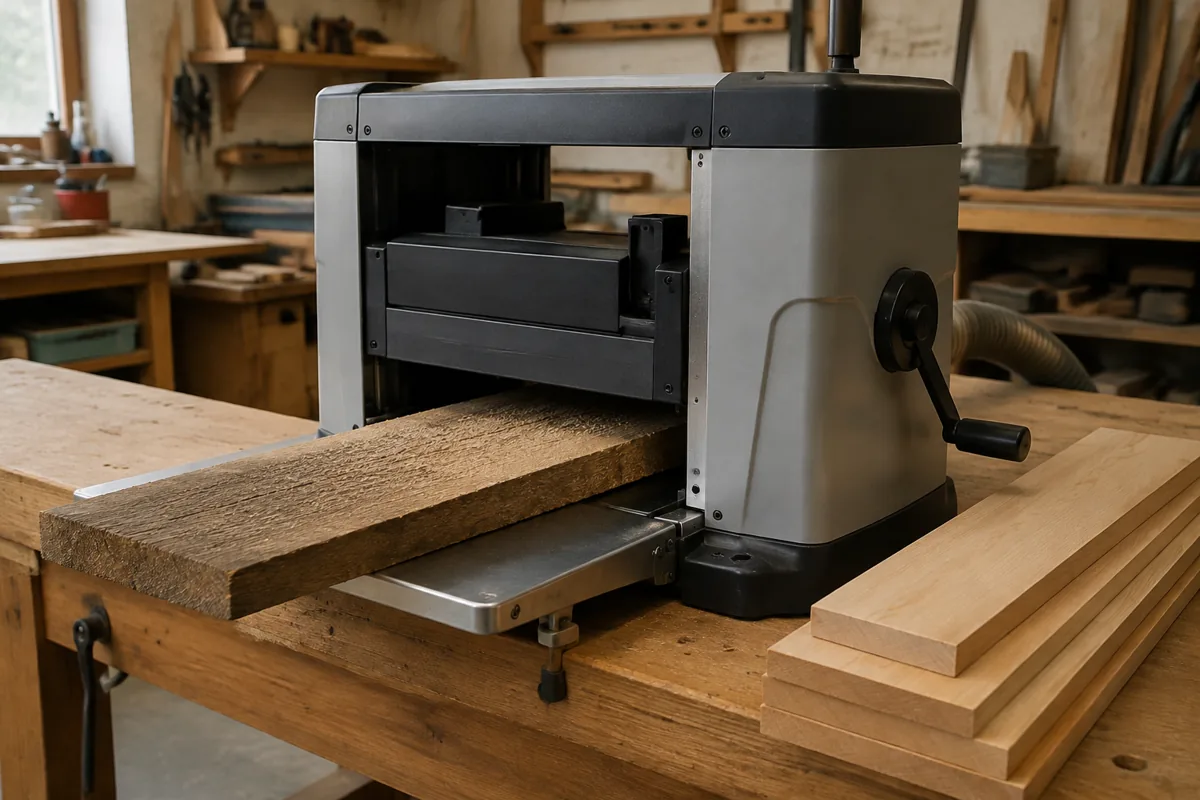
A thickness planer can produce remarkably consistent boards, but only when the cutterhead stays at the same height during the cut. That is the purpose of automatic bed or carriage locking. As you lower the cutterhead, the lock clamps the head assembly to the planer’s posts, reducing movement caused by vibration, cutter pressure, and the lifting force of thick stock entering the machine.
One detail matters: manufacturers do not use “automatic bed locking” consistently. On most portable planers, the feature is an automatic cutterhead or carriage lock. The table itself usually remains fixed. The result is the same—a more stable cutting height and less snipe at the ends of boards.
Contents
What automatic locking does
Without a lock, the cutterhead assembly can move slightly on its threaded elevation mechanism. Even a movement of 0.005 inch is visible as a ridge or thickness change, especially when planing wide panels or making several boards match.
An automatic lock clamps the carriage after you set the depth. Some designs use a spring-loaded mechanism that engages as the head is lowered. Others use a separate lock lever or a transport lock that must be operated by hand. Only the first type should be considered automatic.
The lock does not correct every thickness problem. Dull knives, uneven infeed support, warped lumber, loose elevation screws, and inconsistent pressure from the feed rollers can still cause variation. It also does not eliminate snipe completely. Snipe is often caused by the board lifting as it enters or leaves the rollers, not just by cutterhead movement.
Which planer type is best?
| Planer type | Typical capacity | Locking advantage | Best use |
|---|---|---|---|
| Portable benchtop | 12 to 13 inches wide, about 6 inches thick | Often automatic carriage locking; simple and effective | Small shops, furniture parts, occasional milling |
| Heavy benchtop | 13 to 15 inches wide, about 6 inches thick | Stronger posts and heavier lock mechanism | Frequent hardwood work and wider boards |
| Floor-standing | 15 to 20 inches wide or more | More rigid carriage, usually a manual or powered lock | Production work and large solid-wood panels |
For most home workshops, a 12- or 13-inch portable machine with automatic carriage locking is the practical choice. It is much easier to move and costs less than a floor-standing planer. A good place to compare current machines is this 13-inch thickness planer search.
A heavier stationary planer is worthwhile when you regularly process hardwood, run long boards, or need to flatten wide glue-ups in several passes. The added weight reduces vibration, while larger infeed and outfeed tables support stock more reliably. However, a heavy machine with a poorly adjusted lock can still perform worse than a well-maintained portable model.
Features that matter more than the lock
Look first at the cutterhead and feed system. Helical or segmented carbide heads generally last longer and make less noise than straight disposable knives, though replacement inserts cost more. Straight knives are cheaper to replace and can leave a clean surface when sharp, but a single nick creates a noticeable line across the board.
Check the maximum depth of cut. A claimed 1/8-inch cut is usually available only in softwood or narrow stock. In hardwood, a 1/16-inch pass is more realistic, and 1/32 inch is safer when removing light saw marks. Trying to remove too much material can stall the motor, trip overload protection, or leave a rough surface.
Feed rate is another trade-off. A planer feeding at roughly 16 to 26 feet per minute is suitable for general work. Slower feed improves surface quality but takes longer. Two-speed machines are useful when you want a faster dimensioning pass followed by a slower finishing pass.
Also inspect the elevation mechanism. Four-post designs are common and can hold alignment well when the posts are clean and lubricated. A lock should clamp evenly without making the handwheel difficult to turn. If the lock engages unevenly, the cutterhead can sit slightly skewed, producing a tapered board.
Buying checklist for consistent thickness
- Confirm that the specification says automatic carriage or cutterhead lock, not merely a locking handwheel.
- Look for a published minimum stock thickness, often around 1/8 inch, and do not exceed it.
- Choose a machine with rigid extension tables or plan to build solid supports at the same height as the bed.
- Make sure the dust port matches your collector. A planer can produce several cubic feet of chips per minute.
- Prefer a depth scale with a micro-adjustment or an easy-to-read dial. The scale is a guide, not a precision measurement.
- Check replacement knife or insert cost before buying. Low purchase price can become expensive maintenance.
A helical-head thickness planer is worth considering if you work mainly in hardwood or frequently encounter knots and reversing grain. For occasional pine, poplar, or construction lumber, a conventional knifehead is usually fine and cheaper to maintain.
How to use the lock correctly
Start with a jointed or reasonably flat reference face. Mark the high side with pencil, take a light pass, and reduce the board in steps. For rough hardwood, remove no more than 1/16 inch per pass until the board is close to final size. Measure with calipers at several points rather than trusting the machine’s scale.
Support long stock before and after the planer. A board that drops at the outfeed can lift into the cutterhead and create snipe even when the automatic lock works perfectly. Keep the first and last 12 to 18 inches of the board supported as it passes through the rollers.
After setting the depth, let the automatic lock engage before feeding wood. Do not force the handwheel against its stop. If the cutterhead shifts during a pass, stop using the machine and inspect the lock, elevation screws, and post alignment. Continuing can create a tapered board and may damage the locking mechanism.
When the cheaper option is fine
If you mill only a few boards each month, a basic 12-inch planer with an automatic carriage lock is enough. Spend the savings on sharp knives, accurate support tables, and dust collection. A more expensive machine becomes justified when you need quieter operation, faster stock removal, a helical head, wider capacity, or a stronger feed system.
For a straightforward budget choice, compare 12-inch portable planers with automatic locking. The best machine is not the one with the largest capacity; it is the one that holds its setting, feeds boards evenly, and can be kept sharp and properly supported.