Helical Cutterhead vs Spiral Cutterhead for a Woodworking Planer
What's inside
As an Amazon Associate I earn from qualifying purchases. This post may contain affiliate links at no extra cost to you.
A helical cutterhead and a spiral cutterhead both replace a planer’s long straight knives with rows of small carbide inserts. The names are not used consistently by every manufacturer: some call any staggered insert head “helical.” Check the cutter layout and insert shape, not just the label.
For most buyers, the practical choice is between a traditional straight-knife head and an insert head. Insert heads usually cut more quietly and handle figured or knotty wood with less tear-out. Straight knives cost less to buy and are a sensible choice for ordinary, straight-grained stock. Between two insert heads, the details that matter most are insert orientation, replacement-insert availability, and the cost of maintaining the head.
As an Amazon Associate we earn from qualifying purchases at no extra cost to you.


Contents
What the names mean
A true helical arrangement places small square or rectangular inserts in rows around the cutterhead, with each insert set at an angle to the direction of feed. The angled edges make a shearing cut rather than striking the full width of the board at once. Inserts are typically indexed: when one edge dulls or chips, you rotate it to a fresh edge.
“Spiral” often describes a similar staggered layout, but it may also refer to inserts arranged more nearly parallel to the cutterhead axis. Some spiral heads use round inserts, which present a curved cutting edge. Others use four-sided carbide inserts much like those in a helical head. There is no universal naming standard, so two products sold under different names may work similarly—or two called spiral may have very different insert layouts.
Side-by-side comparison
| Feature | Helical-style head | Spiral-style head |
|---|---|---|
| Typical insert layout | Staggered rows, often angled for a shearing cut | Staggered rows; angle and insert shape vary by design |
| Surface finish | Usually clean, with small scallops that may need sanding | Usually similar; results depend more on edge geometry and feed rate than the name |
| Figured or knotty wood | Often reduces tear-out compared with straight knives | Can also reduce tear-out; verify the cutting angle and user reports for the exact head |
| Damaged edge | Rotate or replace the affected insert | Rotate or replace the affected insert |
| Cost and upkeep | Higher initial cost; needs compatible inserts and accurate seating | Similar trade-offs; insert availability and price can vary substantially |
Cut quality and tear-out
Both insert-head designs can leave a better surface on curly maple, interlocked grain, and wood around knots than a conventional straight-knife head. The shearing action and smaller cutting edges limit how much wood each edge lifts at once. They do not eliminate tear-out. Deep cuts, dull or chipped inserts, poor support, and grain that changes direction abruptly can still leave defects.
Insert heads can leave faint scallop marks. Their size depends on the spacing of the cutting edges, cutterhead speed, and feed rate. These marks are usually easy to remove with sanding or a light finishing pass, but a planer is not a jointer or sander: do not expect a perfectly polished face straight from the machine. If you need a smooth finish on difficult grain, take a lighter final cut—often around 1/32 inch or less—and test on scrap.
Maintenance, noise, and cost
When a straight knife gets nicked, the mark can run across the full width of a board. Replacing or sharpening a full set of knives can mean more setup, and knives must be aligned carefully to avoid ridges. With an insert head, a damaged insert usually leaves a narrow line. Rotate that insert to a fresh edge, then replace it when all usable edges are gone. Keep a note of which inserts you rotate; missing one can leave a repeatable defect in the cut.
Carbide inserts can last a long time in clean wood, but they are not immune to damage. Grit, hidden fasteners, and abrasive material can chip an edge. Clean the pocket before reinstalling an insert, seat it flat, and tighten the screw to the manufacturer’s specification. A chip or dust under the insert can make it sit proud and score the workpiece. Do not assume every insert is interchangeable: shape, thickness, screw, and cutting geometry must match.
Insert heads generally cost more upfront than straight-knife heads, and replacement inserts add an ongoing expense. They are often quieter in use, though the planer’s motor, dust collection, and enclosure also affect noise. If you mainly plane clean, straight-grained construction lumber and can sharpen or set knives yourself, a conventional head is a reasonable budget choice. Compare replacement planer knives before buying an older or inexpensive machine; obscure knife sizes can be inconvenient.
What to check before buying
First, look for a diagram or close-up showing the inserts and their cutting angle. Ask whether the head uses square, rectangular, or round inserts and how many edges each insert provides. Then check the price and availability of the exact replacement inserts. A low-cost head is less attractive if its inserts are hard to source or sold only in large packs.
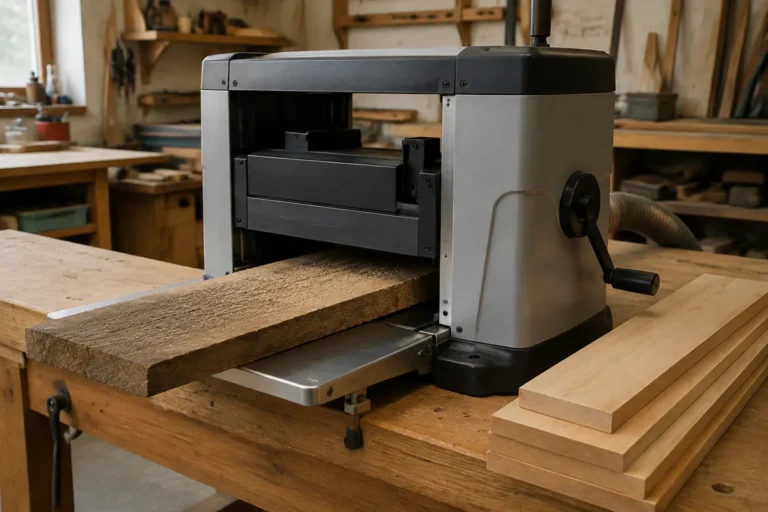
Confirm that the head is designed for your planer’s exact make and model, including its shaft, bearings, and drive arrangement. A cutterhead swap is not always a simple bolt-on job. Some installations require removing covers, belts, and the original head; incorrect setup can cause vibration, poor cuts, or unsafe operation. If you are choosing a new machine, compare complete planer packages rather than assuming a head upgrade will fit later. An insert-head benchtop planer may make sense if you regularly work figured hardwood, while a straight-knife benchtop planer is often the better value for occasional dimensioning.
Finally, check the machine’s maximum cut depth and feed rate. A wider cutterhead does not make a deep cut safer: removing too much material in one pass can overload the motor, stall the feed rollers, or leave a rough surface. Follow the manual, support long boards at both ends, and keep hands clear of the infeed and outfeed openings.
Which one should you choose?
Choose a helical-style insert head when the layout clearly uses angled edges, you plane figured or knotty stock often, and you value easier recovery from a local nick. A spiral-style head can offer much the same benefit; judge the actual insert geometry, finish reports, and parts support rather than treating “spiral” as automatically better or worse.
Choose straight knives when low purchase price matters most, your stock is generally clean and straight-grained, and you are comfortable maintaining and setting knives. For a hobby shop that planes a few boards at a time, the difference in finish may not justify a costly upgrade. For frequent work on difficult grain, the reduced tear-out and the ability to rotate a single damaged insert can be worth paying for—provided replacement inserts remain easy to get.