Jointer vs Router Table for Cutting a Straight Reference Edge
What's inside
As an Amazon Associate I earn from qualifying purchases. This post may contain affiliate links at no extra cost to you.
When a board needs one reliably straight edge, a jointer and a router table can both do the job—but they do it in different ways. A jointer is the faster, more direct machine for jointing lumber. A router table is more flexible and may be the better purchase if you also need to cut profiles, rabbets, grooves, and tenons.
The important distinction is that a jointer references the board against a fence and removes material from the underside as the stock passes over the cutterhead. A router table usually references the board against a fence while a bit trims the edge. The router method works well, but it often needs more setup and careful support.
As an Amazon Associate we earn from qualifying purchases at no extra cost to you.



Contents
What a Jointer Does Best
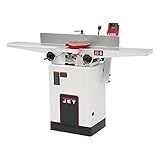
A jointer is designed specifically to create a flat face and a straight, square edge. Once the board has a flat face, you can place that face against the jointer fence and produce a reference edge at 90 degrees. That edge can then ride against a table saw fence for ripping the opposite edge parallel.
For typical furniture lumber, a 6-inch jointer handles boards up to roughly 6 inches wide. An 8-inch machine gives you much more useful capacity, especially for table parts and cabinet components. The trade-off is cost, floor space, and weight. A benchtop jointer is less expensive and easier to store, but its shorter tables provide less support for long boards.
Jointing is most predictable when the board is reasonably flat. If a board rocks badly, is bowed along its length, or has significant twist, the first passes may not establish a stable reference. Use the jointer to flatten one face only if the machine has enough capacity and the board can be controlled safely. For badly twisted stock, a planer sled or hand tools may be needed before normal jointing.
Look for a stationary 8-inch jointer if you regularly work with wider hardwood boards. For occasional small projects, a 6-inch jointer may be entirely adequate.
Using a Router Table for a Straight Edge
A router table can straighten an edge with a flush-trim or straight bit, but the bit needs a reliable reference. The simplest method is to attach a straight guide board to the workpiece, letting the guide ride against the router table fence while the bit removes the exposed edge. The guide must be genuinely straight; a slightly bowed guide transfers that error to the workpiece.
Another method uses a router fence with one adjustable or offset face. Set the outfeed side forward by the amount of material being removed—often 1/32 inch or less—and feed the stock from the infeed side to the outfeed side. This resembles a jointer, but the exposed bit has less cutting width and generally removes material more slowly.
A router table is especially useful for short boards, narrow parts, and pieces that already have one reasonably straight edge. It is less convenient for long, heavy, or rough boards. A long board can catch on the fence, dip at the entry or exit, or twist away from the bit. In practice, you may need infeed and outfeed support extending several feet beyond the table.
Use a router table with a solid fence if you want this option to be repeatable. A small benchtop table can work, but flex in the tabletop or fence makes straight-edge work harder than it needs to be.
Jointer vs. Router Table Comparison
| Consideration | Jointer | Router table |
|---|---|---|
| Primary job | Flattening faces and jointing edges | Routing profiles, joinery, and edge trimming |
| Edge straightness | Very consistent with proper technique | Good, but depends heavily on fence and guide setup |
| Typical stock length | Long stock is manageable with adequate tables | Long stock needs substantial support |
| Wide-board capability | Limited by cutterhead width | Not limited by cutterhead width, but awkward on wide pieces |
| Face flattening | Yes, within its capacity | No, not conveniently |
| Noise and dust | Loud, with large chips and dust | Loud, with fine dust; dust collection is essential |
| Best value | If you regularly prepare rough lumber | If you need one machine for many routing operations |
Accuracy and Safety Details
On a jointer, take light passes—commonly 1/32 inch or less for finishing—and keep the board pressed down on the outfeed table after it reaches the cutterhead. Pressing down on the infeed side after the cut begins can force a hollow into the edge. Feed at a steady rate; stopping over the cutterhead can leave a noticeable depression.
On a router table, use the correct feed direction: move the stock from right to left when standing at the front of the table. Feeding the opposite direction creates a climb cut, where the bit can grab the board and pull it forward. That is one of the most serious router-table failure modes. Use featherboards, a bit guard, push blocks where appropriate, and make multiple shallow passes instead of trying to remove 1/8 inch in one cut.
Check the fence with a straightedge before blaming the machine. A jointer fence that is not square produces an edge that will not sit flat against a table saw fence. A router table fence with misaligned faces can create a tapered edge or a step at the bit. Dust buildup on the table or fence can also tilt narrow stock by a fraction of an inch—enough to spoil a glue joint.
Which Machine Should You Buy?
Buy a jointer if your main work involves rough-sawn boards, glued-up panels, or making square stock from lumber that is not already straight. It is the simpler and faster tool for producing a reference edge, and its support tables make long boards easier to control.
Choose a router table if you mostly buy surfaced, straight lumber and want to add edge profiles, joinery, raised panels, grooves, or rabbets. In that situation, using a straight bit and a guide board for occasional edge correction is usually fine. A straight router bit and flush-trim bit set can cover many of these tasks without buying a dedicated jointer.
If the choice is between a cheap router table and a poorly built benchtop jointer, the router table may offer more overall utility. If you regularly process rough hardwood or need straight edges every week, the jointer earns its floor space. Neither machine replaces a table saw for ripping an edge parallel to an existing reference edge; the usual workflow is jointer first, then table saw.


