How to Mill Thin Stock Without Planer Blowout
What's inside
As an Amazon Associate I earn from qualifying purchases. This post may contain affiliate links at no extra cost to you.
Contents
Why Thin Stock Explodes in a Planer
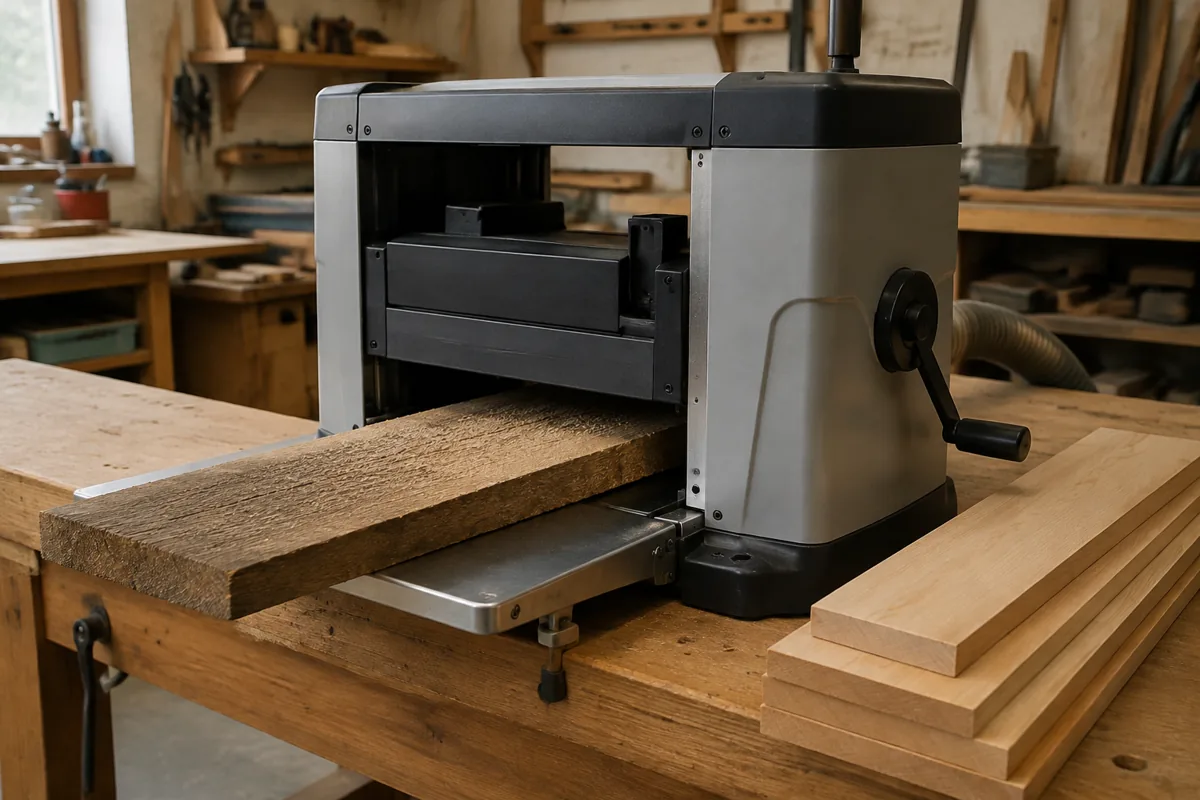
Planer blowout on thin stock isn’t a mystery. It’s leverage. A standard benchtop or stationary planer pushes wood through with serrated steel feed rollers under spring pressure. On 3/4-inch stock that pressure doesn’t matter. On stock under 1/4-inch (6mm), the board is flexible enough to bow, vibrate, and lift into the cutterhead. When the knives grab unsupported grain, the board shatters, folds over the cutterhead, or shoots back out. Snipe gets worse for the same reason.
Three failure modes account for almost all blowout: The roller compresses the thin board and it springs up into the knives on exit. The knives lift the board because the stock is too light to stay flat on the bed. And unsupported end grain or figured grain chips out because there is not enough mass behind the cut to resist the impact. Any method that works addresses one or more of those problems by supporting, weighting, or reducing the cut force.
Know Your Planer’s Real Minimum
Most 12 to 15-inch planers list a minimum thickness of 1/8-inch (3.2mm) to 3/16-inch (4.8mm) in the manual. That is the mechanical limit where the feed rollers can still feed without the cutterhead hitting the bed. It is not the practical limit for clean cuts. For straight-grained hardwood with sharp knives, 1/4-inch is the realistic floor for a direct pass without a sled. For softwoods, figured maple, or anything with runout, expect tearout and chatter below 5/16-inch.
Depth of cut matters as much as thickness. Take more than 1/64-inch (0.4mm) per pass on stock under 1/4-inch and you double the lifting force. Helical or segmented cutterheads reduce blowout significantly because each small carbide insert takes a shearing cut instead of a full-width scoop, but they do not eliminate the flexibility problem. If you plan to mill a lot of thin stock, a helical cutterhead planer is the single best upgrade, but you still need support.
Method 1: The Carrier Sled (Best for Planing to 1/8-Inch)
A carrier sled or planer sled solves the support problem. You are not planing a thin board. You are planing a thick, flat sled with the thin board taped or glued to it. The rollers ride on the sled, the board stays flat, and the cutterhead sees a stable 3/4-inch package.
Build it from 3/4-inch MDF or Baltic birch plywood, 4 inches longer and 1 inch wider than your workpiece. It must be flat, with no twist. Wax the bottom lightly so it slides on the planer bed. Attach the thin stock with double-sided woodworking tape on the leading and trailing 2 inches only, or use a light mist of spray adhesive. Do not use hot glue blobs – they create bumps that telegraph through. Add a cleat at the trailing edge of the sled to prevent the workpiece from slipping back, but keep the cleat 1/16-inch thinner than your stock so the rollers don’t hit it.
Run the sled through with the grain direction correct and take 1/64-inch passes. Do not plane both sides in the sled. Flatten and thickness one side conventionally to about 5/16-inch, then flip the board, tape it flat-side-down to the sled, and plane the exposed face to final thickness. Limit length to at least 12 inches. Shorter pieces can pivot under the rollers even on a sled, and they are a kickback risk. If you need commercial consistency, a manufactured planer sled with adjustable clamps is faster than shop-made MDF, but a flat piece of MDF works just as well if it is truly flat.
Method 2: Resaw and Finish Without the Planer
The cleanest thin stock never goes through the planer at final thickness at all. Resaw on the band saw, then finish with a sander.
Resaw your board to 1/32 to 1/16-inch over final thickness on a band saw with a 1/2-inch or 3/4-inch, 3-4 TPI hook-tooth blade. A band saw with a tall fence and good tension will leave saw marks of 0.010 to 0.015-inch. Clean those with a drum sander or wide-belt sander. A single pass at 80 grit then 120 grit on a drum sander removes saw marks without any blowout risk and holds thickness to within 0.005-inch if you dial it in.
If you don’t own a drum sander, a simple sanding sled in the planer is not a substitute – never put sandpaper through a planer. For occasional thin stock, a flat substrate with adhesive sandpaper and a hand plane or card scraper is slower but safe. For anyone building boxes, drawer bottoms, or instrument parts repeatedly, a dedicated benchtop drum sander will save more ruined wood than any planer accessory.
Comparison: Which Method for Which Thickness
| Method | Best Thickness Range | Finish Quality | Risk / Trade-off |
|---|---|---|---|
| Direct Planing (no sled) | 1/4″ to 3/4″ | Good if straight grain and light cut | High blowout and snipe below 1/4″; board can crack |
| Carrier Sled + Light Cuts | 1/8″ to 1/4″ | Very good | Tape residue; sled must be flat; slow feed required |
| Band Saw Resaw + Drum Sander | 1/16″ to 1/4″ | Excellent, no tearout | Sander is slow; heat buildup on thin stock; higher cost |
| Resaw + Hand Scraper / Sanding Board | 1/16″ to 3/16″ | Excellent on figured wood | Labor intensive; hard to hold tight tolerance |
Use direct planing only if you are above 1/4-inch and can afford to lose a test piece. Use a sled for one-off panels and veneers down to 1/8-inch. Use resaw plus sanding for anything under 1/8-inch, for figured grain, or for production work where consistency matters.
Technique That Prevents Blowout
Support alone is not enough. Grain direction and feed control decide whether the cut shears or pries. Feed thin stock so the grain slopes down and away from the cutterhead, like petting a cat. If the grain dives into the cut, the knife will lift a chip ahead of itself and blow out the trailing edge. For boards with changing grain, diagonal feeding at 10 to 15 degrees can reduce tearout but watch for the sled to skew – keep side pressure against the planer bed rail.
Take 1/64-inch or less per pass. On most planers that is a quarter-turn of the height wheel or less. If your planer has a two-speed gearbox, use the slow feed rate. A slower feed gives more cuts per inch and less impact per knife. Wax the planer bed and the sled bottom before each session. A sticking sled hesitates under the rollers and then jumps, which guarantees snipe or a shattered leading edge. Back up thin stock with a sacrificial leader and trailer board of the same thickness if the ends are blowing out. A 6-inch offcut butted tightly to the front and back supports the grain at entry and exit.
Never plane stock shorter than the distance between the feed rollers, usually about 6 to 7 inches on a 13-inch benchtop and 8 to 9 inches on a 15-inch stationary machine. Short pieces tip up into the head. For narrow strips under 2 inches wide, gang them together with tape on the sled or plane a wider board and rip the strips afterward on the table saw.
When Not to Use the Planer at All
Some stock should never see a planer. Highly figured birdseye or curly maple under 3/16-inch will tear even with a helical head. End-grain cutting boards, cross-grain laminations, and panels with knots at the edge will catch and explode when thin. Plywood and MDF veneers delaminate under roller pressure. In those cases, resaw thick and sand to thickness, or start with commercially sliced veneer.
The cheaper option is often fine here. You do not need a $2,000 planer to make 1/8-inch drawer bottoms. A well-tuned 14-inch band saw for resawing and a 10-inch benchtop drum sander will produce flatter, more consistent thin stock than forcing a planer below its comfort zone. If you only need thin stock occasionally, a sled made from scrap MDF and a roll of double-sided tape costs under $20 and keeps your existing planer safe. Spend money on sharp knives or fresh carbide inserts before you spend it on a new machine. Dull knives are the fastest way to turn thin stock into kindling.