Woodpeckers Router Table Review: Does the Precision Justify the Price?
What's inside
As an Amazon Associate I earn from qualifying purchases. This post may contain affiliate links at no extra cost to you.
Yes—Woodpeckers’ router table system can justify its premium price for frequent users who value a machined-flat work surface, precise fence adjustment, and a platform that remains stable after years of setup changes, but it is excessive for occasional routing or a shop where space and budget matter more than repeatability.
As an Amazon Associate we earn from qualifying purchases at no extra cost to you.


Contents
What you are actually buying
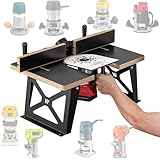
The term “Woodpeckers router table” can describe several configurations rather than one fixed product. The core system typically combines a thick phenolic or cast-iron router-table top, a precision router lift, an adjustable fence, and either a dedicated stand or a shop-built cabinet. That modular approach is important: you can buy the parts that solve your current problem instead of replacing the entire table later.
The main attraction is not simply a larger top. Woodpeckers focuses on flatness, controlled adjustment, and compatibility between its table, lift, insert plates, and fence components. For cabinet doors, raised panels, edge profiles, and repeated production work, those details reduce the small setup errors that accumulate across a project.
Flatness and surface quality
A router table top must resist sagging and provide a reliable reference for the workpiece. Woodpeckers’ phenolic tops are designed to be rigid, moisture-resistant, and machined flat, while its cast-iron options add substantial mass and vibration resistance. A typical top is approximately 24 by 32 inches, giving enough support for wide panels without becoming as cumbersome as a full-size shaper table.
| Characteristic | Woodpeckers-style premium system | Typical budget router table | Practical consequence |
|---|---|---|---|
| Common top size | About 24 × 32 inches | About 16 × 24 inches | More support for panels and long stock |
| Top construction | Machined phenolic or cast iron, depending on configuration | Stamped steel, laminated MDF, or molded composite | Premium tops are less likely to develop uneven reference areas |
| Insert opening | Interchangeable insert rings, commonly up to roughly 3½ inches | Often a fixed opening or fewer ring choices | Better support around smaller bits and more flexibility with larger cutters |
| Fence length | Typically around 32 inches across the table | Often 24 inches or less | Improves support for long stock and broad workpieces |
| Lift adjustment | Above-table height adjustment, commonly in 1/64-inch increments or finer | Usually adjusted beneath the table | Faster, more repeatable bit-height changes |
| Approximate system weight | Roughly 70–150 pounds, depending on top, lift, and stand | Roughly 25–60 pounds | Premium systems stay put but are harder to move |
The exact dimensions and weight vary by model, so buyers should confirm the current configuration before ordering. The important distinction is that the table is intended to function as a calibrated reference surface, not merely as a platform for holding a router upside down.
Fence quality: the feature that affects daily work most
A flat top is valuable, but the fence determines how confidently you can guide stock. Woodpeckers’ fences generally use a rigid aluminum body with adjustable faces and dust collection provisions. The better configurations allow the faces to be shimmed or positioned independently, which helps when jointing an edge or creating a controlled offset for a particular cut.
Micro-adjustment is especially useful when the fence needs to move by a few thousandths of an inch. Instead of loosening both clamps, nudging the fence, and hoping it stayed parallel, the operator can make a controlled change and lock it down. This matters for stopped cuts, joinery, and operations where the final pass must remove a very small amount of material.
There are limits. A precision fence does not correct a twisted board, a dull bit, or an incorrectly aligned insert plate. It also does not eliminate the need to check parallelism with a reliable straightedge or rule. The fence’s dust port can improve chip collection, but routing wide panels still produces debris outside the capture area unless the table is paired with effective overhead or side extraction.
Does the lift justify the cost?
For many buyers, the router lift is the part that changes the ownership experience. Above-table adjustment avoids reaching under the cabinet, and a fine-pitch mechanism makes small height corrections predictable. A lift also makes bit changes and collet access easier, although the router must be compatible with the lift’s motor carriage or adapter system.
That convenience has a price. A complete Woodpeckers router table package can reach the high hundreds or low four-figure range depending on the lift, top material, stand, and accessories. A basic table with a compatible router may cost only a few hundred dollars. The premium becomes easier to rationalize when the table is used several times a week.
Here is a simple ownership calculation. Suppose a complete premium setup costs $900 more than a functional basic table and is used 150 times per year for five years. That is 750 uses, or approximately $1.20 of added cost per use. If the system saves only five minutes of setup time per use, it returns more than 62 hours over that period. That calculation does not prove the premium is worthwhile, but it shows why repeat users value fast, repeatable adjustment.
Durability under daily use
The parts most likely to remain reliable are the table top and the structural fence body. Phenolic surfaces do not rust and tolerate ordinary shop humidity, while cast iron offers excellent mass but needs occasional protection against corrosion. The components that deserve closer attention are the fine-adjustment screw, locking hardware, insert rings, and router-lift carriage.
- Fine-adjustment mechanism: Dust and pitch can make the screw feel rough. Brush or vacuum debris away rather than forcing the adjustment.
- Insert rings: Rings can be damaged by dropped bits or overtightened screws. Keep spare rings for common cutter sizes.
- Fence faces: Replaceable faces eventually show grooves, burns, or impact damage. Keeping them sacrificial is preferable to trying to preserve them indefinitely.
- Cast-iron surfaces: Wipe them clean and apply a suitable non-silicone table protectant when the shop is humid.
- Locking knobs and bolts: Hand-tighten evenly. Excessive force can distort alignment or damage threads.
One common mistake is leaving the router mounted with a large bit installed while storing the table. That places unnecessary load on the lift and increases the chance of an impact. Another is allowing chips to collect below the insert plate, where they can prevent the plate from seating flush.
Which setup fits your situation?
| Your situation | Best choice | Why |
|---|---|---|
| Occasional routing, limited budget | Basic table with a flat top and competent fence | The premium lift and accessories will be underused |
| Several projects per month | Woodpeckers top and fence, with a compatible lift if height changes are frequent | Improves setup repeatability without requiring every accessory |
| Daily cabinet or furniture work | Complete Woodpeckers system with lift, rigid stand, and dust collection | Stability and fast adjustment have measurable workflow value |
| Very small shop | Modular top installed in a mobile or fold-down cabinet | Preserves the precision surface while reducing permanent floor space |
| Heavy wide-panel work | Heavier top, extended support, and a long rigid fence | Reduces vibration and keeps stock supported before and after the cutter |
Setup details that determine whether precision survives
- Level the insert plate with the top. Use the plate’s leveling screws and check it from multiple directions. Even a small lip can catch thin stock.
- Check fence parallelism. Measure from the miter slot or another fixed reference at both ends before locking the fence.
- Verify router collet engagement. Insert the bit fully, then withdraw it slightly before tightening so the shank does not bottom out inside the collet.
- Make a test cut in scrap. Confirm bit height, fence position, and feed direction before routing the project part.
- Clean after substantial sessions. Vacuum around the lift, fence tracks, and insert opening; pitch left in adjustment mechanisms becomes abrasive contamination.
Final verdict
Woodpeckers router tables are best understood as workflow and repeatability equipment rather than as simple router holders. The machined-flat surface, rigid fence, modular inserts, and above-table adjustment can make daily routing faster and more consistent, particularly for cabinet doors, joinery, and repeated profiles. The price is difficult to defend for occasional use, a temporary workshop, or users who are still learning basic router-table technique.
For a serious hobbyist or professional who will use the table weekly, the premium is most defensible when purchasing the system selectively: prioritize the flat top, fence, and compatible lift, then add the stand and accessories as the shop’s needs become clear. That approach captures the main advantages of Woodpecker router tables without paying for components that will spend most of their lives unused.