Table Saw vs Planer for Producing Uniform Cabinet Components
What's inside
As an Amazon Associate I earn from qualifying purchases. This post may contain affiliate links at no extra cost to you.
For cabinet work, a table saw and a planer solve different problems. A table saw makes parts the correct length and width. A planer makes boards uniform in thickness and gives opposite faces a parallel relationship. Neither machine replaces the other, and choosing based only on the machine that costs less usually creates extra work later.
If your cabinet parts start as rough lumber, the planer is usually the more important machine for producing consistent solid-wood components. If you already have surfaced boards and mainly cut plywood, sheet goods, or prepared panels, a table saw is the better first purchase.
As an Amazon Associate we earn from qualifying purchases at no extra cost to you.


Contents
What Each Machine Actually Does
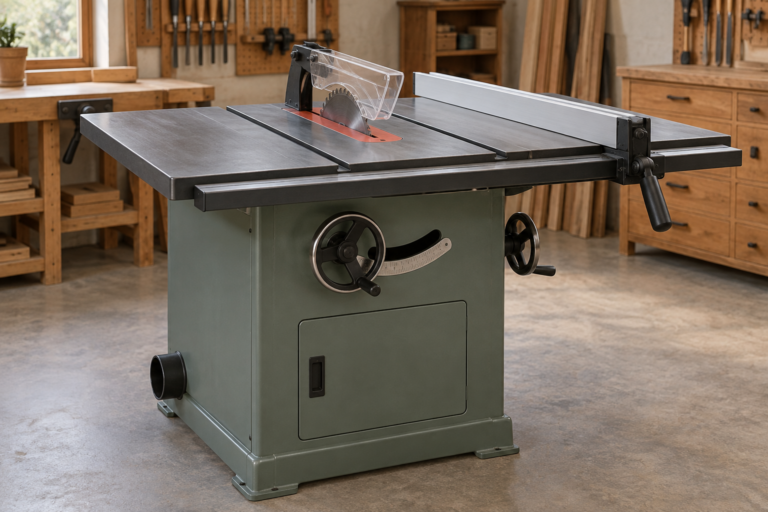
A table saw cuts stock along a defined line. With a properly aligned fence, it can rip cabinet stiles, rails, face-frame parts, shelves, and strips to repeatable widths. A crosscut sled or miter gauge handles accurate length cuts. The machine references one edge or face at a time; it does not make rough stock flat or uniform in thickness.
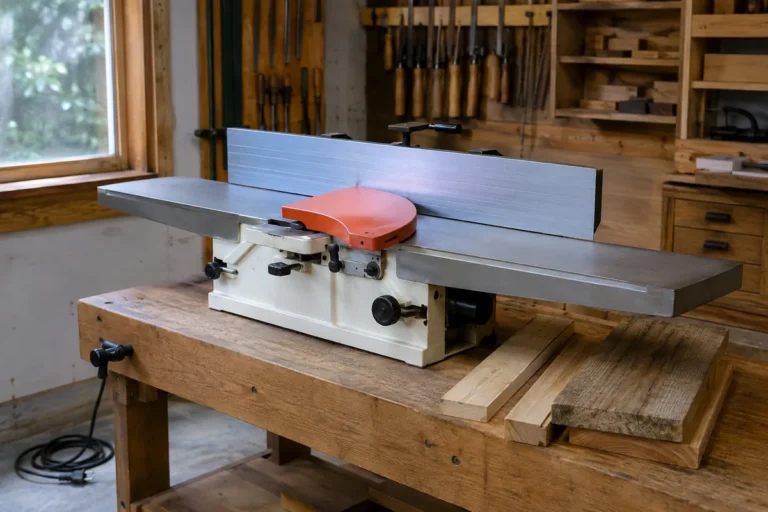
A planer, also called a thickness planer, cuts the top surface of a board while the bottom surface rides on the bed. It is excellent for making a batch of boards the same thickness. For example, you can turn several boards into parts measuring 18 mm (about 23/32 inch) or 19 mm (3/4 inch), provided the boards already have a reasonably flat reference face.
The planer follows the existing bottom face. If that face is twisted, bowed, or badly cupped, the top face can become parallel to a poor reference rather than truly flat. That is why a jointer, sled, or careful hand-tool preparation may be needed before planing.
Table Saw vs Planer for Cabinet Parts
| Task | Table saw | Planer |
|---|---|---|
| Rip a 3-inch-wide stile | Excellent | Not possible |
| Make ten boards the same thickness | Possible, but slow and limited | Excellent |
| Cut plywood panels | Excellent with support and a suitable blade | Usually unsuitable |
| Flatten a twisted board | Unsafe or impractical | Not by itself |
| Cut repeatable crosscuts | Excellent with a sled or stop system | Not possible |
| Produce matching solid-wood door parts | Needs already-uniform stock | Excellent for thickness, then use the saw for width and length |
When the Table Saw Should Come First
Buy a table saw first if most of your cabinet work involves plywood, MDF, melamine, or lumber that is already surfaced on four sides. Cabinets commonly require many repeatable cuts: 24-inch-deep sides, 3-inch face-frame strips, narrow edging, and shelves cut to identical lengths. A stable fence and reliable outfeed support matter more than maximum motor size.
A table saw is also the more versatile machine for joinery. It can cut rabbets and dados with an approved dado setup where permitted, make splines, and produce tenons with a jig. A planer cannot perform any of those operations. For sheet goods, use a blade intended for plywood or laminate, support the full panel, and prevent the offcut from pinching the blade.
The main failure mode is assuming the fence alone guarantees accuracy. A fence that is not parallel to the blade can cause burning, wandering cuts, or kickback. Check blade alignment, fence position, throat-plate fit, and dust extraction before making cabinet parts. A quality contractor table saw for cabinet making is often a better choice than a cheaper saw with a flimsy fence.
When the Planer Should Come First
Choose a planer first when you buy rough-sawn hardwood or need to match existing solid-wood components. Rough boards can vary by several millimeters in thickness, even when they look similar. A planer lets you process a batch to one setting, then rip every piece to the same width on the table saw.
For cabinet doors, face frames, and solid-wood edging, consistent thickness prevents uneven joints and visible steps at glue lines. It also makes later routing and sanding more predictable. A planer with a 12- or 13-inch capacity handles most home-shop cabinet stock; a wider machine is useful for broad panels but costs more and needs more space.
Do not feed painted, dirty, or nail-embedded stock through the cutterhead. Metal can damage knives or create a dangerous projectile. Take light passes—often 1/32 inch or less on difficult grain—and leave the final 1/64 to 1/32 inch for a cleanup pass. A 12-inch thickness planer is generally enough for typical cabinet components.
The Best Workflow Uses Both
For solid wood, start by jointing one face and one edge, or use a planer sled if you do not own a jointer. Plane the opposite face until the board reaches a consistent thickness. Joint or straighten one edge, then rip the board to width on the table saw. Finally, crosscut parts to length using a stop block or sled.
This order prevents a common mistake: ripping rough stock first and then trying to plane narrow strips. Narrow pieces can tip, rock, or become difficult to hold safely. It is usually more efficient to flatten and thickness a wider board, then rip several cabinet parts from it.
For plywood, skip the planer. Break down the sheet with a track saw, circular saw, or panel-cutting jig, then use the table saw for accurate final sizing. A planer can chip veneer, expose core material, and create a panel too thin for the intended hardware.
Cost, Space, and Buying Advice
A basic thickness planer can be cheaper than a well-equipped table saw, but it still needs infeed and outfeed space. A 4-foot board may require more than 10 feet of clear travel once support stands are included. Planer knives and cutterhead inserts are consumables, and feed rollers can leave marks if dirty or incorrectly adjusted.
Table saw ownership brings different costs: a stable stand, outfeed table, quality blade, dust collection, and accurate measuring accessories. A low-cost saw can be fine for occasional shelving if its fence locks firmly and the blade stays aligned. It is a poor bargain if repeated cabinet parts vary by 1/16 inch or more.
If budget allows only one machine, buy the table saw for plywood-based cabinets and the planer for rough hardwood work. If you build mixed cabinets, prioritize the table saw, then add a planer. A jointer may be the next purchase when rough boards are frequently twisted or cupped; without a reliable flat reference face, even the best planer cannot produce truly flat cabinet stock.