Best Table Saws with Long Rip Capacity for Cabinet Panels
What's inside
As an Amazon Associate I earn from qualifying purchases. This post may contain affiliate links at no extra cost to you.
A cabinet panel can be wider than a table saw’s rip capacity even when the saw is otherwise capable of the job. Rip capacity is the distance from the blade to the fence when it is positioned on the right side. For sheet goods, look for at least 30 inches; 36 inches gives more room for common 48-inch-wide panels, though a helper or outfeed support is still essential. Capacity is not the same as safe handling: a large panel can tip, bind, or pull away from the fence if it is unsupported.
As an Amazon Associate we earn from qualifying purchases at no extra cost to you.

Contents
How much capacity do cabinet panels need?
A 4-by-8-foot sheet is 48 inches wide. If you need a 30-inch cabinet side from it, a saw with 30 inches of rip capacity can make that cut, but the remaining strip will be awkward to control. A 36-inch fence opening provides more flexibility for breaking down panels, yet it does not let you safely rip a full sheet alone on a small shop saw.
For cabinet work, plan the cut around the sheet’s long edge and use a track saw or a panel-cutting station for the first breakdown when practical. Then use the table saw for narrower, more manageable pieces. This reduces the chance of a sheet levering against the fence or trapping the blade as the cut closes.
Table saw types compared
| Type | Typical right-side capacity | Best fit | Main trade-off |
|---|---|---|---|
| Contractor-style saw | About 30 inches | Small shops and occasional cabinet panels | Less capacity and support than larger cabinet saws |
| Hybrid saw | About 30–36 inches | Frequent furniture or cabinet work in a home shop | Needs floor space and a suitable electrical circuit |
| Cabinet saw | About 36–50 inches | Regular production and large panels | High cost, weight, and space requirements |
| Portable jobsite saw | Often around 24–32 inches | Site work or limited storage | Lightweight stands and smaller tables are less forgiving with sheet goods |
What to prioritize when buying
The fence matters more than a large number on the spec sheet. It should lock without shifting at the front or rear, stay parallel to the blade, and provide solid support across its full extension. A fence that moves even slightly can spoil a cabinet panel; if the workpiece is pinched between blade and fence, it can also kick back. Check that the fence rails do not flex when extended and that the locking mechanism is easy to verify.
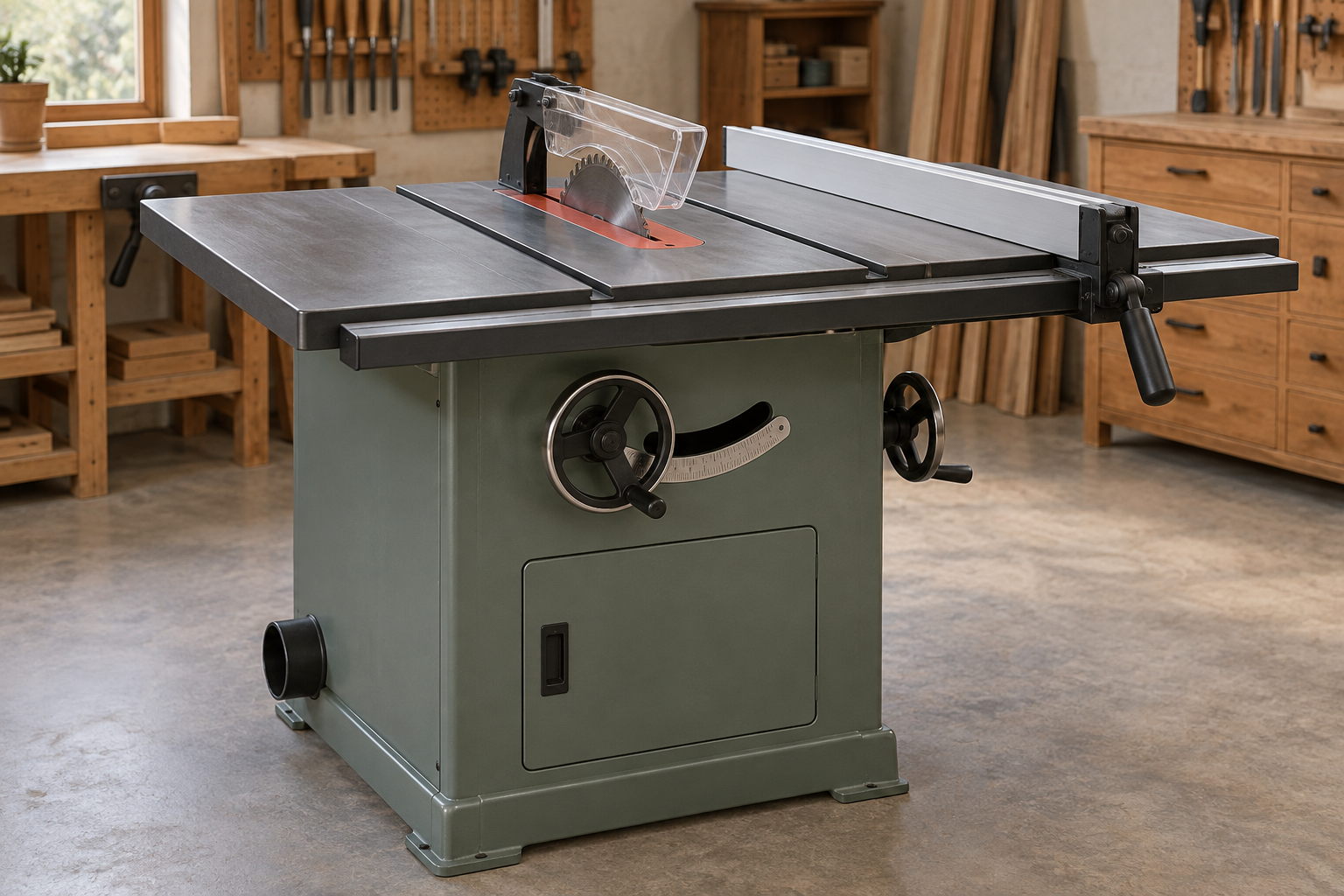
For a stationary shop, a hybrid or cabinet saw with a 36-inch fence system is a practical target. A 30-inch setup is enough for many cabinet parts if you break down sheets first. Choose a hybrid table saw with a 36-inch rip system when you want a substantial fence and cabinet-shop capability without moving up to the largest industrial footprint.
Cabinet saws generally offer heavier trunnions and more stable tables, but the extra mass does not compensate for poor material support. A cabinet table saw with extended rip capacity makes sense if you routinely cut large panels and have space for the rails, extension table, and outfeed support. Measure the complete installed footprint, not just the saw cabinet. Long rails can make a machine difficult to fit through a shop layout.
When a cheaper saw is enough
If you cut sheet goods only a few times a year, a 30-inch contractor-style saw may be the sensible choice. Spend the savings on a stable outfeed table, a sharp quality blade, and a track saw for sheet breakdown. A contractor table saw with a 30-inch rip capacity can handle cabinet parts after rough sizing, provided its fence is accurate and the stand does not rock.
A jobsite saw can also work for occasional cabinet projects, but its narrow table and light stand make large-panel cuts harder to control. Do not buy one expecting the maximum advertised capacity to make full-sheet ripping easy. If you cannot support the panel on both sides of the blade and beyond the saw, use another method for the first cut.
Making the cut safely and accurately
Before cutting, check blade alignment and fence parallelism. A practical starting point is to align the fence parallel to the blade, or very slightly open at the rear, according to the saw maker’s instructions. Use a sharp 40-tooth or 60-tooth combination blade for general plywood work; a dedicated high-tooth-count plywood blade can reduce veneer tear-out, but it may feed more slowly. Test on scrap from the same sheet because plywood cores and veneers vary.
Support the panel so it stays flat and cannot rotate as the cut begins or finishes. Use an outfeed table or roller support, and have a helper support the offcut without pulling it sideways. Keep hands clear of the blade and use the riving knife and guard whenever the operation allows. Never stand directly behind the stock, and stop if the panel binds, lifts, or begins to close on the blade.
Measure the actual fence-to-blade distance rather than trusting a rail scale alone. On an extended fence, verify the measurement at the blade and lock the fence before feeding. A scale can be off by a fraction of an inch after setup, enough to create cabinet parts that do not match. Make a test cut, measure the result, and adjust the scale or use a reliable stop reference for repeat parts.
Choosing for your shop
For regular cabinet-panel work, favor a stable stationary saw with a dependable 36-inch fence system, room for outfeed support, and a motor suited to your electrical supply. A 30-inch saw is a reasonable lower-cost choice when panels are broken down before they reach the table. Choose a larger cabinet saw only if you will use the added capacity often and can safely support the material; otherwise, the money and floor space are better spent on panel-handling equipment.