Best Table Saws for Repetitive Dado Cuts in a Small Shop
What's inside
As an Amazon Associate I earn from qualifying purchases. This post may contain affiliate links at no extra cost to you.
Contents
What matters for repetitive dado work
A dado is a flat-bottomed groove cut across the grain, usually to house a shelf or divider. Repeating the same dado in a small shop puts a premium on a stable fence, a dependable depth setting, and a way to keep stock square against the fence. The saw’s maximum rip capacity matters less than whether you can make the same cut reliably without wrestling a long board around the machine.
First check that the saw’s manual permits a stacked dado set. Many jobsite saws accept blades up to 8 inches, but arbor length, flange design, and the manufacturer’s instructions determine whether a particular stack fits. Don’t assume that removing a washer or using an improvised arbor arrangement makes an incompatible setup safe. If the saw manual prohibits dado sets, use a router or make multiple standard-blade passes instead.
As an Amazon Associate we earn from qualifying purchases at no extra cost to you.


For repeated cuts, a dado stack typically includes two outer blades and chipper blades. A common 8-inch set can cut grooves roughly 1/4 to 13/16 inch wide, though the exact range depends on the set. Test the width on scrap from the actual project: plywood thickness is often undersized or oversized, and a nominal 3/4-inch sheet may not fit a 3/4-inch groove.
Which saw type suits a small shop?
| Saw type | Best fit | Dado-cut trade-off |
|---|---|---|
| Contractor-style or hybrid saw | A shop with room for a permanent setup | Heavier tables and fences can help with repeatability; check dado compatibility and available arbor length. |
| Benchtop or jobsite saw | Limited space or occasional breakdown and storage | Usually less costly and compact, but a short table and lighter fence can make large panels harder to control. |
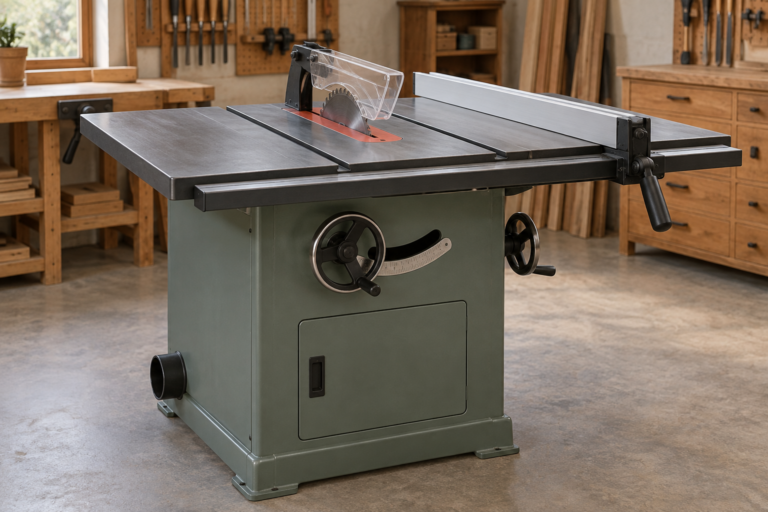
| Cabinet saw | Frequent production and a dedicated machine footprint | Mass and table support are useful, but the price, weight, and space needs are difficult to justify for occasional dados. |
For a small shop making cabinets or shelving regularly, a solid contractor-style or hybrid saw is often the practical middle ground. A cabinet saw is not automatically the right buy: it takes substantial floor space and may offer little benefit if the main problem is supporting wide panels. A compact saw can work well when paired with outfeed support and a careful workflow.
Features worth checking before you buy
Fence alignment and locking: The fence should lock parallel to the blade without shifting as you tighten it. Check it at the front and rear of the table, then repeat after unlocking and relocking. A fence that moves a small amount can turn a snug shelf fit into a visibly loose one across several parts.
Table and stock support: A longer table is helpful, but it does not replace an outfeed stand or a helper when handling full sheets. In a tight shop, a folding or mobile support may be more useful than buying the largest saw that fits. Keep the work supported so it cannot tip or pull away from the fence.
Dust collection and guard setup: Dado stacks throw chips, and some saws collect them less effectively than they do with a standard blade. Use the dust port and an appropriate dado throat plate; install or adjust guarding as the manufacturer directs. Never cut with a plate opening that leaves a gap where small offcuts can fall into the saw.
Blade and arbor compatibility: Confirm the saw’s stated dado capacity, arbor dimensions, and required throat plate before choosing a stack. A quality 8-inch stacked dado set is useful only if it fits the saw and produces a clean bottom in your material. Chippers and outer blades must be installed in the set’s specified order and orientation.
Buying options for a small shop
If the saw will stay set up and dados are a routine part of the work, compare dado-compatible hybrid table saws by fence performance, table support, and the manufacturer’s stated dado capacity—not horsepower alone. For a shop that needs to pack the machine away, a dado-compatible jobsite table saw can be a sensible compromise. Verify compatibility in the manual for the exact saw, since product listings can be incomplete.
Choose a router instead if you only need a few grooves, the saw does not support a dado stack, or the work is too large to control safely on the table. A straightedge guide or router jig takes setup time, but avoids buying a heavier saw just for one operation. Multiple passes with a regular blade also work for narrow dados, although they require accurate fence resets and usually leave a less clean bottom.
How to make the cuts repeatable
Build a simple checklist into the setup. Use scrap to dial in the stack width, set the depth, and confirm the groove fit before cutting project parts. Measure depth from the table to the tooth tips; a groove around 1/4 to 3/8 inch deep is common for shelf joinery, but follow the design and material thickness rather than treating that range as a rule. A digital caliper or a test-fit block helps catch errors before they multiply.
Make a stop block for repeated crosscuts, but do not trap the offcut between the stop and the blade. Keep the stop positioned so the cutoff can move free after the cut. For a dado cut, use a crosscut sled or miter gauge with a securely attached sacrificial fence when the work crosses the blade. Keep hands out of the blade path and use push blocks where they improve control; never freehand the stock.
Common failures are a groove that is too wide, a ragged edge from tear-out, and a workpiece that lifts or skews during a pass. A sharp, clean stack and a steady feed help with tear-out. For plywood, test the face veneer and consider a shallow first pass before reaching final depth. If the stock rocks, bows, or cannot be held flat, stop and improve the support rather than trying to force it through.
For most small shops, buy the saw that fits the space and supports the stock safely, then spend time on fence alignment, a suitable dado plate, and a repeatable stop or sled. Those details usually matter more to consistent joinery than moving up to a larger motor or cabinet-sized machine.