How to Choose a Stationary Table Saw for a Home Workshop
What's inside
As an Amazon Associate I earn from qualifying purchases. This post may contain affiliate links at no extra cost to you.
Contents
Start With the Workshop, Not the Saw
A stationary table saw is useful only when you can leave it set up, feed stock into it safely, and collect its dust without constantly rearranging the room. Measure the available footprint first. Allow at least 3 feet of clear space on each side of the blade and 6 feet in front and behind it for full-sheet or long-board cuts. In a small garage, the saw may fit physically but still be impractical if a car, workbench, or wall blocks the outfeed path.
Check the electrical supply before shopping. Most home-workshop saws run on 120 volts and draw close to the practical limit of a 15-amp circuit. A 15-amp saw can work well, but a long extension cord, shared circuit, or damp lumber can cause nuisance breaker trips and slow the blade. A 240-volt saw usually delivers more consistent power, but it may require a dedicated circuit and electrician. Do not choose 240 volts simply because the number sounds better; it is worthwhile mainly for frequent ripping of thick hardwood.
Choose the Right Saw Type
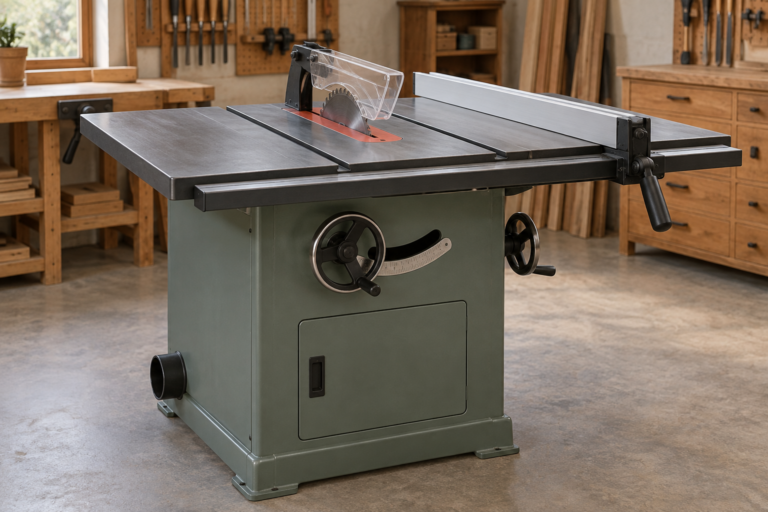
For a permanent home workshop, the main choices are a contractor-style saw, a hybrid saw, and a cabinet saw. Their practical differences matter more than marketing terms.
| Type | Typical strengths | Typical drawbacks | Best fit |
|---|---|---|---|
| Contractor-style | Lower cost, movable, usually 120-volt | More vibration, weaker dust collection, smaller stock capacity | Occasional DIY work and smaller shops |
| Hybrid | Quieter, heavier, enclosed base, better alignment | Costs more and is less portable | Most serious home workshops |
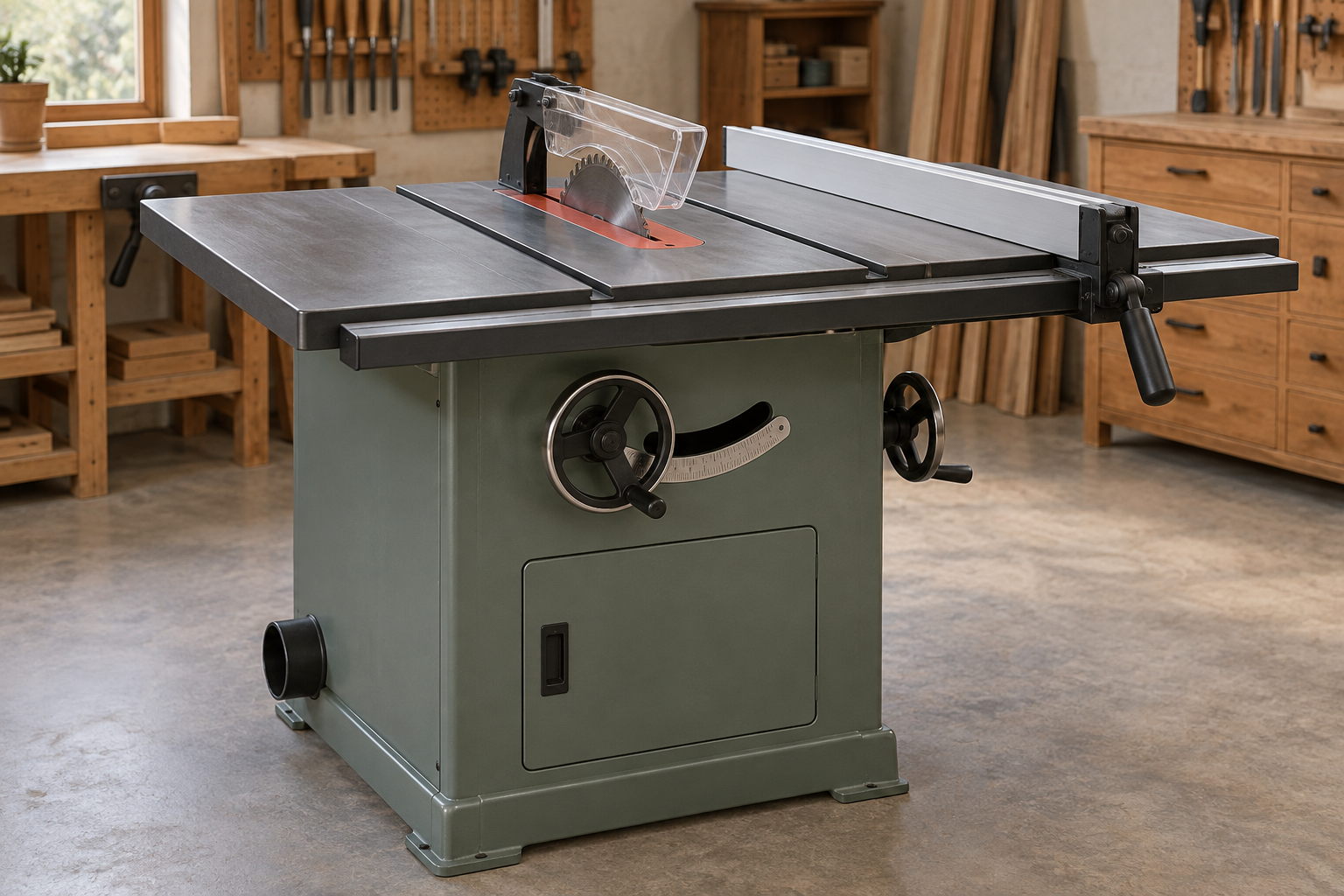
| Cabinet | Strong motor, rigid table, excellent dust control and stability | Expensive, heavy, often needs 240 volts | Frequent hardwood work and built-in shops |
A contractor table saw is the sensible cheaper option when you mostly cut construction lumber, plywood, shelving, and occasional hardwood. It can produce accurate work, but expect to spend time tuning the fence, checking the blade alignment, and controlling vibration. A hybrid saw is often the better long-term purchase if the machine will stay in one place and your budget allows it.
Evaluate Motor Power and Cutting Capacity
Horsepower ratings are not directly comparable because manufacturers measure motors differently. Look instead at blade size, cutting depth, rip capacity, and how the saw behaves under load. A standard 10-inch blade should cut roughly 3 to 1/8 inches at 90 degrees and about 2 to 1/4 inches at 45 degrees. That is enough for 2-by material and most cabinet work. A 12-inch saw cuts deeper but costs more, needs larger blades, and is usually excessive for basic home projects.
Rip capacity describes the distance from the blade to the right side of the fence. About 24 inches handles most narrow cabinet parts and general joinery. Around 30 to 32 inches is more useful for breaking down plywood. A stated capacity is not enough: inspect the fence rails and table extensions. A wide fence that flexes or locks unevenly is less useful than a smaller, rigid one.
For thick hardwood, the saw’s ability to maintain blade speed matters more than its no-load rating. If the blade slows dramatically, the cut can burn, wander, or kick back. Use a sharp, appropriate blade and make multiple passes when necessary. Do not force a dull blade through oak to compensate for an underpowered saw.
Prioritize the Fence, Table, and Adjustments
The rip fence is the part you use on nearly every cut. It should lock at both ends without moving, remain parallel to the miter slot, and stay square to the table. A fence that shifts by even 1/16 inch can turn a repeatable cabinet cut into a tapered part. Test the locking action in the store if possible, or read owner reports specifically about fence deflection rather than general star ratings.
Cast iron tables are heavy and stable, while stamped steel tables reduce cost and weight. A flat cast-iron surface is valuable for hardwood and repeated work, but it can rust in an unheated garage. Wax the table periodically and keep humidity under control. Steel extensions are fine if they sit flush with the main table. A lip or dip at the joint can catch plywood and spoil a cut.
The blade should tilt smoothly and return reliably to 90 degrees. Look for accessible handwheels, a clear bevel scale, and a positive stop at 45 degrees. Before relying on any saw, verify the stops with a square. Factory settings are not guaranteed to survive shipping.
Do Not Treat Safety Features as Optional
Buy a saw with a riving knife that stays close to the blade and can be used with the blade guard. The knife helps prevent the kerf from closing and launching the workpiece backward. A blade guard protects fingers and improves dust control, so remove it only when the cut genuinely requires it and use another suitable method of protection.
A magnetic or large paddle-style power switch is easier to hit in an emergency than a small toggle. Anti-kickback pawls are useful, but they do not replace correct stock support, a sharp blade, and a properly aligned fence. Never stand directly behind the blade. Support long stock with an outfeed table or roller support; an unsupported board can lift, bind, and kick back as its weight comes off the table.
Dust collection is another buying criterion, not an accessory. A fully enclosed cabinet generally captures dust better than an open contractor stand, but neither is perfect without a suitable collector. A shop vacuum may handle a contractor saw for occasional cutting; frequent work benefits from a 1- to 2-horsepower dust collector and a 4-inch hose. Fine dust escaping below the blade is both a cleanup problem and a respiratory hazard.
Spend Money Where It Improves the Cut
When funds are limited, choose a rigid fence and a flat table before paying for a larger motor or oversized rip capacity. A hybrid table saw is a strong middle ground for a fixed workshop. If you mainly cut sheet goods, put part of the budget toward an outfeed table, support rollers, and a quality combination blade. Those additions often improve results more than moving from one modest motor rating to another.
A cabinet table saw makes sense when you cut hardwood every week, need low vibration for joinery, or want a machine that can remain accurately set for years. It is not automatically safer or more accurate out of the box; alignment, blade selection, stock support, and operating habits still determine the cut. Before buying, confirm the saw fits your electrical service, dust collector, doorway, and available outfeed space.