How to Choose Table Saw Motor Voltage for a Stationary Workshop
What's inside
As an Amazon Associate I earn from qualifying purchases. This post may contain affiliate links at no extra cost to you.
Contents
Why Motor Voltage Matters on a Stationary Table Saw
Motor voltage is not a measure of cutting power by itself. A 2-hp motor can usually produce roughly the same mechanical output on either 120 or 240 volts when it is designed for dual-voltage operation. The difference is how much current the motor draws from the circuit.
At 120 volts, the motor needs approximately twice the amperage it needs at 240 volts. That matters in a stationary workshop because long wire runs, shared receptacles, undersized extension cords, and weak branch circuits cause voltage drop. Voltage drop makes a motor run hotter and can prevent it from reaching full speed before the blade enters the wood.
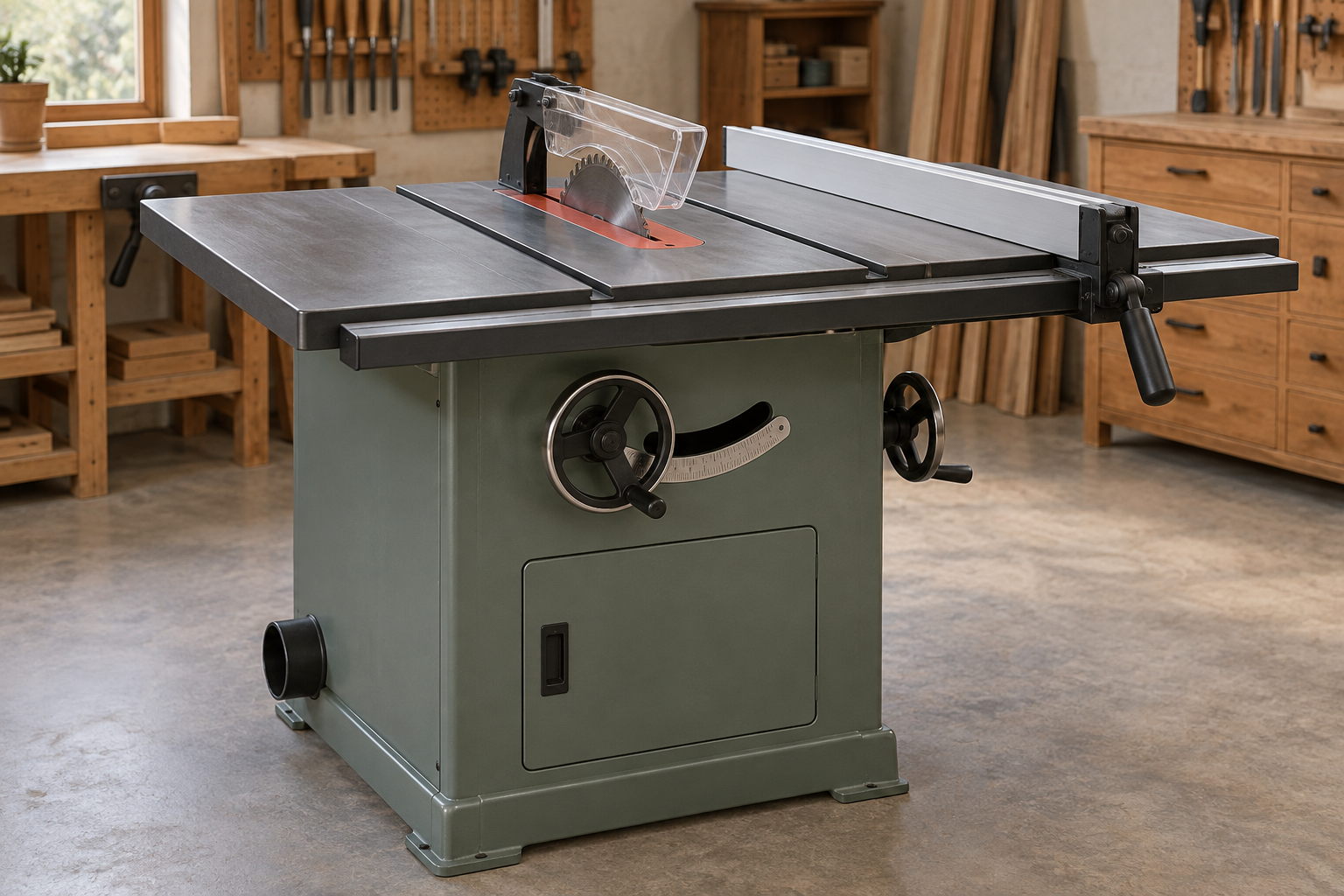
For a contractor-style or cabinet-style saw that stays in one location, a 240-volt table saw is often the cleaner installation. It is not automatically a stronger saw, but it puts less stress on the branch wiring and leaves more capacity on the 120-volt circuits for dust collection, lights, and smaller tools.
120 Volts Versus 240 Volts
| Factor | 120-volt motor | 240-volt motor |
|---|---|---|
| Typical current for a 2-hp motor | About 15–20 amps, depending on the motor | About 8–10 amps, depending on the motor |
| Installation | Usually works with an existing receptacle | Needs a correctly wired 240-volt circuit and receptacle |
| Best use | Small saws, portable setups, light-duty work | Permanent machines, heavy cuts, long work sessions |
| Main drawback | Higher current and greater sensitivity to voltage drop | Less convenient if you move the machine or lack a suitable circuit |
A 120-volt saw is perfectly adequate for many home shops. If you cut mostly plywood, softwood, and ordinary hardwood at moderate feed rates, a properly wired 120-volt machine can perform well. The cheaper option is fine when the saw has a dedicated 20-amp circuit, the motor is not routinely stalled, and you are not running a dust collector from the same circuit.
Choose 240 volts when the saw has a 3-hp motor, you regularly rip thick hardwood, or the machine will run for hours in a fixed location. The lower current can reduce nuisance breaker trips and makes a long, permanent installation more forgiving. It does not eliminate the need for correct wire sizing or proper overload protection.
Read the Motor Nameplate, Not Just the Horsepower
Manufacturers sometimes advertise peak or “developed” horsepower rather than the motor’s continuous rating. Look at the nameplate for voltage, full-load amperage, phase, frequency, and service factor. A dual-voltage nameplate may list something similar to 120/240 volts and two different amperage figures. The motor must be connected internally for the voltage you plan to use.
Do not assume that every motor marked “2 hp” can be converted to 240 volts. Some smaller motors are 120-volt only. Others require a different switch, plug, or magnetic starter when changing voltage. If the manual gives a wiring diagram, follow it exactly. A wrong connection can damage the windings or create a shock hazard.
Starting current is also important. Induction motors can draw several times their running current for a fraction of a second while coming up to speed. A circuit that barely supports the nameplate amperage may still trip during startup, especially if a dust collector or another motor starts at the same time.
Match the Circuit to the Machine
Use the motor’s nameplate amperage and the manufacturer’s instructions to select the branch circuit. A 120-volt saw rated at 15 amps should not share a circuit with a high-current dust collector. A 240-volt saw may use a 20-amp, 30-amp, or larger circuit depending on its rating and starting requirements; do not choose the breaker simply because the receptacle is available.
Keep the permanent wiring short and use the wire size required by local code. If the panel is 75 feet from the saw, or the wiring passes through a detached garage, have an electrician calculate voltage drop rather than guessing. A long run of undersized cable can leave a motor seeing substantially less than its rated voltage under load.
Extension cords are a common failure point. A light 16-gauge cord may work for a small drill press but is a poor choice for a table saw. For high-current 120-volt equipment, use the shortest heavy-gauge cord that the manufacturer permits. With a stationary machine, installing the correct receptacle is usually safer and more convenient than relying on an extension cord.
Check Phase and Switching Requirements
Most residential stationary woodworking machines use single-phase power. Three-phase motors are common in commercial shops but require appropriate three-phase service or a properly selected phase converter or variable-frequency drive. A standard residential 240-volt receptacle will not run a three-phase motor just because both systems are called 240 volts.
For a motor changed from 120 to 240 volts, the existing switch may not be suitable. The saw may need a two-pole switch or a magnetic starter that disconnects the correct conductors. A magnetic switch is useful in a workshop because it helps prevent automatic restarting after a power interruption. That feature is worth considering on any permanently installed saw, planer, or jointer.
Choose Around Your Whole Workshop
Do not evaluate voltage in isolation. A 240-volt table saw can free a 120-volt circuit for a 120-volt dust collector, but a 240-volt dust collector may still be the better overall arrangement if your shop runs several large machines. Planer and jointer motors often have similar voltage choices, while drill presses and small band saws are commonly easier to keep on 120 volts.
For a new stationary shop, map the machines by voltage and current before buying. Put large motors on dedicated circuits, avoid operating two high-load machines simultaneously, and leave capacity for lighting and dust collection. If you are replacing an existing saw and already have a sound 20-amp 120-volt circuit, staying with 120 volts may be the least expensive and entirely satisfactory choice.
If you are buying a permanent cabinet saw, upgrading to 240 volts, or building a new shop, a correctly rated 240-volt magnetic starter can be a sensible part of the installation. Have the circuit and connections checked by a qualified electrician when the panel, receptacle, or motor wiring is unfamiliar. The right voltage is the one that matches the motor, the circuit, and the way you actually work.