How to Joint Boards with Severe Bow and Crook
What's inside
As an Amazon Associate I earn from qualifying purchases. This post may contain affiliate links at no extra cost to you.
Severely bowed or crooked boards are difficult because a jointer and planer can only make a surface flat after the board is held securely. A twisted board may rock on the jointer bed, while a bowed board can spring back after a cut. The goal is not to force every board through one machine. It is to create one reliable reference face and one straight edge in stages.
Contents
Inspect and Mark the Board
Set the board on a flat workbench or the outfeed table of your planer. Check it from both faces and edges. A straightedge, winding sticks, and a long ruler will reveal bow, crook, and twist. Mark the high spots with chalk or pencil. Also mark the intended finished face and edge.
Measure the board before cutting. If a 1-inch-thick board has a 3/8-inch bow, it may not contain enough material to flatten conventionally. Check the grain direction and look for loose knots, splits, nails, and end checks. Remove metal before using any machine. Boards with severe defects are often best crosscut into shorter pieces rather than flattened whole.
Keep the board’s usable thickness in mind. A jointer may remove 1/16 inch or more before the board sits steadily, and the planer then removes material from the opposite face. If the finished dimension matters, calculate the waste before starting.
Choose the Right Machine
| Problem | Best first operation | Main limitation |
|---|---|---|
| Edge crook | Jointer or table-saw taper jig | A jointer removes width and may not support a badly curved edge |
| Face bow | Jointer, sled, or shims | The board can rock or spring during the cut |
| Face twist | Jointer with careful hand pressure | Removing all twist can consume substantial thickness |
| Excessive length or waste | Band saw to cut into shorter parts | Cut surfaces still require flattening |
A woodworking straightedge and winding sticks are inexpensive and useful for deciding whether the board is worth saving. For a severe problem, a wide jointer is helpful, but width alone does not solve instability. A 6-inch jointer cannot flatten a 9-inch board without working in sections or using another method.
Flatten One Face First
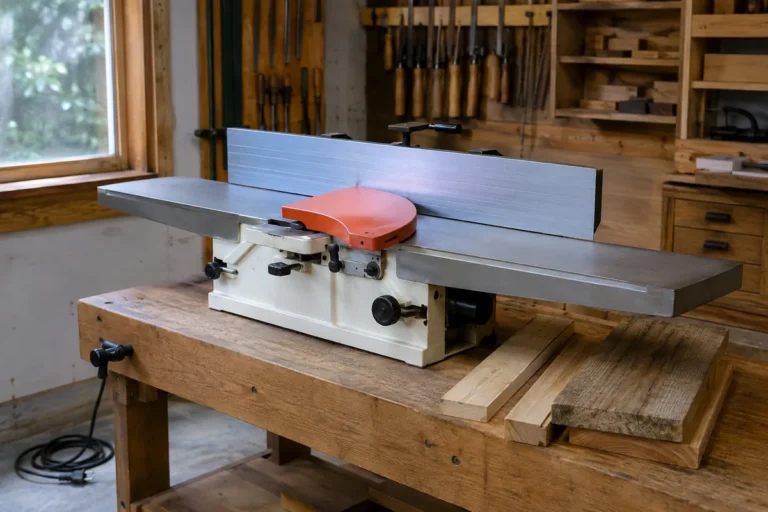
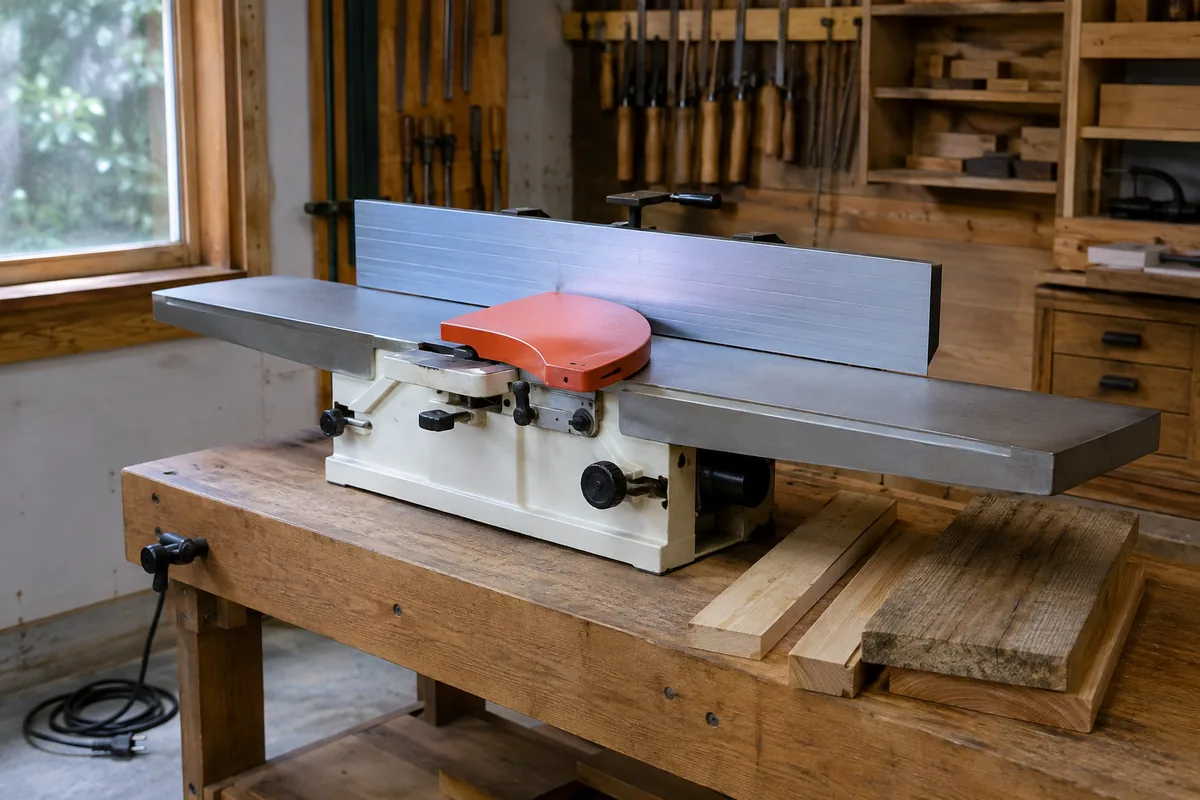
On a jointer, place the board with the concave side down when possible. The ends should contact the table while the hollow section bridges the cutterhead. Start with light cuts, around 1/32 inch. Apply downward pressure over the infeed table at the beginning, then shift pressure to the outfeed table as the board passes the cutterhead. Do not press the middle down; that can cut the ends lower and preserve the hollow.
For a twisted board, concentrate on removing the high corners first. Use winding sticks to check progress after each few passes. Stop when the board no longer rocks and the face has a continuous flat area. It does not need to be perfect if the next operation will finish the face.
Severely bowed stock can be unsafe or impossible to joint directly. A carrier sled is usually better. Screw or hot-glue temporary cleats to a flat sled, then shim the board so it cannot rock. Keep the shims below the cutter path and secure the board firmly. Run the sled through a planer with shallow cuts, typically 1/32 inch or less. Once one face is flat, remove the board, clean off the cleats, and plane the second face normally.
Never send a loose, rocking board through a planer. It can lift at the cutterhead, stop feeding, or emerge with a scalloped surface. A sled also reduces the planer’s practical thickness capacity, so check the opening before loading it.
Make One Edge Straight
After flattening one face, put that face against the jointer fence. Joint the crooked edge with light cuts until it is straight and square to the reference face. Check with a square and straightedge rather than relying only on the fence setting.
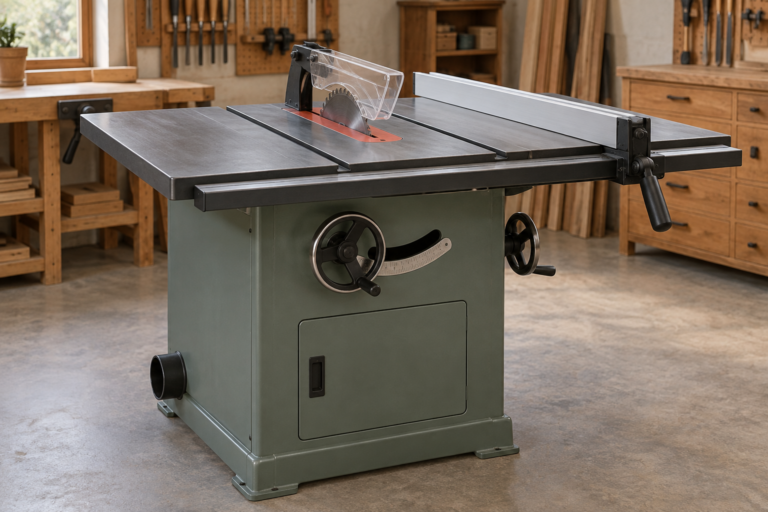
If the board is too wide for the jointer, use the table saw. A straight-line ripping jig is safer than trying to hold a crooked edge against the fence. The jig carries the board with a straight runner against the fence while the blade trims the irregular edge. Leave at least 1/16 inch of cleanup stock if you expect to joint the edge afterward.
For a board with a dramatic crook, mark the desired straight line and use a table-saw straight-line ripping jig. Make sure the offcut cannot close against the blade. Use a riving knife, stand out of the kickback path, and support long stock on both sides of the saw.
Use the Band Saw to Save Material
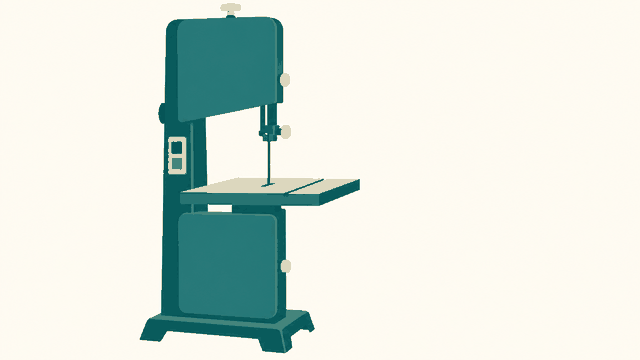
A band saw is often the best answer when flattening would remove too much wood. Cut the board into shorter sections at natural defects, or rip along a marked line that follows the grain. A 1/2-inch or 3/4-inch blade with an appropriate tooth count handles ordinary hardwood resawing better than a fine scroll-style blade.
Leave roughly 1/16 to 1/8 inch for cleanup after a band-saw cut. The cut may wander, especially in stressed wood. A sharp blade, correct tension, and steady feed matter more than maximum horsepower. If the board is wider than the band saw’s resaw capacity, do not tilt it or force it through; change the plan or use a larger machine.
Finish with the Planer
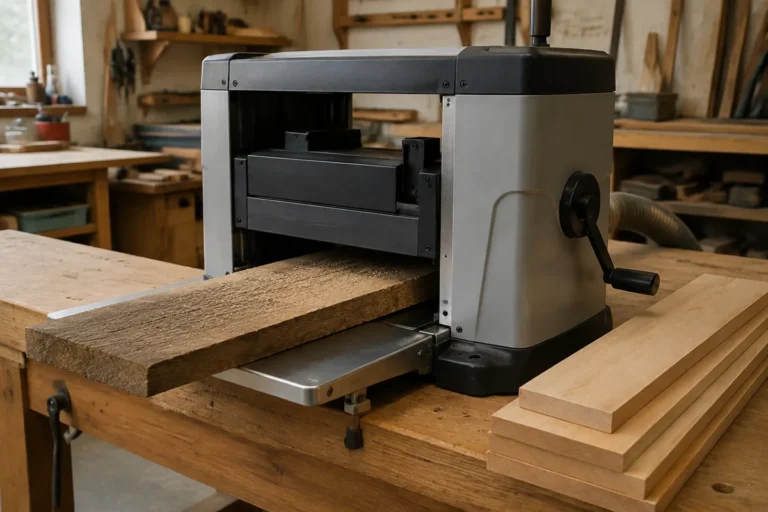
Once one face and one edge are reliable, plane the opposite face to thickness. Take equal, shallow passes and measure frequently. If the board is near its final thickness, remove only 1/64 inch per pass. Feed with the grain when possible to reduce tear-out, and use a sacrificial sled or carrier if the board still rocks.
A thickness planer does not straighten a board by itself. It copies the shape presented to its rollers, so a bowed board placed directly on the bed usually comes out bowed to the same degree. The planer is a finishing machine after the jointer, sled, or band saw has established a reference.
When to Buy or Skip a Machine
If you routinely process rough lumber wider than 6 inches, a wider woodworking jointer saves setup time, but it is not essential for occasional projects. A planer plus a sturdy sled can handle many boards cheaply. A table saw and straight-line jig are adequate when the main problem is edge crook.
Pay for a jointer when you need repeatable square edges and regularly flatten boards in one pass. Choose the cheaper sled method when board width varies, shop space is limited, and you can tolerate slower preparation. For truly twisted, cracked, or heavily stressed stock, cutting it shorter is often safer and produces more usable lumber than trying to win a fight with the machine.