Best Router Bits for Dados: Straight Cuts and Clean Shoulders
What's inside
As an Amazon Associate I earn from qualifying purchases. This post may contain affiliate links at no extra cost to you.
Contents
Best Router Bits for Dados: Straight Cuts and Clean Shoulders
The best router bit for dados is usually a sharp, carbide-tipped straight bit sized to the actual panel thickness; choose a spiral bit when chip clearing, cut quality, or repeated deep passes matter more than the lowest purchase cost.
For plywood, nominal thickness is unreliable: a sheet sold as ¾ inch may measure closer to 23/32 inch, and its veneer layers can vary. Measure the panel with calipers, then select a bit and setup that produce a snug fit. For solid-wood panels, allow for seasonal movement if the dado crosses the grain; a fit that is too tight can become a problem as the wood changes size.
As an Amazon Associate we earn from qualifying purchases at no extra cost to you.
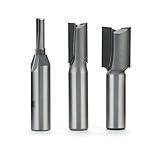


Choose by material and cut depth
| Bit type and example size | Best suited to | Chip clearing and shoulder quality | Practical limits |
|---|---|---|---|
| Carbide straight, 1/4 in diameter, 1/2 in cutting length | Shallow dados, narrow grooves, or multiple passes | Moderate chip clearing; leaves flat-bottomed cuts and crisp edges when sharp | Small diameter can deflect if pushed hard; depth per pass should stay conservative |
| Carbide straight, 1/2 in diameter, 1 in cutting length | Common shelf dados and wider stock | More rigid than a 1/4 in bit; removes material efficiently, but chips can pack in deep cuts | Cutting length must exceed dado depth; a larger diameter may not match the panel thickness |
| Carbide upcut spiral, 1/2 in diameter, 1 in cutting length | Deep cuts in solid wood or dados made in several passes | Pulls chips upward and away from the cut; strong evacuation, but may lift veneer fibers at the top edge | Can leave a rougher top edge in fragile plywood; secure the work firmly |
| Carbide downcut spiral, 1/2 in diameter, 1 in cutting length | Clean top shoulders in veneered plywood | Presses top fibers down for a cleaner surface edge; chips collect in the groove | Use shallow passes and clear packed chips, especially in deeper dados |
| Carbide compression spiral, 1/2 in diameter, 1 in cutting length | Both faces of plywood when edge quality is critical | Opposing flute directions support fibers at both faces; chips still need room to escape | Works best when the cut engages both flute directions; initial shallow cuts may not benefit fully |
These are common example sizes, not a promise that every brand offers the same geometry. Check the bit’s cutting length, shank diameter, and maximum speed against your router and the job. A bit’s cutting length is the usable flute length, not the total length of the bit.
Straight bit: the economical, predictable choice
A straight bit is a sound choice for occasional dados, shallow cuts, and straightforward work in solid wood. It is often the best router bit for cutting dados when the groove is not unusually deep and you can clear chips between passes. A 1/2-inch shank generally offers greater rigidity than a 1/4-inch shank when your router accepts both, but the cutting diameter still has to suit the groove.
In plywood, a straight bit can leave a clean, square-bottomed dado, but veneer quality and bit sharpness matter. A dull edge crushes fibers and can tear veneer regardless of the bit’s label. For a long dado, use a guide or straightedge that cannot shift, and make a light scoring pass before removing more material.
Spiral bit: better evacuation or better veneer support
Spiral geometry is worth considering for repeated cuts, deeper grooves, or materials that tend to pack chips around a straight cutter. An upcut spiral clears chips well, which helps reduce heat and recutting, but its upward pull can damage the top veneer. A downcut spiral favors a clean top shoulder, though chips remain in the groove and need attention. A compression bit combines upcut and downcut sections to support both faces of sheet goods, but it is not automatically the right choice for a very shallow pass.
Spiral bits typically cost more than basic straight bits. For a one-off project, careful shallow passes with a sharp straight cutter may be better value. For a shop making plywood cabinets regularly, cleaner edges and more effective cutting can justify keeping a suitable spiral bit on hand.
Fit the bit to the panel, not the nominal label
Measure the actual panel thickness at several points. If a plywood edge measures 0.720 inch, for example, a 3/4-inch bit would cut a groove 0.030 inch wider overall—about 0.015 inch of clearance on each side if the panel is centered. That may be loose for a glued joint. A bit close to the measured thickness, or a two-pass setup that trims the groove to fit, gives more control.
For a two-pass setup, cut the first groove with the router guide referenced from one edge, then shift the guide by the small amount needed to widen the groove. Test the fit on offcuts from the same sheet. This accounts for real-world variation in panel thickness and router setup better than relying on the printed sheet size.
Set up for clean shoulders and a safe cut
- Check the workpiece and bit: Inspect the cutter for resin buildup, chipped carbide, or looseness. Clamp the panel securely and use eye and hearing protection.
- Set depth in stages: For a 1/2-inch-deep dado, two passes of roughly 1/4 inch are a sensible starting point, subject to the router, bit, and material. Deep single-pass cuts increase load and encourage chip packing.
- Use a guide with a test cut: Clamp a straightedge or use a suitable fence. Make a short test dado in scrap and check both width and squareness before cutting the project panel.
- Control chip buildup: Pause between passes to clear the groove, especially with a downcut or straight bit. Stop the router before removing chips; do not reach near a moving cutter.
- Check the fit before assembly: The panel should seat without hammering or excessive side-to-side play. For solid wood crossing the grain, avoid designing a rigid, overly tight fit that prevents seasonal movement.
Which bit should you buy?
| Your situation | Practical choice | Why |
|---|---|---|
| Occasional shallow dados; tight budget | Sharp carbide straight bit in a diameter near the measured panel thickness | Low-cost and versatile; multiple passes can refine width and depth |
| Frequent plywood work; clean top veneer is the priority | Downcut spiral, or compression spiral when both faces need support | Helps limit top-edge tear-out; plan to clear chips and test the cut |
| Deep grooves in solid wood; chip packing is a concern | Upcut spiral with adequate cutting length | Moves chips out of the groove effectively; secure the work against upward pull |
| Only a 1/4-inch router collet available | Appropriately sized 1/4-inch-shank bit, used in shallow passes | Compatible with the tool; avoid forcing a small cutter through a heavy cut |
For many woodworkers, the most useful starting purchase is a quality carbide straight bit in the diameter that matches their most common panel, plus a reliable way to guide the router. Add a spiral cutter when the work justifies its cost. Buying a bit with cutting length barely equal to the dado depth can leave little room for chip clearance; choose adequate flute length, but do not expose more cutter than the operation requires.
Ownership: what wears and what causes poor cuts
Carbide edges eventually dull, and pitch or adhesive residue can make a bit cut as though it were worn. Clean buildup with a product intended for router bits, following its directions, and avoid scraping carbide edges with hard tools. Replace or professionally sharpen a bit that is chipped or persistently burns the wood after cleaning and correcting feed rate.
Common causes of rough shoulders are a loose guide, a dull cutter, too much depth in one pass, and a poor fit between bit diameter and panel thickness. A test cut in matching scrap is a small investment that catches all four before they spoil a finished panel.