Woodworking Clamp Set Review
Key takeaways
- An editorial woodworking clamp set review that judges clamps on rail stiffness, jaw parallelism, pad quality and honest value rather than sticker count.
What's inside
As an Amazon Associate I earn from qualifying purchases. This post may contain affiliate links at no extra cost to you.
Most clamp sets are sold on quantity, not capability. A blister pack promising twenty pieces usually means sixteen small spring clamps, two flimsy F-styles and a pair of bar clamps whose rails flex before the glue line closes. That is the core problem this woodworking clamp set review exists to address: the number printed on the box tells you almost nothing about whether the set will square a face frame, hold a mitered box, or survive being dropped on a concrete floor.
We approach clamps the way we approach any shop tool, by mechanical criteria. A clamp is a spine, a sliding head, a screw mechanism and two pads. Each of those parts fails in a predictable way, and the failures show up in your work as bowed panels, glue-starved joints, dented edges and clamps that walk out of position while you are still spreading adhesive. Below we sort the categories, explain what each one is genuinely good for, and point out where a bargain set is fine versus where it will cost you a workpiece.
As an Amazon Associate we earn from qualifying purchases at no extra cost to you. Product prices and availability are accurate as of the date shown and are subject to change.


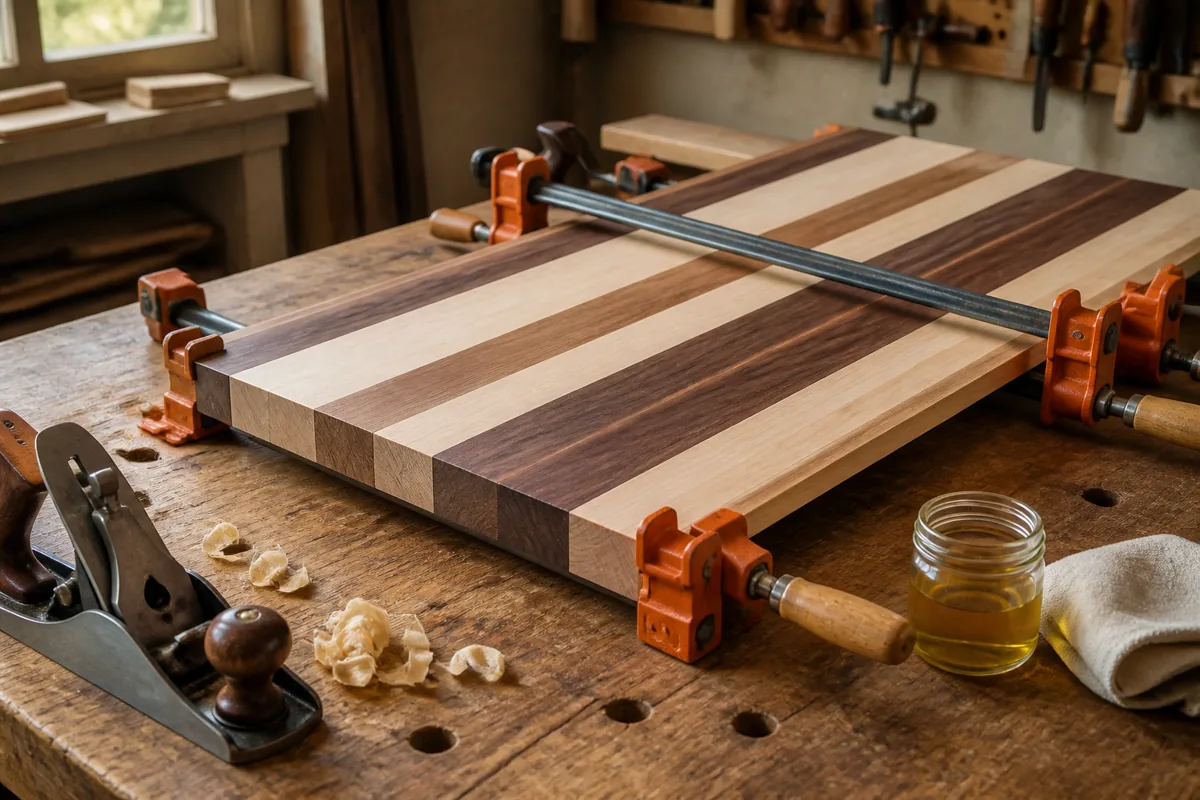
Clamp Types at a Glance
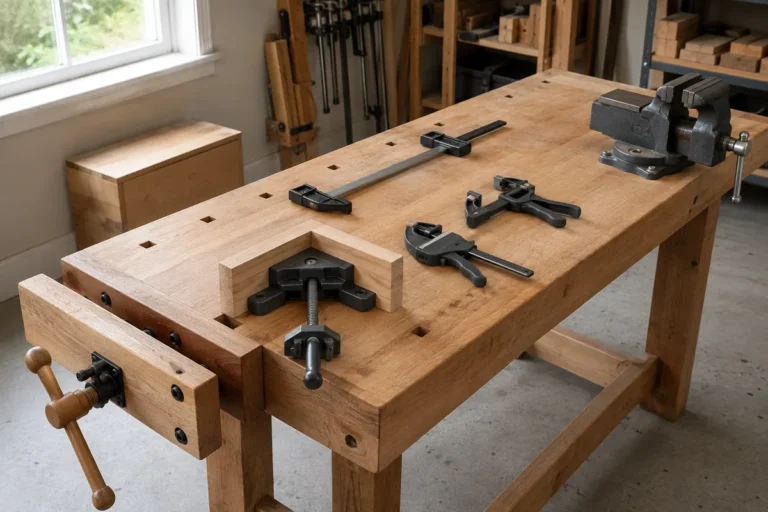
Before spending money, understand that clamp families are not interchangeable. Buying one large set of a single type is the most common early mistake. Here is how the categories compare on the things that matter.
| Clamp Type | Best Use | Typical Clamping Force | Watch Out For |
|---|---|---|---|
| Parallel jaw clamps | Cabinet carcasses, wide panels, squaring assemblies | Very high, evenly distributed | Weight, price per clamp, storage space |
| Bar or F-style clamps | General glue-ups, jigs, holding stock to a bench | Moderate to high | Rail flex, jaw tilt under load |
| Pipe clamps | Long panels, tables, anything over 4 feet | High, depends on pipe stiffness | You supply the pipe, no built-in parallelism |
| Ratcheting or one-handed bar clamps | Quick holds, dry fits, positioning parts | Low to moderate | Plastic pads slipping, limited pressure |
| Spring clamps | Trim, edge banding, jigs, clamping cauls | Low | Nothing more than light pressure |
| C-clamps and deep-throat clamps | Metal jigs, thick stock, reaching past an edge | Very high, small footprint | Marring, slow to adjust |
A functional starter kit for furniture work is not one set. It is roughly four parallel or bar clamps in a mid length, two long clamps or a pair of pipe clamp fixtures, four to six F-styles, and a handful of spring clamps for odd jobs. That mix handles more assemblies than a twenty-piece bin of small clamps ever will.
The Mechanical Criteria That Separate Good Sets from Filler
When we evaluate a set, we start with the bar. Take a clamp, extend it near full capacity, tighten it against a scrap block and watch the rail. Cheap rectangular steel with thin walls will visibly bow, and every bit of that bow becomes a curve in your panel. Thicker rails, I-beam profiles and heat-treated steel resist this. Extruded aluminum saves weight but generally deflects sooner than steel of a similar section.
Second is jaw parallelism. True parallel clamps hold both faces square to the rail under load, which is why they double as squaring fixtures for carcass work. F-style and cheaper bar clamps let the head tilt as pressure builds, so the pressure concentrates at the top or bottom edge of the joint. You can compensate with cauls, but you should know you are compensating.
Third is the screw and handle. Look for a long, coarse thread with a smooth thrust surface behind it. Grinding, chattering or a handle that goes tight then suddenly loose usually means poor thread finish or a pressed-in pivot that is already deforming. Wooden handles and large plastic knobs both work; the important thing is enough leverage to reach pressure without a cheater bar.
Fourth is the pads. Removable, replaceable pads are a real advantage because they are the first component to wear out. Hard plastic pads mar softwoods, glue sticks to bare metal, and rubber pads that swell with solvent will smear across your finish surface. Some manufacturers sell replacement pads separately, which quietly extends the life of an otherwise mid-tier clamp.
Finally, consider the sliding head lock. On bar clamps, a wedge or cam that bites the rail should hold with modest hand pressure and release cleanly. Heads that slip under load are the single most frustrating failure in a glue-up, because you discover them with wet glue on the parts.
Parallel jaw clamp set for cabinet and panel work
If you build casework, this is where your clamp budget should go first. Parallel clamps hold their jaws square to the rail, which means the assembly comes out of the clamps as close to square as you set it. Expect to pay several times what an F-style costs per clamp, so buy four in a useful length rather than eight short ones. Check listings for rail thickness and stated clamping force, and confirm whether replacement pads are available.
Woodworking Clamp Set Review: Where Value Actually Lives
Not every clamp on your wall needs to be premium, and pretending otherwise is how people end up with three good clamps and no way to finish a cabinet. Spend on the clamps that determine geometry. Save on the clamps that merely hold something still.
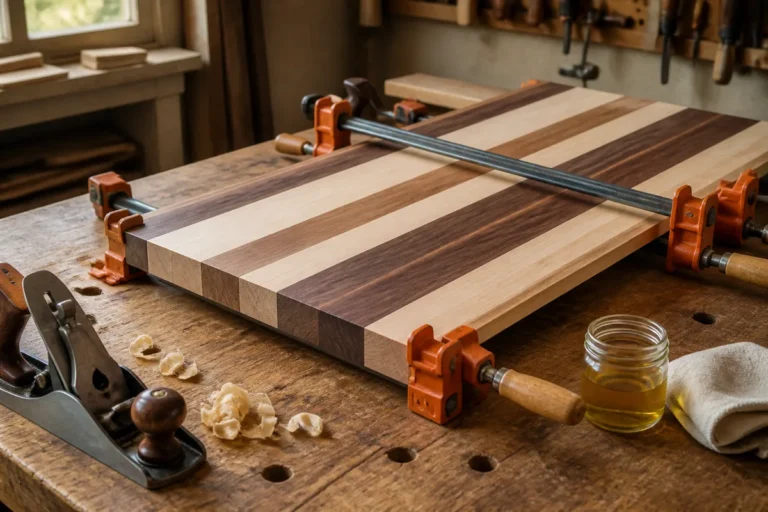
Spend on parallel clamps, long bar clamps and pipe clamp fixtures. These carry real load across real distances, and rail quality directly affects flatness. Save on spring clamps, small ratcheting clamps and light F-styles used for jigs, cauls and edge banding. A budget spring clamp that loses tension after two years costs you nothing meaningful. A budget four-foot bar clamp that bows on a tabletop glue-up costs you a tabletop.
Pipe clamps deserve a specific mention because they are the best price-to-capacity option in the shop. You buy cast fixtures and thread your own black pipe to length at a hardware store. Half-inch pipe is lighter and flexes more; three-quarter-inch pipe is significantly stiffer and is what we would choose for anything wide. The tradeoff is that pipe clamps offer no parallelism and the pipe itself can leave black marks on damp wood, so plan on cauls or wax paper.
- ✔ Pipe clamp fixtures give the lowest cost per inch of capacity
- ✔ Parallel clamps double as squaring tools for casework
- ✔ Replaceable pads extend clamp life considerably
- ✔ Mixed sets cover more assembly types than one large single-type set
- ✘ Large multi-piece kits often pad the count with low-value spring clamps
- ✘ Thin-walled bar rails flex and can bow panels
- ✘ Aluminum bars save weight but deflect sooner than comparable steel
- ✘ Storage and wall space are usually underestimated
Buying Strategy, Sizes and Storage
Choose lengths by what you actually build. For face frames, small boxes and drawer work, clamps in the 12 to 24 inch range do most of the labor. Cabinet carcasses generally want 30 to 40 inches. Tables, doors and wide glued panels need 50 inches and up, which is where pipe clamps become the sensible answer. Buying clamps in pairs matters more than buying them in bulk, since balanced pressure on both sides of a joint is what keeps an assembly from racking.
Watch the throat depth as well. A shallow throat forces pressure right at the edge of a panel, so glue lines in the middle stay open. Deep-throat clamps and cauls both solve this; cauls are cheaper and you can make them from scrap.
Storage is not a footnote. Clamps are heavy, and a rack that fails takes cast iron heads down onto whatever is below. French cleats on a stud wall, a rolling clamp cart, or simple pipe racks all work. Keep the screws clean, wipe off glue before it cures, and give bare steel a light coat of paste wax if your shop swings through humidity.
F-style bar clamp multipack for everyday shop use
F-style clamps are the workhorses you reach for without thinking, which is exactly why buying six to eight makes sense. Look for a thick rail, a sliding head that locks without wobble and pads you can replace. These are also the right clamps for holding stock to a bench, clamping jigs and pressing small parts, so a multipack rarely goes unused.
Pipe clamp fixtures for long panel glue-ups
For tabletops and wide panels, cast pipe clamp fixtures paired with three-quarter-inch black pipe give you serious capacity for less than long bar clamps. You cut and thread the pipe to whatever length you need, and you can re-pipe a fixture later. Just plan on cauls or wax paper, since damp pipe can leave marks on bare wood.
FAQ
How many clamps do I really need to start building furniture? A practical minimum for cabinet and small furniture work is around a dozen usable clamps: four parallel or heavy bar clamps at 30 to 40 inches, two long clamps or pipe fixtures, four to six F-styles, and a few spring clamps. Add in pairs from there as projects demand. Quantity in a kit matters far less than having matching pairs in the lengths you use most.
Are parallel clamps worth the extra cost over F-style clamps? For casework, yes. Their jaws stay square to the rail under pressure, so they help hold an assembly square rather than pulling it out of true. For general holding, jig work and clamping to a bench, F-styles do the job for a fraction of the price. Most shops end up with both.
Can I use one clamp type for everything? You can, but you will fight it. Spring clamps cannot deliver the pressure a panel glue-up needs, and heavy parallel clamps are clumsy for holding a small part while a screw goes in. Matching the clamp to the load is what keeps glue lines tight and edges undented.
The Verdict
Judged on mechanics rather than piece count, the sets worth buying are the ones with stiff rails, heads that lock without slipping, screws that turn smoothly under load and pads you can replace. Put your money into the clamps that set geometry, meaning parallel clamps for carcasses and pipe clamp fixtures for anything long, and buy inexpensive spring and light F-style clamps freely for the hundred small holding jobs that fill a working day. Build the collection in pairs, store it on something that will not tear off the wall, and it will outlast most of the machines in the shop.
Check prices on Amazon →