5 Best Orbital Sanders with Dust Control
What's inside
As an Amazon Associate I earn from qualifying purchases. This post may contain affiliate links at no extra cost to you.
Contents
5 Best Orbital Sanders with Dust Control
The best orbital sander with dust control for most indoor work is the Bosch GET75-6N, thanks to its six-inch pad, multiple dust-extraction options, and useful two-mode design; choose the Festool ETS EC 150/5 EQ for a premium low-profile setup, or the Makita BO5041K for lighter, occasional work on a tighter budget.
Dust collection depends on more than the sander: the abrasive needs holes that match the pad, the filter or vacuum must have enough airflow, and the work surface must stay clear of buildup. The ranking below weighs those practical factors alongside pad size and handling. Published weights and specs can vary slightly by configuration.
As an Amazon Associate we earn from qualifying purchases at no extra cost to you.


Quick comparison
| Rank and model | Pad and orbit | Approx. tool weight | Dust-control setup | Best fit |
|---|---|---|---|---|
| 1. Bosch GET75-6N | 6 in.; 3/32 in. (2.4 mm) random orbit, plus aggressive mode | 5.3 lb (2.4 kg) | Dust canister or vacuum hookup; use compatible six-inch abrasives | Frequent stock removal and fine finishing |
| 2. Festool ETS EC 150/5 EQ | 6 in.; 5 mm orbit | About 2.9 lb (1.3 kg), tool only | Designed for extraction through a connected vacuum and matching abrasives | Indoor finishing and sustained, controlled sanding |
| 3. Mirka DEROS 650CV | 6 in.; 5 mm orbit | About 2.2 lb (1.0 kg) | Central vacuum connection; requires a suitable extraction setup | Low-fatigue work with a dedicated vacuum |
| 4. Makita BO5041K | 5 in.; 1/8 in. (3 mm) orbit | About 3.1 lb (1.4 kg) | Built-in dust collection and vacuum port | Occasional work and compact projects |
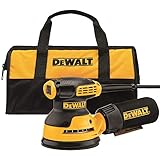
| 5. DeWalt DCW210B | 5 in.; 3/32 in. (2.4 mm) orbit | About 2.6 lb (1.2 kg), bare tool | Dust bag or vacuum connection; battery sold separately | Portable sanding without a cord |
“Measured dust collection” needs context: results depend on abrasive, wood, pressure, extraction airflow, and how dust is measured. Rather than treat an inconsistent percentage as universal, this ranking favors designs with a practical, sealable path from the sanding surface to a filter or vacuum. A tight-fitting external extractor generally collects fine dust more consistently than a small onboard bag, but it adds hose drag, noise, and setup.
Ranked picks by workshop situation
1. Bosch GET75-6N — best all-rounder for a connected workshop
The GET75-6N is the most versatile pick here: it has a six-inch pad for covering broad panels efficiently and a switchable aggressive mode for faster removal when the job allows it. Its dust canister works for smaller tasks, while the vacuum connection is the better choice for indoor use or long sanding sessions. The trade-off is bulk: it is heavier than the compact finishing-focused options, and the larger pad can feel unwieldy on narrow parts.
Choose it if you move between leveling and finishing, and can connect a shop vacuum or extractor. For delicate veneer or final sanding, use the regular random-orbit mode, light pressure, and a finer abrasive; the aggressive mode can remove material quickly enough to leave marks or round edges.
2. Festool ETS EC 150/5 EQ — best premium choice for indoor finishing
This six-inch sander pairs a 5 mm orbit with a low-profile body and a system designed around vacuum extraction. Its appeal is control during extended finishing work, particularly on large furniture surfaces where consistent hose-and-abrasive compatibility matters. The vacuum is not an optional afterthought: account for the extractor, hose, and matching abrasives when comparing total cost. For small pieces or cramped corners, a five-inch model may be easier to steer.
3. Mirka DEROS 650CV — best for low-fatigue, frequent sanding
The DEROS 650CV is notably light for a six-inch machine and is intended to work with a central vacuum or suitable extractor. That makes it attractive for cabinet shops and repeated overhead or vertical sanding, where tool weight matters as much as pad diameter. Its dust-control performance relies on maintaining a good extraction path; without the right vacuum and hole pattern, paying for a light tool will not solve airborne dust. Check the exact kit and hose fittings before buying.
4. Makita BO5041K — best value for occasional projects
This corded five-inch sander is a practical option for furniture touch-ups, shelves, and general home-shop use. Its smaller pad is easier to manage than a six-inch one on modest workpieces, and it offers both onboard collection and a vacuum port. A bag is convenient for quick jobs, but a vacuum is the more sensible choice for indoor sanding, especially when working with fine dust. Its cord and higher weight than some premium brushless models are the main handling compromises.
5. DeWalt DCW210B — best cordless option for moving around
The DCW210B is a five-inch, battery-powered sander for work where cords are inconvenient or the task is spread across several locations. It supports a dust bag and vacuum hookup, so cordless does not have to mean relying on the bag alone. This is a bare-tool listing in many configurations: include the battery and charger in your cost and weight comparison. Runtime varies with battery capacity, abrasive grit, material, and pressure, so it is harder to predict than a corded tool’s continuous operation.
Choose by dust setup and job size
| Your situation | Best starting pick | Why |
|---|---|---|
| Indoor sanding, already own a compatible vacuum | Bosch GET75-6N or Festool ETS EC 150/5 EQ | Both support a vacuum-led setup; match hose, pad holes, and abrasive before work. |
| Long sessions; tool weight is the priority | Mirka DEROS 650CV | Light six-inch format can reduce fatigue, provided extraction is adequate. |
| Small projects or occasional home-shop use | Makita BO5041K | Five-inch pad and onboard collection offer a useful balance without requiring a premium system. |
| No convenient power outlet | DeWalt DCW210B | Battery operation improves mobility; budget for batteries and consider a vacuum where practical. |
| Mostly narrow parts and edges | Makita BO5041K or DeWalt DCW210B | A five-inch pad is easier to position on smaller surfaces than a six-inch pad. |
Market prices shift with kits, included pads, and promotions. As a broad guide, the Makita and DeWalt options are typically in the lower-to-mid market range (with DeWalt battery costs extra); Bosch is generally mid-to-upper; and Festool and Mirka sit in the premium range, particularly when the required extraction equipment is not already owned.
Set up dust control so it actually works
- Match the abrasive holes to the pad. A misaligned or incompatible disc blocks extraction holes and leaves dust trapped under the pad. Use the correct hole pattern and keep it centered.
- Connect a vacuum for indoor work. A dust bag is handy for short tasks, but its capacity and filtration are limited. Use a suitable extractor and filtration for fine wood dust, following the vacuum maker’s guidance for the material being sanded.
- Keep airflow open. Empty bags and canisters before they are packed full; inspect hoses, ports, and filters for clogs. A nearly blocked filter can make a capable sander collect poorly.
- Let the pad do the work. Excess pressure can slow the pad, worsen collection, and create uneven sanding. Keep the tool flat and moving at a steady pace.
- Inspect consumables. Abrasive discs clog and lose cutting ability, while hook-and-loop pads wear or collect debris. Replace worn parts when discs slip, vibrate, or no longer sit evenly.
For regular indoor sanding, the extractor, hose fit, and disc compatibility may matter more than a small difference in the sander’s published dust features. If you already own a vacuum, verify the port diameter or adapter and the abrasive pattern before choosing a model. If you do not, compare the full system cost—not just the tool price.