Bench Vise vs Woodworking Vise
Key takeaways
- A criteria-led comparison of bench vises and woodworking vises, covering jaw geometry, mounting, racking control and which one earns bench space first.
What's inside
As an Amazon Associate I earn from qualifying purchases. This post may contain affiliate links at no extra cost to you.
Walk into any hardware store and you will find two very different tools sold under almost the same name. The confusion in the bench vise vs woodworking vise question is not marketing noise, it is a genuine split in engineering intent. One is built to grip hard, small, round metal without deflecting. The other is built to hold a wide, flat, easily bruised panel parallel to a benchtop while you saw a dovetail. Buy the wrong one and you will spend years wrapping jaws in leather scraps and wondering why nothing clamps square.
We see this mistake most often in second-year shops. Someone bolts a 5 inch cast iron machinist vise to the corner of a bench, discovers it cannot hold a cabinet door edge-up, and concludes vises are a scam. They are not. They are specialized. Below we lay out the mechanical criteria that actually separate the two categories, then say plainly which one should come first for a woodworker.
As an Amazon Associate we earn from qualifying purchases at no extra cost to you. Product prices and availability are accurate as of the date shown and are subject to change.


| Criterion | Bench (machinist) vise | Woodworking vise |
|---|---|---|
| Jaw material | Hardened serrated steel | Smooth cast iron, drilled for wood liners |
| Jaw width | Typically 4 to 6 in | Typically 7 to 10 in |
| Jaw depth | Shallow, 2 to 3 in | Deep, 3 to 4 in, clears wide stock |
| Mounting | Bolts on top of the bench | Bolts under the benchtop, jaw flush |
| Screw | Coarse, high clamping force | Coarse with quick-release and toe-in |
| Racking control | Not a design concern | Guide bars or twin-screw resist racking |
| Best at | Metal, pipe, sharpening jigs, repairs | Panels, drawer sides, joinery, hand planing |
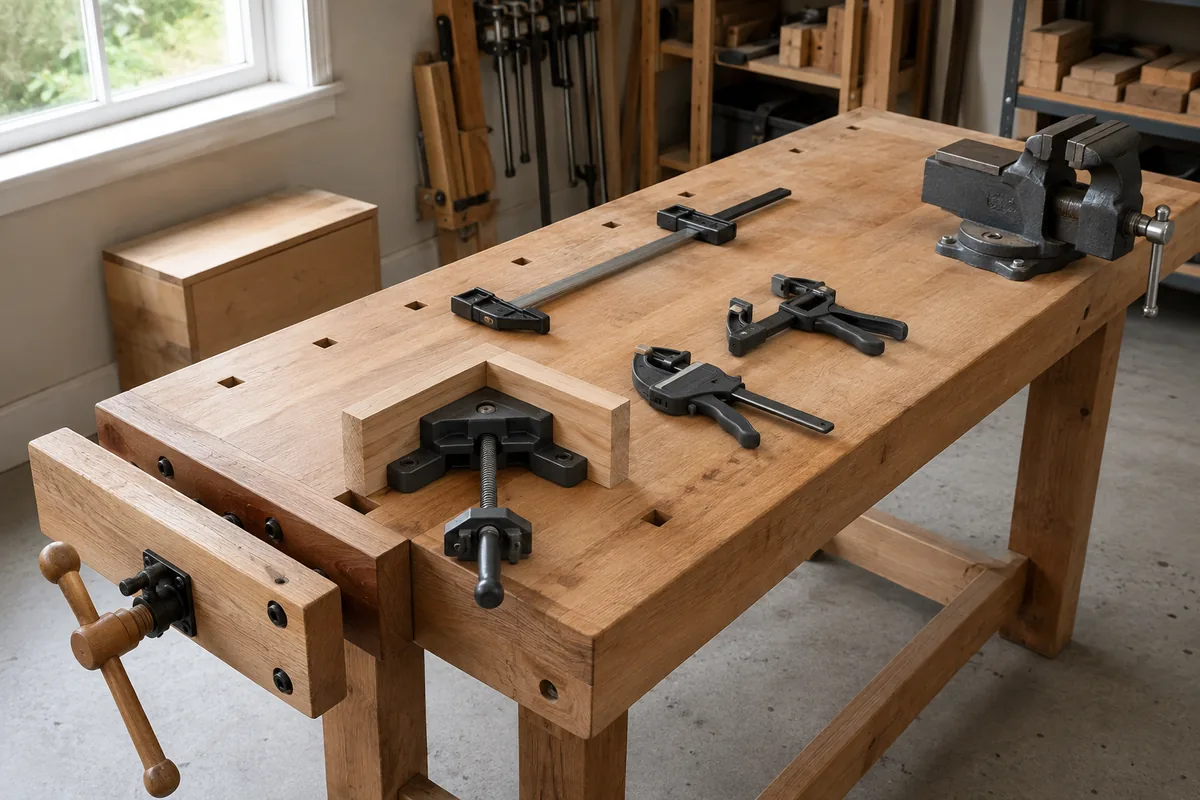
Bench Vise vs Woodworking Vise: The Mechanical Differences That Matter
Start with the jaws, because everything else follows from them. A machinist bench vise uses hardened, cross-hatched steel jaws. Those serrations exist to bite into steel stock so it cannot creep under a file or a hacksaw. Put pine or cherry in them and you get a permanent waffle print roughly a sixteenth of an inch deep. Woodworking vise jaws are smooth cast iron and, critically, come predrilled so you can bolt on hardwood or plywood liners. Those liners are consumable, replaceable, and can be planed flush after you inevitably saw into them.
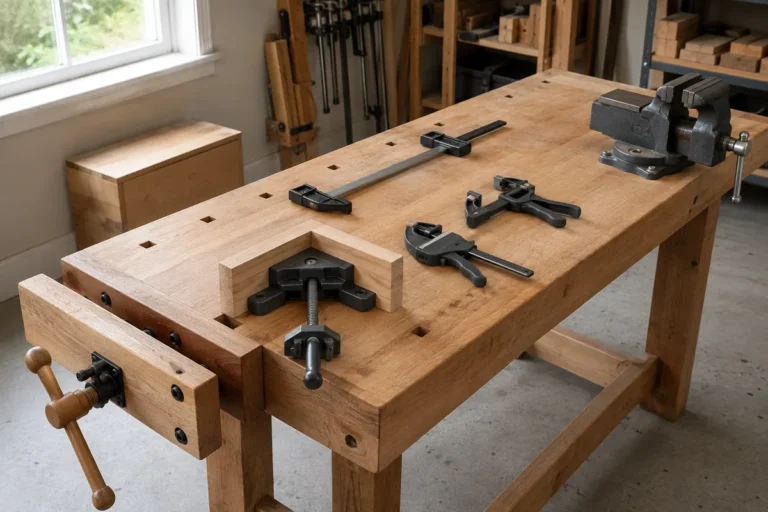
Second, mounting geometry. This is the difference most buyers overlook. A metalworking vise sits on top of the bench, which means the workpiece sits several inches above the work surface. That is exactly what you want when you need swing room for a hacksaw. A cabinetmaker’s vise mounts underneath the benchtop with the top of the jaw flush to the benchtop surface. That flush relationship lets a long board be supported by both the vise and the bench itself, which is what makes edge planing an eight foot rail possible without the board flexing away from the iron.
Third, jaw depth and width. Woodworking vises are wide and deep because the load case is a panel, not a bolt. More jaw area means lower pressure per square inch, which means fewer dents. It also means the workpiece is held over a longer span, so a drawer side clamped for dovetailing does not pivot when you tap a chisel.
Fourth, racking. When you clamp a workpiece off center in a single-screw vise, the jaw tilts and grips at one corner only. Machinist vises largely ignore this because the work is small and centered. Woodworking vises address it directly: guide rods on either side of the screw, deliberate toe-in where the jaw is cast slightly open at the top so it closes parallel under load, and on higher-end options a twin-screw design that lets you tighten each end independently. If you have ever clamped a wide board and watched one end go slack, you have met racking.
Front vise (quick-release cabinetmaker's style)
For a woodworker with one vise slot to fill, this is the shape to buy. Look for a 7 to 10 inch jaw, a quick-release half nut so you are not spinning the handle for twenty turns, and predrilled jaw faces for wood liners. Check the casting for flatness across the jaw before you install it, since a bowed jaw will grip at the edges and never at the center.
Where a Machinist Bench Vise Still Earns Its Keep
We are not arguing against the metal vise. A woodworking shop generates a steady stream of metal work: grinding a chisel bevel, straightening a bent bandsaw guide bolt, cutting threaded rod for a shop-built clamp, pressing a bearing out of a router baseplate, holding a dull card scraper while you file a fresh edge. None of that is comfortable in a wooden-jawed vise.
Judge a metal vise on a short list of criteria. Body construction first: ductile iron or forged steel outlasts gray cast iron, which cracks when someone uses the anvil as an anvil. Then look at the slide way, the rectangular channel the movable jaw rides in. It should be long, machined, and free of casting flash. A short slide way means the jaw cantilevers and the front of the jaw opens under load. Check whether replacement jaw inserts are available, because you will want smooth soft jaws for aluminum and for the occasional wooden part. A swivel base is convenient but adds a joint that can slip, so if you mostly work in one orientation a fixed base is stiffer.
Mount it at the end of the bench, not the middle of the working edge, or on a separate metalwork station. Bolted to the prime working corner it becomes a shin magnet and a permanent obstruction to clamping panels.
Tail Vises, Twin Screws and the Rest of the Family
The woodworking side of the category is broader than a single front vise. A tail vise or wagon vise sits at the end of the bench and clamps stock between a dog in its jaw and a dog in the benchtop, holding a board flat for surface planing. That is a different job from the front vise, which holds stock vertically. Many benches want both.
A twin-screw vise, effectively two screws chain-linked so they turn together, is the answer to dovetailing wide carcase sides. Because you can also clutch one screw and tighten the other, it grips tapered work without racking. It costs more, takes more benchtop real estate, and is overkill if your work is small boxes.
Leg vises are the traditional option: a tall wooden jaw pinned or screw-adjusted at the bottom, which spreads clamping force over a very long jaw and handles thick timber gracefully. They are excellent and they demand a bench built to accept them.
Then there are the portable compromises. Clamp-on vises and drill press vises have a place, but do not expect a clamp-on unit to survive resawing by hand.
Ductile iron machinist bench vise, 4 to 5 inch jaw
Buy this second, not first, and buy it in ductile iron rather than the cheapest gray cast option. Pay attention to the length of the machined slide way and to whether the pipe jaws below the main jaws are usable, since that feature saves real money the first time you need to cut conduit. Add smooth soft jaw covers so it can handle non-ferrous and wooden parts too.
How to Choose, and What Each Option Costs You
The decision is mostly about material, not budget. If nine out of ten workpieces are wood, the flush-mounted front vise is the correct first purchase, and it is not close. If you build furniture but also maintain machinery, plan for both and give the metal vise its own corner or a removable mounting plate.
Prices in both categories span a wide range, from budget imports to premium hardware built for a lifetime, and street prices at Amazon, Rockler, Woodcraft, and Home Depot move constantly, so compare current listings rather than trusting a number in an article. What does not change is that the money in a woodworking vise buys casting quality, jaw flatness, and a screw and nut that will not wear loose in five years.
- ✔ Flush-mounted woodworking vise supports long stock together with the benchtop
- ✔ Wide, deep, linable jaws hold panels without bruising
- ✔ Guide bars or twin screws control racking on off-center work
- ✔ Quick-release mechanisms cut handle spinning dramatically
- ✘ A woodworking vise needs installation, hardwood liners, and benchtop mortising
- ✘ Serrated machinist jaws will scar wood unless you fit soft covers
- ✘ Twin-screw and tail vises consume significant benchtop space
- ✘ Clamp-on portable vises flex under hand-sawing loads
Twin-screw vise for wide dovetailing
Only worth the outlay if you regularly cut joinery on carcase-width boards. The real benefit is not raw clamping force, it is parallel grip across 20 inches or more and the ability to hold tapered work without racking. Verify your benchtop thickness and apron layout will accept the two screws before ordering.
Frequently Asked Questions
Can I just line a metal bench vise with wood and use it for woodworking? For small parts, yes, and plenty of shops do exactly that. Cut plywood or hardwood pads, glue on leather or cork, and it will hold a tenon cheek fine. What it cannot fix is the mounting height and the shallow, narrow jaws. Anything long or wide will still hang unsupported above the benchtop.
What jaw width should I look for in a woodworking front vise? Seven inches is workable for boxes and small furniture. Nine to ten inches is the sweet spot for general furniture work, giving enough span to hold drawer sides and door stiles without racking. Beyond that you are into twin-screw territory, where width becomes the whole point.
Does toe-in really matter, or is it a marketing term? It matters mechanically. A jaw cast or shimmed slightly open at the top deflects into parallel as the screw loads it, so pressure lands on the whole face instead of the bottom edge. Many vises let you shim the wooden liner to tune it. If your vise grips only at the bottom, that is the first adjustment to try.
The Verdict
These are complementary tools with almost no overlap, and treating them as competitors is what leads to bad purchases. If you build in wood, mount a quick-release front vise flush under the benchtop first, fit hardwood liners, and tune the toe-in. Add a tail or wagon vise when hand planing surfaces becomes routine, and a twin-screw only when wide joinery justifies the bench space. Keep a ductile iron machinist vise at the end of the bench or on a separate stand for the metal work every shop accumulates. Judge any candidate on jaw flatness, slide way length, screw and nut quality, and how it resists racking, because those four things determine whether a vise is still useful in a decade.
Check prices on Amazon →